
Early-Decade Elegance and Tailoring
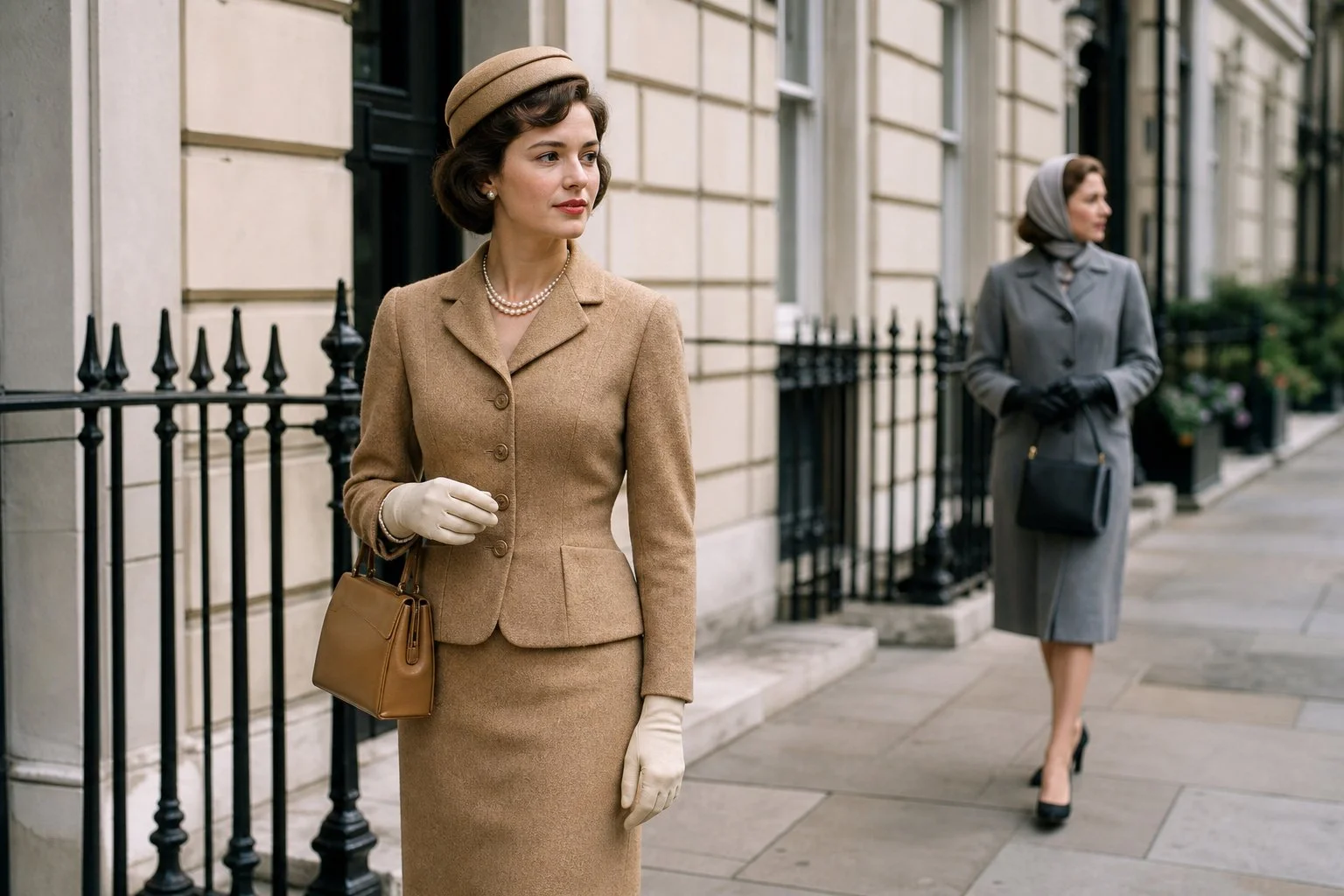
In the early 1960s, British women still leaned into that crisp, polished look from the ’50s—think neat skirt suits, simple A-line dresses, and hats you just had to wear if you wanted to look proper.
The big names in London couture, and a few American icons, really set the pace for female fashions in the 1960s and cahnged what you’d see on the streets or at a formal do.
Jacqueline Kennedy and the First Lady Look
As soon as JFK took office in 1961, British women started watching Jacqueline Kennedy’s every outfit. Papers and magazines couldn’t get enough, and dressmakers wasted no time copying her style.
She wore things clean and sharp—no frills, just solid colours and tidy lines. British high street brands and sewing patterns jumped on board, offering up boxy jackets and matching dresses in her style.
Audrey Hepburn, based in Britain, had a similar impact. Her wardrobe in Breakfast at Tiffany’s (1961), thanks to Hubert de Givenchy, made the slim black dress and narrow silhouette look fresh, not stuffy.
Both women proved you could look dressed-up and still young—a big deal for younger shoppers who didn’t want to look like their mums.
Skirt Suits, A-Line Dresses and Pillbox Hats
Tailoring in the early ’60s ditched the cinched waist and full skirt of the New Look. Instead, shapes got straighter and a little less fussy.
Key pieces included:
- Skirt suits with boxy, collarless jackets, three-quarter sleeves, and big buttons
- Shift dresses under matching jackets, so it all felt like one tidy outfit
- A-line dresses, narrow at the top and gently widening out
- Pillbox hats, small and brimless, perched back on the head
Skirts hovered just below the knee at the start of the decade but crept up every year. Fabrics were sturdy—wool crêpe, bouclé, tweed, heavy cotton—so everything kept its shape.
Hardy Amies and Norman Hartnell dressed the formal set, while Susan Small and others brought similar styles to the high street.
Polished Accessories and Occasionwear
If you stepped out in the early ’60s, you didn’t skip accessories. A daytime look wasn’t done unless everything matched up.
Usually, that meant short gloves in cotton or kid leather, a structured handbag, court shoes or kitten heels, and of course a hat. Headsquares and silk scarves tied under the chin kept your hair in place (and your ears warm).
Oversized sunglasses started popping up as the decade rolled on, hinting at a more relaxed vibe.
For evening, the go-to was a full-skirted gown with a boat or low neckline, often in taffeta or satin, plus a stole and a tiny clutch. Cocktail dresses were slimmer, meant for dinners or parties.
The Mod Look and the Miniskirt Revolution

The mod look handed young British women shorter hemlines and bold colours you just didn’t see before. From Mary Quant’s Chelsea shop to patterned tights and knee-high boots, it was all about movement and style you could actually afford.
Mary Quant, Bazaar and Youthquake
Mary Quant opened Bazaar on King’s Road in Chelsea back in 1955. She was selling clothes for young women who absolutely did not want to dress like their mothers.
People love to say Quant invented the miniskirt, but honestly, hemlines inched up gradually. Skirts only got really short around 1966, and even Quant said London girls were already hacking off their own hems.
Her Ginger Group label, launched in 1963, made these looks affordable and widely available. That mattered more than any single design because it put mod style in reach for shop girls and students.
In 1966, she collected her OBE in one of her own jersey minidresses. That says it all.
Shift Dresses, Bright Colours and Graphic Prints
The shift dress was mod fashion’s bread and butter. It hung straight from the shoulders, skipped the waist, and didn’t need any corsetry. That was a big break from the hourglass shapes of the ’50s.
Quant borrowed wool jersey from sportswear, so her minis moved and stretched like football kits.
Details came straight from kids’ clothes:
- Peter Pan collars and pinafore-style bibs
- Patch pockets right on the front
- Chain belts slung low on the hips
- Swing coats cut wide to match the short dress underneath
Prints went graphic, not floral. Op art stripes, checks, targets, and bold geometric blocks were everywhere, along with pop art motifs in punchy colours like pillar-box red, mustard, and cobalt blue.
Go-Go Boots, Patterned Tights and Bold Make-Up
Short skirts changed the whole game below the knee. Stockings and suspenders gave way to tights—ribbed, striped, spotted, lace, you name it—to match or contrast with your dress.
Shoes followed suit. Low-heeled, white knee-high go-go boots, first seen from André Courrèges and then everywhere in Britain, kept things flat and perfect for walking or dancing all night.
Make-up was all about the eyes—heavy liner, cut-crease shadow, drawn-on lower lashes, sometimes double sets of falsies. Lips stayed pale.
Twiggy became the face of this look, with her cropped, boyish cut and those famous lashes.
Swinging London, Boutiques and Style Icons

Carnaby Street and the King’s Road turned into the epicentre of British fashion in the ’60s, selling clothes that spoke to young shoppers and left their mothers behind. The models and boutiques that defined these scenes changed how women bought and thought about fashion.
Carnaby Street and King’s Road
Carnaby Street started out as a sleepy side street with a few menswear shops. By the mid-’60s, boutiques selling bold prints and mod styles packed the place.
King’s Road in Chelsea had its own thing going. Mary Quant’s Bazaar opened there in 1955 with Alexander Plunket Greene and Archie McNair, becoming a hangout for the Chelsea Set.
What really set these streets apart was the whole shopping vibe:
- Music blasted in-store, sometimes too loud
- Late hours for young workers
- Constantly changing stock, with fresh styles every week
- Wild window displays, mannequins in odd poses and all
Street style outside the shops often set the trends inside. People watched what others wore on the pavement and took notes.
Twiggy, Jean Shrimpton and the New Model Ideal
Lesley Hornby—better known as Twiggy—was just 16 when she was dubbed “The Face of 1966“. Her short crop, cut by Leonard of Mayfair, and those painted-on lower lashes were copied everywhere.
Jean Shrimpton came first, though. David Bailey’s photos for Vogue made her the highest-paid and most photographed model of the early ’60s.
Shrimpton turned heads at the 1965 Melbourne Cup with a shift dress way above the knee—no hat, no gloves, no stockings. Scandalous, apparently.
Veruschka, the German model, played it differently—more dramatic, with editorial shoots and body paint.
These women helped move the ideal away from the polished, older look of ’50s fashion plates. Suddenly, everyone wanted to look young and slim. Diana Vreeland called it a “youthquake,” and she wasn’t wrong.
Biba and Ready-to-Wear Fashion
Barbara Hulanicki launched Biba in 1963 as a mail-order gig. A simple gingham dress advertised in the Daily Mirror brought in thousands of orders overnight.
The first Biba shop opened on Abingdon Road, then moved to Kensington Church Street and finally to Kensington High Street.
Biba’s big draw was price. You could snag a dress for just a few pounds, so even shop assistants and secretaries could keep up with the trends.
The look? Moody plums, browns, and rusts, long sleeves, narrow shoulders, and a clear nod to Art Nouveau and the 1930s. Hulanicki loved vintage and let it show.
The shops were dark, with potted palms, bentwood hat stands, and communal changing rooms. Ready-to-wear at this scale meant you didn’t need a couture house or a dressmaker anymore.
Space-Age Design, Fabrics and Futuristic Style

The space race made designers dream up what we might wear in the future, and British shops filled up with white PVC, silver trims, and sharp geometric shapes. You could pick up a dress in bonded jersey, a plastic mac in fire-engine red, or those flat white boots that looked nothing like what your mum wore.
André Courrèges and Pierre Cardin
Two Paris designers shaped what British women wore during this period.
André Courrèges debuted his “Moon Girl” collection in 1964, and it was impossible to ignore. White and silver trouser suits, short A-line dresses, flat mid-calf boots, and helmet-style hats—everything looked sharp, straight-edged, and a bit futuristic. He preferred straight seams and hard edges over soft curves, which felt almost radical at the time.
Pierre Cardin, meanwhile, charged ahead in a similar direction. He played with cut-out panels, vinyl discs, and tabard shapes, and in 1964, he rolled out unisex “cosmocorps” outfits—men and women in the same tunics and tights, which must have raised a few eyebrows.
British shops wasted no time copying both looks. Mary Quant’s PVC “Wet Collection” of 1963 and her minidresses slid right into this futuristic mood. Cheaper versions popped up on Carnaby Street and high street chains almost overnight.
Synthetic Fabrics and Experimental Materials
New man-made fabrics made the look possible and affordable.
| Material | Why it mattered |
|---|---|
| PVC | Shiny, waterproof and available in strong colours; used for macs, boots and pinafores |
| Bonded wool jersey | Held a stiff shape without darts, ideal for shift dresses |
| Crimplene and polyester | Crease-resistant, machine-made and cheap to produce |
| Metallic and Lurex fabrics | Reflected light, suggesting spacesuits and foil |
Paco Rabanne took things even further. In 1966, he sent models down the runway in dresses made from small plastic discs and aluminium plates, all linked with metal rings. These pieces ended up on singers and film stars, not really on the average woman in the street.
PVC, for all its shine, was a nightmare to sew. Quant’s own PVC range took about two years to finally hit the shops. The seams just wouldn’t seal right, so she teamed up with Alligator Rainwear up in Stockport to crack it.
Clean Lines, Patent Leather and Modern Accessories
The silhouette was simple on purpose. Dresses hung straight from the shoulder, hems sat above the knee, and colour blocks in white, black, red and navy replaced fussy prints.
Geometric patterns did much of the decorative work—stripes, circles, chequerboards and target motifs, often borrowed from Op Art.
Accessories completed the effect:
- Patent leather flat boots, T-bar shoes and wide belts, usually in white
- Large white plastic sunglasses and visor-style hats
- Chunky Perspex jewellery and enamel daisy brooches
- Coloured and glitter tights, which Quant sold in mustard, prune and silver
Trousers and culottes brought the same clean lines into casual wear, giving you a practical option when hems felt too short.
Late-Sixties Hippie and Counterculture Dressing
By 1967, the sharp lines of mod dressing had given way to loose, layered clothing borrowed from other cultures and earlier decades. You would have found swirling prints, floor-length hems and denim flares filling stalls at Kensington Market and boutiques along the King’s Road.
From Structured Shapes to Flowing Fabrics
The stiff, geometric shift dress lost ground to clothing that moved with the body. Instead of PVC and structured tailoring, you would see chiffon, cotton muslin, velvet and Indian silk.
Hemlines dropped. The maxi dress became a direct answer to the mini, often worn with a smock top, a long waistcoat or a cape layered over it.
Much of this look came from the counterculture movement’s interest in Eastern culture and second-hand clothing. Vintage pieces from the 1930s and the late Victorian era were mixed with kaftans, cheesecloth blouses and embroidered tunics.
Zandra Rhodes, Foale and Tuffin, and Barbara Hulanicki’s Biba all reflected this shift towards softer shapes and richer textiles.
Tie-Dye, Paisley and Psychedelic Prints
Pattern carried the message of flower power. Three print families dominated:
- Tie-dye — hand-dyed spirals and sunbursts, often made at home, which made each garment slightly different
- Batik fabrics — wax-resist prints imported from Indonesia and India, used for skirts, scarves and wall hangings
- Paisley prints — the teardrop motif from Kashmir, revived on blouses, headbands and neck scarves
Psychedelic prints pushed things further, using neon colours, warped lettering and mismatched patterns worn together on purpose.
Emilio Pucci’s earlier printed silks had already primed the market for this kind of visual noise. Musicians spread it faster: Jimi Hendrix and The Rolling Stones wore paisley and velvet on stage, and their audiences copied the look.
Denim, Bell-Bottoms and Festival-Inspired Style
Denim moved from workwear to a statement. Jeans were unisex, cheap and easy to customise with embroidery, patches, badges and painted slogans.
Bell-bottom jeans, cut narrow at the thigh and wide from the knee, became the defining trouser shape of 1968 and 1969. You would wear them low on the hips with a wide belt.
Festivals shaped the rest of the outfit. Events like the Isle of Wight Festival encouraged practical, weather-ready pieces: fringed suede jackets, floppy felt hats, sandals or bare feet, and beads worn in layers.
Headbands held long, uncut hair in place — a small item that signalled where your loyalties sat.
Music, Media and the Lasting Influence of the Decade
Pop music and television carried British women’s fashion far beyond London, turning shop-window styles into looks copied in Ohio, Osaka and Oslo. The designers behind those looks changed how clothes were cut, and their details still show up in modern wardrobes.
The British Invasion and Youth-Led Trends
When The Beatles arrived in America in 1964, they brought more than songs. Their slim-fitting suits, skinny ties and neat boots set a template that fans on both sides of the Atlantic followed.
The Who spoke to the mod crowd, whose women wore sharp shift dresses, polo shirts and flat loafers built for dancing and for riding on the back of a scooter.
Television did the rest. Programmes such as Ready Steady Go! and Top of the Pops put a new hemline in front of millions each week.
That speed mattered. A look could travel from a Carnaby Street rail to a Saturday night dance floor in a matter of weeks, which is why the decade is tied so closely to personal style and individual expression rather than one fixed uniform.
Designers Who Redefined Womenswear
A handful of names did the heavy lifting, each pushing womenswear in a different direction.
| Designer | Contribution |
|---|---|
| Mary Quant | Popularised the miniskirt and simple, easy-to-wear pinafore dresses |
| André Courrèges | Brought clean white lines, flat boots and a space-age silhouette |
| Yves Saint Laurent | Introduced Le Smoking and the Mondrian dress, borrowing menswear for women |
| Rudi Gernreich | Designed the topless monokini in 1964 and pushed bikini design forward |
| Barbara Hulanicki (Biba) | Sold rich, dark colours and low prices to shop girls and students alike |
| Ossie Clark | Cut fluid dresses that pointed towards the 1970s |
How to Recognise Authentic Sixties-Inspired Styling
Look at the shape first. A true sixties line falls straight from the shoulder, skimming rather than nipping the waist.
Other markers to check:
- Fabric: crisp cotton, gabardine, PVC or early synthetics that hold a shape
- Colour: block brights, monochrome and geometric prints rather than soft florals
- Length: hems above the knee, paired with tights instead of stockings
- Shoes: flat Mary Janes, low block heels or knee-high boots, never a stiletto
- Detail: visible zips, contrast trims, oversized buttons and round collars
Hair and make-up finish the look, usually a short crop or a bouffant, heavy liner and pale lips.
If a piece relies on a fitted waist and a full 1950s skirt, it belongs to an earlier decade, not this one.
British women’s fashion in the 1960s moved from Jackie Kennedy-style skirt suits to Mary Quant’s miniskirts, then on to long, flowing hippie styles. Along the way, boutiques on the King’s Road changed how you shopped, and go-go boots, geometric bobs and PVC changed what you wore.
What were the most popular women’s fashion trends in Britain during the 1960s?
The miniskirt and minidress were the biggest trends of the decade. Both sat well above the knee and came in bright, simple shapes with no defined waist.
Shift dresses and A-line dresses were everywhere by the mid-1960s. The waist was dropped completely, which is the clearest difference between 1960s and 1950s clothing.
Space Age styles also took hold after André Courrèges showed his 1964 collection. Think white and silver, shiny PVC, plastic details and clean, boxy lines.
By 1967 and 1968, the mood shifted again. Kaftans, Afghan coats, suede, beads and long flowing skirts came in as the hippie look spread.
What did women typically wear for casual occasions in 1960s Britain?
Trousers took over as everyday wear for women—a big shift, honestly. Drainpipe jeans and capri pants got a boost from Audrey Hepburn, who just made them look so easy.
Casual dress felt more unisex than before. You’d see people in plaid button-downs with slim jeans or comfy slacks, especially on weekends.
Shift dresses worked for casual wear too, since they were easy to move in and didn’t need a girdle or petticoat. Plenty of young women just threw them on with flats or low boots.
By the late ’60s, second-hand shopping caught on. Sometimes you’d mix a 1930s or 1940s dress found at a market with something brand new.
Which London-designed clothing item became a global fashion trend in the 1960s?
The miniskirt. Mary Quant really put it on the map when she opened Bazaar on King’s Road in Chelsea back in 1955.
Quant’s short, punchy, colourful designs appealed to teenagers and young women eager to spend their own money. The look took off in London and jumped to Paris, where designers like Pierre Cardin put their own spin on it.
How did Swinging Sixties fashion influence women’s clothing in the UK?
Swinging London really put young people at the heart of fashion. Music, shops, and clothes all mixed together, and Carnaby Street or King’s Road turned into the places you just had to be.
Boutiques replaced the stiff old fitting rooms of couture houses and the hush of department stores. Suddenly, you’d walk into a shop run by someone your age, blasting music, and racks packed with smaller sizes.
Quant cranked out as many as twenty-eight collections in her early years, ditching the usual seasonal routine. Styles changed fast and didn’t cost a fortune.
Street style started to matter more too. Instead of designers dictating the trends, young people set the tone and designers followed.
What hairstyles, accessories and shoes were popular with British women in the 1960s?
The geometric bob stood out—sharp, often angled, and unmistakable. Early in the decade, people teased their hair into beehives, but by the end, long and straight hair took over.
Make-up zoomed in on the eyes. Heavy liner, pale lips, and those drawn-on lower lashes gave that wide-eyed look Twiggy made iconic.
Go-go boots stole the show for shoes. Courrèges came out with a white mid-calf boot in 1965, and low block heels or flat Mary Janes were everywhere too.
Accessories really depended on your crowd:
- Early 1960s: white gloves, pearls, matching hats, and boxy handbags
- Mid-1960s: white-rimmed sunglasses, chunky plastic jewellery, and wide hairbands
- Late 1960s: headbands, beads, fringed bags, and floppy hats
How did women’s fashion in Britain change from the early to the late 1960s?
In 1960 and 1961, people still clung to those classic 1950s rules. Skirt suits, matching accessories, and hems that dipped below the knee—those were the staples. Jacqueline Kennedy? She really set the bar for that polished, almost impossibly ladylike vibe.
By 1965, though, everything felt different. Hems shot up to the upper thigh, and most dresses just forgot about the waist altogether. Suddenly, acrylic, polyester, and even PVC started popping up, making outfits look fresh—maybe even a bit space-age.
But then, oddly enough, things swung back. Skirts started dropping to mid-calf, and by 1969, the full-length maxi skirt had taken over.
The last couple of years brought in softer fabrics, folk-inspired patterns, and a bunch of non-Western touches. Take a look at Janis Joplin’s stage outfits if you want a sense of how far things had come from those prim 1962 skirt suits.






Leave a Reply