
When you start thinking about childhood in the 1960s, it almost feels like peering into a different universe.
Children in 1960s Britain enjoyed remarkable freedom to explore their neighbourhoods, play outdoors unsupervised for hours, and make their own entertainment in ways that seem almost impossible today.
Kids would vanish after breakfast and tumble home at teatime, their knees scraped and clothes muddy—proud trophies from a day well spent.
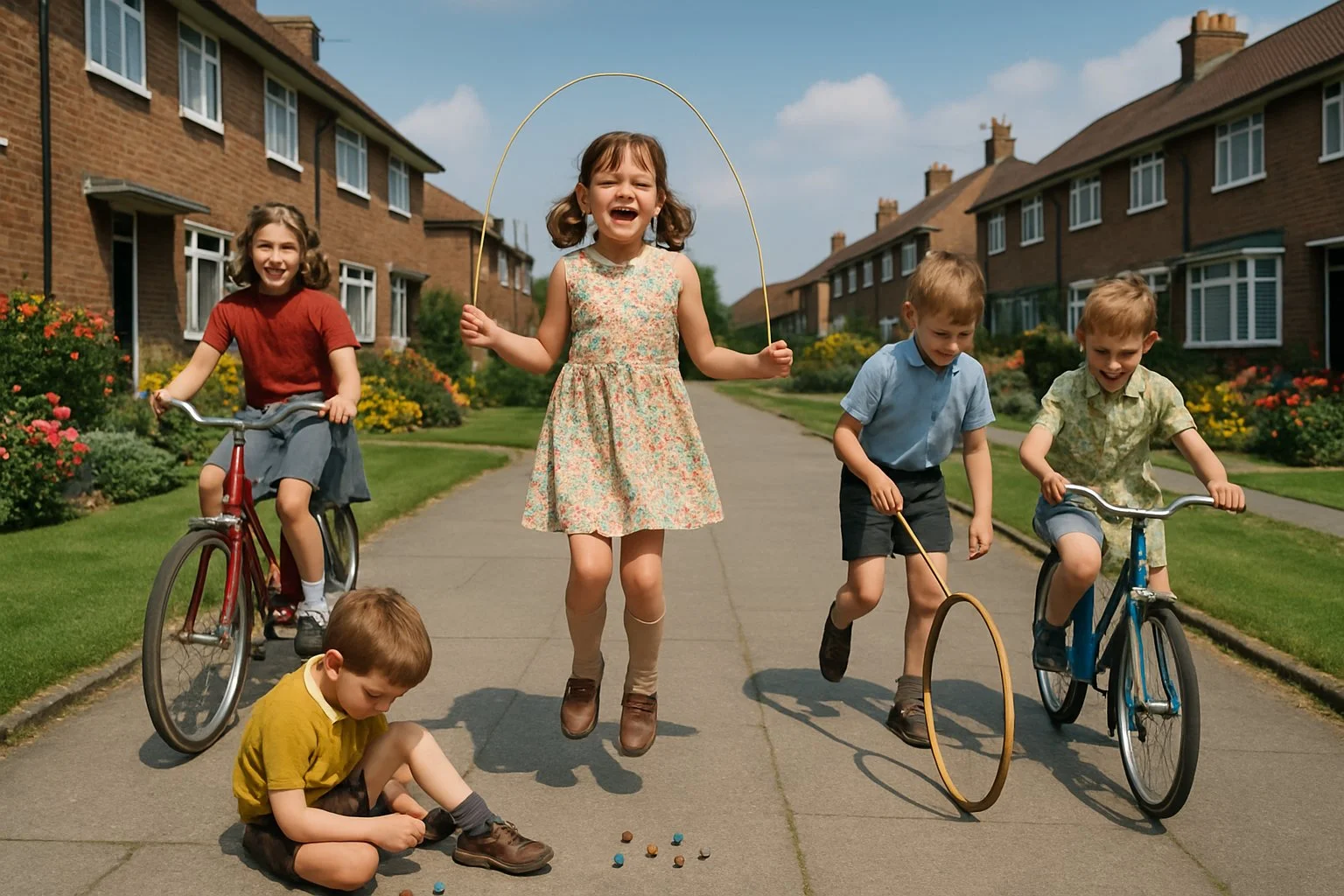
The 1960s really did feel like a golden pocket of British history—childhood seemed lighter, more independent. Streets barely saw any cars, so they turned into impromptu football pitches and hopscotch courts.
With television offering only a handful of hours, we had to invent our own fun: dens on bomb sites, long bike rides to the edge of the city, and games that filled up the whole day.
Back then, a generation grew up with a kind of independence you rarely see now. Simple toys and games, a pocketful of change for sweets, and the thrill of Saturday morning cinema—all of it made childhood in the ‘60s a heady mix of freedom and adventure. Sometimes I wonder if we even realized how lucky we were.
Unprecedented Freedom for Children

Kids in 1960s Britain had a level of independence that feels almost wild now. Streets were our playgrounds, bomb sites became our castles, and we wandered from dawn till dusk with barely a glance from an adult.
Independence and Outdoor Play
We grew up expecting freedom. After breakfast, you’d grab your bike or just your friends and disappear until teatime. Parents trusted us—maybe more than they should have, but we managed.
That kind of independence shaped us, honestly. We learned to handle our own squabbles, patched up our own scrapes, and solved problems on the fly. With almost nothing on TV during the day, the outdoors called to us. There was no one to tell us how to play or what to do.
Exploring Urban and Rural Spaces
Those leftover bomb sites from the war? Pure magic for kids. We’d build dens, set up secret bases, and let our imaginations run wild. If you had a bike, the whole countryside opened up—parks, woods, streams where you’d catch sticklebacks with a net made from an old bit of curtain wire.
Parks were something else too—tennis courts and putting greens you could use for a few pennies. The line between organized play and just mucking about blurred until you hardly noticed.
Street Games and Adventures
Streets came alive with games, especially in summer. Cricket, football, skipping ropes, hopscotch chalked onto the pavement. Sometimes we’d play cowboys and Indians, using whatever we could find for props.
Everyone in the street seemed to know each other’s kids. We looked out for each other in a way that felt natural, not forced. Marbles, conkers, and all those little seasonal games passed down from older siblings—those things stitched the neighbourhood together.
Popular Pastimes and Toys

Our days were packed with games, crafts, and toys that still bring a smile when you spot them at a car boot sale. The ‘60s introduced some real classics—LEGO, Action Man, and a whole world of collectibles.
Favourite Outdoor and Indoor Games
If the weather was decent, you’d find us outside. Hopscotch, skipping ropes, endless games of football—those never got old. Hide and seek, British Bulldog (a bit rough-and-tumble, but we loved it).
We built go-karts from whatever we could scrounge—old pram wheels, wooden crates, a bit of rope for steering. Tin can telephones stretched across gardens, carrying our secrets and giggles.
Rainy days sent us indoors for jacks, pick-up sticks, or a marathon game of Monopoly. We turned cardboard boxes into castles, made sock puppets with mismatched buttons for eyes, and let our imaginations do the heavy lifting.
Iconic Toys and Collectibles
Some toys from the ‘60s still feel special. Action Man showed up in 1966 and instantly became the must-have. Girls adored Sindy dolls (our own British twist on Barbie).
Scalextric sets meant hours spent racing tiny cars—always a bit of a tangle with the wires, but worth it. Collecting things was huge: football cards swapped in the playground, stamps and coins (especially with decimalisation coming in), and marbles you’d guard like treasure.
Corgi and Dinky cars filled our toy boxes, each one a little slice of a film or TV show. And when the moon landings happened, suddenly every kid wanted a rocket ship or an astronaut figure.
Creative Play with LEGO
LEGO arrived in Britain and, honestly, it changed everything. Those bright bricks could become anything—houses, cars, spaceships, whole cities sprawling across the bedroom floor.
We’d follow the instruction booklets sometimes, but mostly we built whatever popped into our heads. Sets got mixed, bricks swapped with friends, and creations left half-finished for days, waiting to be improved.
There was a special satisfaction in snapping those bricks together. LEGO never seemed to get old, and it survived being trodden on—well, mostly.
Television and Media
Television crept into almost every home during the ‘60s, becoming the centrepiece of family life. Children’s shows became instant classics, and Saturday mornings at the cinema were something else entirely.
Influence of Children’s Shows
Watch With Mother aired at 1:30 pm, a daily ritual if you were home sick or on school holidays.
Each day brought a different show:
- Monday: Picture Book
- Tuesday: Andy Pandy
- Wednesday: The Flower Pot Men
- Thursday: Rag, Tag and Bobtail
- Friday: The Woodentops
Noggin the Nog and Captain Pugwash whisked us away on adventures—pirates, Vikings, and all kinds of nonsense we adored.
Crackerjack on Fridays was a highlight. Prizes for right answers, cabbages for wrong ones—simple, silly, and brilliant.
Tales of the Riverbank, with Johnny Morris voicing those animals, still has a theme tune that can make me smile out of nowhere.
Zoo Quest with David Attenborough opened our eyes to animals and places we’d never imagined—Madagascar sounded impossibly exotic.
Family Time Around the TV
Television brought us together, no doubt about it. After tea, everyone squeezed into the sitting room—one telly, one channel (BBC1 if you were lucky). The set didn’t even start up till late afternoon.
We’d watch Dixon of Dock Green or some variety show, all ages together, arguing over who got the best seat. Furniture got rearranged so nobody missed a thing.
Those shared moments around the TV—little things, really—became the glue of family life.
Saturday Cinema Mornings
Saturday mornings meant a trip to the local cinema for the children’s matinee. It was a world apart from watching TV at home.
Serial adventures kept us coming back every week—no streaming, just old-fashioned anticipation. Cartoons, short films, heroes and villains cheered and booed by a hundred noisy kids.
Cinema managers often ran competitions or sing-alongs before the main event. Some places had clubs you could join, complete with badges or membership cards.
The sweet shop outside did a roaring trade—penny sweets, ice lollies, the works. And for a couple of hours, our parents got a bit of peace while we lost ourselves in the big screen’s magic.
Music, Fashion, and Cultural Icons
The ‘60s shook everything up—music, fashion, the whole idea of what it meant to be young. The Beatles exploded onto the scene, the miniskirt caused a stir, and Carnaby Street became the epicentre of cool.
The Beatles and the Music Revolution
The Beatles changed the game for British kids. Suddenly, music was ours. We saved up for their records, tried to strum guitars like John or Paul, and argued about who was the best Beatle.
Their impact? Massive:
- British music went global
- Kids everywhere wanted to start a band
- The “British Invasion” hit America
- Even the way we dressed and wore our hair shifted
Other bands like the Stones and the Kinks followed. Suddenly, being young and British felt exciting—music wasn’t just something in the background anymore. It was the pulse of our lives.
Rise of the Miniskirt
Mary Quant’s miniskirt turned heads and raised eyebrows. Girls and young women flocked to this bold new look—shorter hems, brighter colours, white boots, and tights.
The miniskirt wasn’t just fashion. It was a statement: “We’re not our mothers.” It meant freedom, confidence, and a bit of rebellion. Parents grumbled, but that only made it more appealing.
Carnaby Street and Youth Fashion Trends
Carnaby Street in London buzzed with energy—boutiques spilling over with colour, patterns, and wild new styles. Before this, kids mostly wore scaled-down grown-up clothes. Now, we had our own look.
Trends exploded: psychedelic prints, bell-bottoms, geometric shirts, platform shoes. Young people travelled from all over just to soak up the atmosphere, maybe buy something daring.
Fashion became a way to show who you were—or at least who you wanted to be. The old rules faded, and suddenly anything felt possible.
Changing Family Life and Home
Family life in the ‘60s followed a familiar rhythm, but new technology and a post-war baby boom started to shift things. The biggest generation of kids yet grew up with comforts their parents could only dream of.
The Nuclear Family Structure
Most families stuck to the nuclear model: dad off to work, mum running the household, kids in tow. The routines were set in stone—Sunday night baths, Monday wash days (the air always seemed fresher then).
Mums did the daily shop, cooked everything from scratch, and the only break from routine was fish and chips on a Friday—a treat everyone looked forward to.
Mealtimes mattered. We all sat down together, no distractions, no phones (not that we had them). Snacks were rare, a true treat when they appeared. Life felt structured, but there’s a certain comfort in that memory, isn’t there?
Modern Conveniences in Homes
Back in the 1960s, British homes started filling up with gadgets that felt almost futuristic at the time. Television quickly became the heart of family evenings, pulling everyone together and letting us peek into worlds we’d never even imagined before.
It was pretty common to spot a hefty set of encyclopaedias on the shelf—usually the Encyclopaedia Britannica, with its 24 handsome volumes. Door-to-door salesmen would show up, promising you could pay in installments, and somehow, those books always seemed like a ticket to a brighter, smarter future.
Washing machines and other appliances started popping up in more and more kitchens. Suddenly, mums (and let’s be honest, it was almost always mums) could tackle the daily chores with a bit less sweat than their own mothers had endured.
Yet, a lot of the things we casually expect now just weren’t around. If you wanted to know something, you’d head to the local library, not Google. There was no internet—just the promise of a good librarian and maybe a lucky find in those encyclopaedias.
The Baby Boomers Generation
We—those kids of the 1960s—belonged to the baby boomers, a generation so big it seemed like every street was bursting with children. Born after the war, we grew up surrounded by the sense that anything was possible.
Childhood felt like a different universe compared to now. We lived outside, inventing games, dodging the traffic, and making our own adventures. Screens? Not unless you count the telly, and even that had its limits.
Popular activities included:
- Building dens on leftover bomb sites (probably not the safest, but nobody worried much)
- Setting off on bikes for what felt like entire days, just to see what was out there
- Street games—hopscotch chalked on the pavement, football with jumpers for goalposts
- Saving up milk bottle tops and stamps for Blue Peter, hoping for that coveted badge
Freedom was just part of life. You’d leave after breakfast and only come home when you were hungry or the streetlights flickered on. Parents seemed to trust us in a way that’s rare now—maybe too much, but we survived.
Our toys? Action Man, Sindy, Meccano, Lego—simple, sturdy, and built for imagination. Some of us even had chemistry sets full of things that would definitely raise eyebrows (and probably alarms) today.
Society and Shifting Social Attitudes
The 1960s really did shake things up in Britain. Everything felt like it was changing—how families worked, what kids could do, even what you could wear. Parents started talking about freedom and individuality, and worries about safety just didn’t dominate the conversation the way they do now.
Growth of Personal Expression
Suddenly, kids could be themselves in ways our parents never dreamed of. The so-called “permissive society” meant experimenting with clothes, music, and ideas, and not getting in trouble just for being a bit different.
Fashion and Style Freedom
- Boys let their hair grow out, and nobody dragged them to the barber in protest (well, not always)
- Girls started choosing their own clothes—skirts got shorter, colours got bolder
- Children’s wardrobes exploded in bright patterns, a world away from the drab hand-me-downs of the fifties
Pop culture was everywhere. The Beatles, the Stones—it wasn’t just teenagers, even little kids caught the fever. By the mid-sixties, most families had a TV, so even if you didn’t get to go to the gigs, you could watch the world change right from your sofa.
Parents who’d survived wartime rationing and blackouts wanted their kids to have the freedom they’d missed. That created a bit of a gulf—suddenly, kids were questioning authority, and parents weren’t always sure how to respond.
We started having opinions about things adults used to keep quiet about. Protests flashed across the TV, and suddenly, you realised the world wasn’t as simple as you’d thought. It made us more curious, more willing to ask, “Why not?”
Emergence of Civil Rights Awareness
Kids in Britain couldn’t help but notice the civil rights movements, both in our own country and across the Atlantic. The stories and images from America’s struggle for equality made their way onto our screens, and at the same time, new neighbours from the Commonwealth were changing the face of our towns.
Key Influences on Children:
- Televised scenes from the American civil rights movement—sometimes shocking, always unforgettable
- The arrival of Caribbean and South Asian families, bringing new sounds, foods, and friendships into British life
- Conversations about fairness—sometimes awkward, often overdue—in schools and at home
We started to see what equality really meant, or at least what it should mean. Mixed-race friendships popped up in city schools, and suddenly, the world felt a little bigger.
Schools tried to talk about diversity, though it was clumsy and half-hearted at times. For lots of us, meeting classmates from different backgrounds was a first, and it changed how we saw things.
The civil rights movement made us think about standing up for what’s right, even if it wasn’t easy. Some of us started to wonder why rules were the way they were—and whether they deserved to be challenged.
Safety and Parenting Practices
Safety in the 1960s just felt… different. Parents weren’t so consumed by stranger danger, and kids got a whole lot more freedom—sometimes maybe too much, if you ask folks now.
Common 1960s Parenting Approaches:
- Kids as young as 6 or 7 would just walk themselves to school
- Staying out playing until the streetlights flickered on was totally normal
- No one really bothered with bike helmets or buckling up in the car
- Streets were for playing, and adults mostly kept to their own business
Back then, we trusted our communities in a way that’s hard to find now. Neighbours kept an eye out, but not in any official sense—just a nod or a wave, maybe a quick word if you got into trouble. Extended families lived close by, and you always knew you’d run into a cousin or an auntie somewhere.
Parents put their energy into teaching practical stuff—how to fix a flat tire, how to cross busy streets, or just how to handle yourself. You figured out your neighborhood by exploring it, not by being chauffeured everywhere.
There was this whole laid-back vibe about risk and responsibility. People seemed to think kids needed a bit of freedom, even if it meant a few scraped knees or a scare or two. Looking back, it almost feels like a different world.






Leave a Reply