
Growing up in 1950s Britain was a peculiar mix of innocence and resilience, a time when the world still felt a little battered but hopeful.
Kids back then had a freedom that’s hard to imagine now—whole days spent outside, climbing trees, getting muddy, racing bikes, and wandering until dusk or a rumbling stomach finally pulled us home.
Most of us left in the morning with a jam sandwich and a wink from Mum, and that was about all the supervision we needed.
The decade was a strange jumble: rationing still lingered for sweets and meat, but there was also the thrill of Queen Elizabeth II’s coronation and, for some lucky families, the magic of a television set blinking to life in the lounge.
We grew up with one foot in the old world—strict manners, Sunday best, and deference to grown-ups—and the other in a future that seemed to be arriving faster every year.
Strict teachers in overcrowded classrooms, the excitement of Saturday morning at the pictures, and the first stirrings of rock and roll—these were the rhythms of life. The post-war recovery touched everything, from the way our families worked and played to the lessons we learned at school.
Childhood in Post-War Britain

After the war, everything felt a bit new and a bit patched together. Families were rebuilding, and kids like us roamed with a sense of possibility. The government’s promises—better homes, free healthcare—changed childhood in ways we probably didn’t even notice at the time.
Daily Life for Children
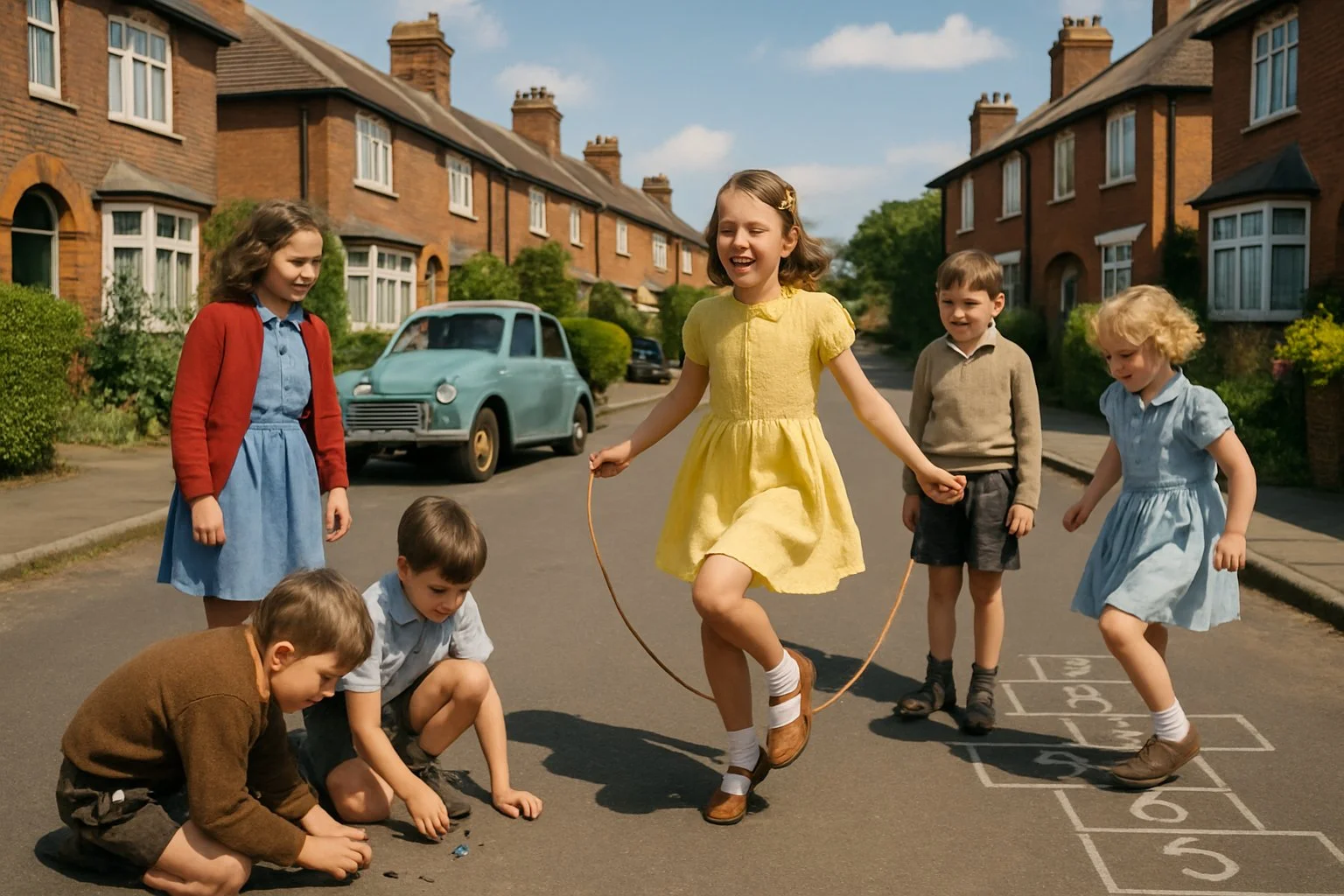
We really did vanish for hours, sometimes with just a sandwich and a bottle of pop. Nobody worried, not like today. The streets belonged to us: hopscotch chalked on the pavement, makeshift goalposts, and endless games of football. With hardly any cars about, we cycled everywhere and played wherever we fancied.
Adults—especially teachers or the local bobby—expected instant respect. If you got a telling-off or even a quick clip round the ear, you’d best not complain at home. Parents always took their side. Saturday mornings at the cinema were a highlight, all of us glued to cowboys and spacemen, dreaming of six-shooters and adventure.
By the late fifties, something started to shift. Teenagers—well, they were practically a new species. Rock and roll from America crept in, and suddenly there were Teddy Boys, slick hair, and a bit of swagger on the street.
Housing and Home Environment
Most of us grew up in houses that would seem shockingly basic now. At the start of the fifties, less than half of English homes had a bathroom. Tin baths in the kitchen and outdoor loos were the norm, especially in the Midlands and Wales. You’d heat water on the stove, and everyone took turns in the same bathwater—eldest first, if you were lucky.
Gradually, things improved. Washing machines, vacuum cleaners, and food mixers started to appear, freeing up mothers’ time bit by bit. The government put money into clearing slums and rebuilding bombed-out areas, so more homes boasted indoor plumbing—though even by the mid-sixties, a quarter of houses still didn’t have it.
With these gadgets, women snatched back a few hours and some even found part-time work. It meant a little extra in the family purse, maybe enough for a treat or two.
Health Improvements and the NHS
The NHS, launched in 1948, changed everything for families. Suddenly, doctors and dentists didn’t cost a penny. It’s hard to overstate what that meant for peace of mind.
In 1958, mass vaccinations against polio and diphtheria rolled out, and those terrifying diseases started to fade away. Antibiotics helped beat tuberculosis and other nasties that once haunted every parent. Better food and free school milk made kids stronger—calcium, iron, and fibre were staples, and sugar was still a rare treat.
Every day at school, a little bottle of milk waited on our desks. Not everyone liked the taste, but it did the job—stronger bones, fewer sick days, and a sense that things were getting better, even if we grumbled about it.
Schools and Education in the 1950s

The school system in the fifties owed a lot to the 1944 Education Act. Everyone got free secondary education until fifteen, but the eleven-plus exam loomed large, sorting us into different futures before we’d even hit our teens.
Types of Schools and School Life
That exam at age eleven felt like a fork in the road. Do well, and you landed in grammar school—only about one in five made it, and the odds depended on where you lived. Latin, French, maths, and science filled our timetables, all geared toward O-levels.
Most ended up in secondary modern schools, which focused on the basics and getting kids ready for work. Not many left with qualifications. Technical schools were rare, and comprehensives barely existed yet.
We started school at five—infants, then juniors, then the big leap at eleven. You could leave school after your fifteenth birthday, and plenty did. The day ran from 9 to 4, with a long lunch break. Corporal punishment was just part of the deal—no one thought much of it.
School Dinners and Uniforms
School dinners were a fixture. The law said they had to cover a third of our daily nutrition, though the taste was hit or miss. Dinners cost 7 pence in ’51, rising to a shilling by ’57, but if your family struggled, you got them free.
Uniforms were a big deal, especially in grammar schools:
Boys:
- Blazers or jackets
- Short or long trousers
- School cap with a badge
- Tie and scarf
- Pullover in school colours
Girls:
- Gymslips or skirts
- Blouse and tie
- Blazer or cardigan
- Hat or beret
- Colours varied by school
Not every secondary modern insisted on uniforms, but most did. What you wore said a lot about where you went and, honestly, who you were.
Notable Changes to the Curriculum
The curriculum split sharply along gender lines. Boys did woodwork, metalwork, and technical drawing—preparing for trades. Girls learned cookery, needlework, and typing, aimed at home or office life.
Everyone got the basics: arithmetic, English, history, geography, PT, music, and religious education. History lessons were heavy on British heroes, and we spent a lot of time copying from textbooks. Independent research? Not really a thing.
Radio broadcasts like ‘Music and Movement’ became part of lessons, filling classrooms with sound and a bit of excitement. Secondary moderns sometimes rolled history and geography into ‘social studies,’ and only the top streams got to tackle foreign languages.
Family Life and Social Traditions
Home life in the fifties had its own rhythm—clear roles, shared routines, and rituals that brought everyone together. The end of rationing changed what we ate, and for many, the annual trip to the seaside was the highlight of the year.
Role of Parents and the Housewife
Dad went out to work, Mum ran the house. That’s just how it was. Most married women stayed home, cooking from scratch, scrubbing clothes by hand, and juggling the shopping. Appliances were scarce, so housework took ages.
A typical day for Mum:
- Three meals from scratch
- Washing everything by hand
- Shopping at several shops (no supermarkets yet)
- Looking after the kids and helping with homework
No fridge? No problem—just more trips to the shops. Coal fires did double duty for cooking and heating.
Dad was the breadwinner and the one who laid down the law. He worked long hours, usually six days a week, and expected respect. Children pitched in, minded their manners, and didn’t talk back.
Family Meals and Food Rationing Ending
When rationing ended in 1954, it was a huge relief. Sweets had come off the list a year earlier, and suddenly chocolate and boiled sweets were everywhere again.
What changed at the table:
- More meat
- Spaghetti and other novelties appeared
- Tinned foods gained popularity
- Fresh fruit became easier to find
Sunday dinner was a big deal—roast meat, veg, a proper pudding, and everyone around the table for ages. Mums got creative with new ingredients and tinned veg, saving precious time.
Most families still ate together three times a day. With TV sets still rare, meals were proper family occasions, full of chatter and, if you dared, the odd squabble. Good manners mattered.
Holiday Traditions and Seaside Trips
By the late fifties, more families could finally afford a holiday. During ‘wakes weeks,’ whole towns seemed to decamp to the seaside. Blackpool, Brighton, Scarborough—these places buzzed with families, rain or shine.
Where we stayed:
- Boarding houses (with hearty meals)
- Butlin’s holiday camps
- Caravans by the coast
- Relatives’ spare rooms
Holidays were simple—sandcastles, paddling in icy water, sticks of rock, and Punch and Judy on the beach. Most families scrimped and saved all year, joining holiday clubs to make it happen. Even day trips by charabanc coach felt like an adventure.
Packing up, catching the train, the smell of salt in the air—those memories stick, don’t they?
Toys, Entertainment, and Everyday Fun
Kids in 1950s Britain had to make their own fun, and we got pretty good at it. Plastic toys were new and exciting, Lego bricks arrived from Denmark, and the outdoors was always calling. TV was just starting to work its magic, but books and comics still ruled.
Popular Toys and Games
Plastic toys changed everything—suddenly, there were bright, sturdy playthings in every shop window. Lego showed up in 1958 and quickly became a favourite, letting us build whatever our imaginations could muster.
Old favourites stuck around:
- Dolls and teddies for make-believe
- Building blocks and puzzles for rainy days
- Bikes for real adventure
- Skipping ropes and balls for playground games
Board games like Snakes and Ladders, Ludo, and Draughts were family staples. But mostly, we played outside—climbing trees, building dens, careening down hills in homemade go-karts, or chalking hopscotch on the pavement.
Television and Radio Programmes
By the mid-fifties, more homes had a black-and-white telly in the corner, and everyone gathered round to watch—sometimes with neighbours squeezed in too. Children’s programmes became a real event. Watch with Mother started in 1952, and suddenly Andy Pandy, the Flowerpot Men, and the Woodentops were household names.
Radio was still a big deal, especially for adventure stories and music on the BBC Light Programme. Families often made an evening of it, huddled around the set, sharing laughs and the odd argument over what to listen to next.
Looking back, it’s hard not to feel a pang for the days when fun was simple and the world seemed just a little bit bigger.
Children’s Books and Comics
Reading was just part of growing up for British kids. Enid Blyton pretty much ruled children’s literature back then, with her adventure stories stacked on every library shelf.
The book series everyone seemed to have:
- The Famous Five adventures
- The Secret Seven mysteries
- Noddy stories for the little ones
Comics were a weekly ritual—just a few pence, but packed with laughs. The Beano and The Dandy gave us characters like Dennis the Menace and Desperate Dan—somehow, they never got old.
When Eagle comic arrived in 1950, it felt fresh and a bit futuristic, especially with Dan Dare flying off into space. Older kids couldn’t get enough of it.
Libraries actually made reading fun, with special children’s corners and the occasional storytelling hour. Most schools had their own little libraries, too, and we always looked forward to swapping out books.
The Influence of the Coronation
Queen Elizabeth II’s coronation on 2nd June 1953—now, that was a proper event. For a lot of families, it meant bringing home their very first television, just to catch the big moment.
The whole country seemed glued to the screen as the ceremony at Westminster Abbey unfolded. Kids crowded around the telly, at home or at school, or sometimes at the community hall if you were unlucky enough not to have a set yet.
Street parties popped up everywhere. We loved:
- Coronation cakes and all sorts of treats
- Red, white, and blue everywhere you looked
- Commemorative mugs (most of us still have one tucked away)
- Games and little competitions in the street
Television suddenly felt like magic. For a lot of us, the coronation was the first time we saw something live, right as it happened.
All those special souvenirs—books, postcards, toys with the Queen’s face—became prized treasures. If you got one that year, you probably held onto it for ages.
Major Events That Shaped 1950s Britain
The 1950s really did shake things up. Britain started to crawl out from under the weight of the war and look ahead. There was the Festival of Britain, the Queen’s coronation, Hillary’s Everest climb, and the first big wave of Caribbean arrivals—each one changing the country in its own way.
The Festival of Britain 1951
The Festival of Britain felt like a breath of fresh air. Held exactly a century after the Great Exhibition of 1851, it let the world know Britain was back on its feet.
From May to September 1951, London’s South Bank was suddenly full of bold, modern buildings. The Skylon tower and Dome of Discovery—those images still stick with me.
Festival Highlights:
- Sleek new architecture
- Science exhibits that made us dream
- Art and culture everywhere
- New homes springing up in Poplar, East London
After years of grey uniforms and blackout curtains, seeing all those bright colours was almost shocking. The festival made us believe things really could get better.
More than 8 million people turned up to see it all. Kids gawked at inventions that seemed almost magical. For families, it was a chance to finally enjoy a day out together, after so much time apart during the war.
Coronation of Queen Elizabeth II
The Queen’s coronation on 2nd June 1953 was the first big event most of us ever watched on television. It changed how we saw the world, and each other.
The BBC broadcasted the whole ceremony live from Westminster Abbey. If you didn’t have a TV, you probably squeezed into a neighbour’s living room or maybe caught it at the local cinema.
Loads of families splurged on their first television just for this. Watching the young Queen crowned felt like history in the making, even if the ceremony dragged on for nearly three hours.
Coronation Day Fun:
- Streets decked out with bunting and flags
- Special treats, now that rationing was finally ending
- Coronation games and keepsakes
- Everyone out in the street, celebrating together
Sweet rationing ended that February, so the party food tasted even better. We’d waited years for proper cakes and sweets.
The coronation pulled everyone together. It was the start of the TV era for so many families.
Edmund Hillary and Everest
On 29th May 1953, Edmund Hillary and Tenzing Norgay stood on top of Mount Everest. The news reached Britain just in time for the coronation, and honestly, the timing couldn’t have felt more perfect.
With the Queen’s big day coming up, suddenly we’d conquered the world’s highest mountain too. Hillary came from New Zealand, but as part of the Commonwealth, it felt like a win for all of us.
Every paper and radio station buzzed with the story. Kids learned about the climb at school, and we tried to imagine the freezing, dangerous trek.
That success gave us a real lift. It was proof—maybe we really could do great things again.
Emergence of the Windrush Generation
When the Empire Windrush docked at Tilbury on 22nd June 1948, it kicked off a wave of Caribbean immigration that reshaped Britain in the 1950s.
Throughout the decade, more and more Caribbean families arrived, ready to help rebuild after the war. Hospitals, buses, post offices, factories—there was work, and Britain needed hands.
Life wasn’t easy for these newcomers. Decent housing was hard to find, and some employers turned them away, even when jobs went begging.
Jobs New Arrivals Took On:
- NHS hospitals and clinics
- London Transport—buses, trains, the works
- Post offices
- Factory floors and construction sites
Caribbean families brought their own flavours and rhythms—reggae, calypso, foods like Jamaican patties and rice dishes. Suddenly, British towns felt a little more colourful.
Their children started school alongside ours. Over time, this changed the face of British society. The Windrush generation laid down the roots of the multicultural Britain we know today.
Changing Society and Looking Ahead
The 1950s was a decade of change—Britain slowly swapped ration books for modern comforts. Gadgets arrived, communities shifted, and young people started to find their own voice, setting the stage for the wild ride of the 1960s.
Technological Progress in the Home
Homes in the 1950s looked nothing like before. Modern gadgets finally became affordable for regular families, and suddenly life wasn’t quite so hard.
Electric cookers, fridges, and even vacuum cleaners turned up in more and more houses. Getting a television felt like a big deal—now families could actually sit together and watch something other than the wireless.
Biggest Home Upgrades:
- Electric gadgets taking over from gas and coal
- TV sets making their way into front rooms
- Tape recorders for music (the sound wasn’t great, but we loved it)
- Better heating—no more shivering in bed, at least not as much
Kitchens changed first. Suddenly, tinned peas and other processed foods showed up in shops. Refrigerators meant you could keep things fresh longer, which felt like a small miracle.
With less time spent scrubbing and cooking, families had more time to just be together. Even the gap between rich and poor started to shrink, as more homes got these new conveniences.
Television changed our evenings. Millions watched the Queen’s coronation in 1953, all at the same time. It’s hard to explain now, but it really did bring people together.
Migration, Diversity, and Community
Communities in Britain started to look different. The war had already scattered families, but now people moved for new jobs and new homes.
Many left bombed-out cities for brand-new towns. The government built shiny new estates where old ruins had been. London especially seemed to reinvent itself overnight.
Workers from across the Commonwealth arrived, bringing new foods, music, and traditions. Suddenly, neighbourhoods had a mix of accents, smells, and sounds.
Community Shifts:
- New estates on old bomb sites
- Fresh cultural influences in every town
- Old traditions blending with new ones
- Communities mixing in ways that felt new and sometimes strange
Some areas welcomed newcomers with open arms. Others, well, not so much. Kids growing up in these mixed neighbourhoods saw a kind of diversity their parents never imagined.
Shops started to stock new foods. Spaghetti, for instance, was a novelty. And with rationing over in ’53, sweet shops came back to life.
Beginning of a New Youth Culture
Teenagers in the 1950s did something their parents never quite managed—they carved out their own identity.
They had pocket money, picked their own clothes, and danced to rock and roll from America. Suddenly, being young wasn’t just a waiting room for adulthood; it was something special.
Youth Culture Highlights:
- Rock and roll and wild dancing
- Teddy boy suits and slicked-back hair
- Hanging out in coffee bars and youth clubs
- Attitudes that baffled (and sometimes annoyed) parents
Christian Dior’s “New Look” inspired the girls—out went the drab, in came pastels and full skirts. It was a bit daring, honestly.
With a bit of spare cash, we bought records and new clothes. For the first time, “teenager” meant something.
Young people started to push back against old rules. They wanted more than the life their parents had, shaped by war and rationing. And who could blame them?
From the 1950s to the 1960s
The late 1950s—what a time. You could almost sense something big was about to happen, like the air just felt different. Changes that once crawled along suddenly picked up speed as the decade wound down.
Britain’s first motorway opened up in 1958. Suddenly, it wasn’t such a big deal to pack up the family and drive somewhere new. The idea of a holiday far from home didn’t seem so wild anymore.
Cars became affordable for more folks, and suddenly those package tours to Spain started luring people away from the old British seaside haunts. Sunburn and sangria replaced sandcastles and rock candy for many.
Key developments included:
- Better transport links
- Rising living standards
- International influences
- Growing confidence
The National Health Service came along and, honestly, it changed everything. Free healthcare for everyone—can you imagine what a relief that was? Our grandparents never had that kind of safety net.
Schools opened up new doors. More kids stuck around past the age their parents would’ve left, and some even made it to university. That felt like a real shift.
By 1960, you could feel the optimism in the air. The shadows of the war and rationing seemed to finally loosen their grip. Young people, especially, started dreaming bigger—hungry for whatever the next decade might bring.






Leave a Reply