
The 1960s—what a time to be a kid. Streets and schoolyards echoed with laughter, and every day felt like a new adventure.
In this golden era of outdoor play, we made our own fun with nothing but a bit of rope, some chalk, and a battered rubber ball or two.
No one needed fancy gadgets—just a bit of imagination and a gang of friends.
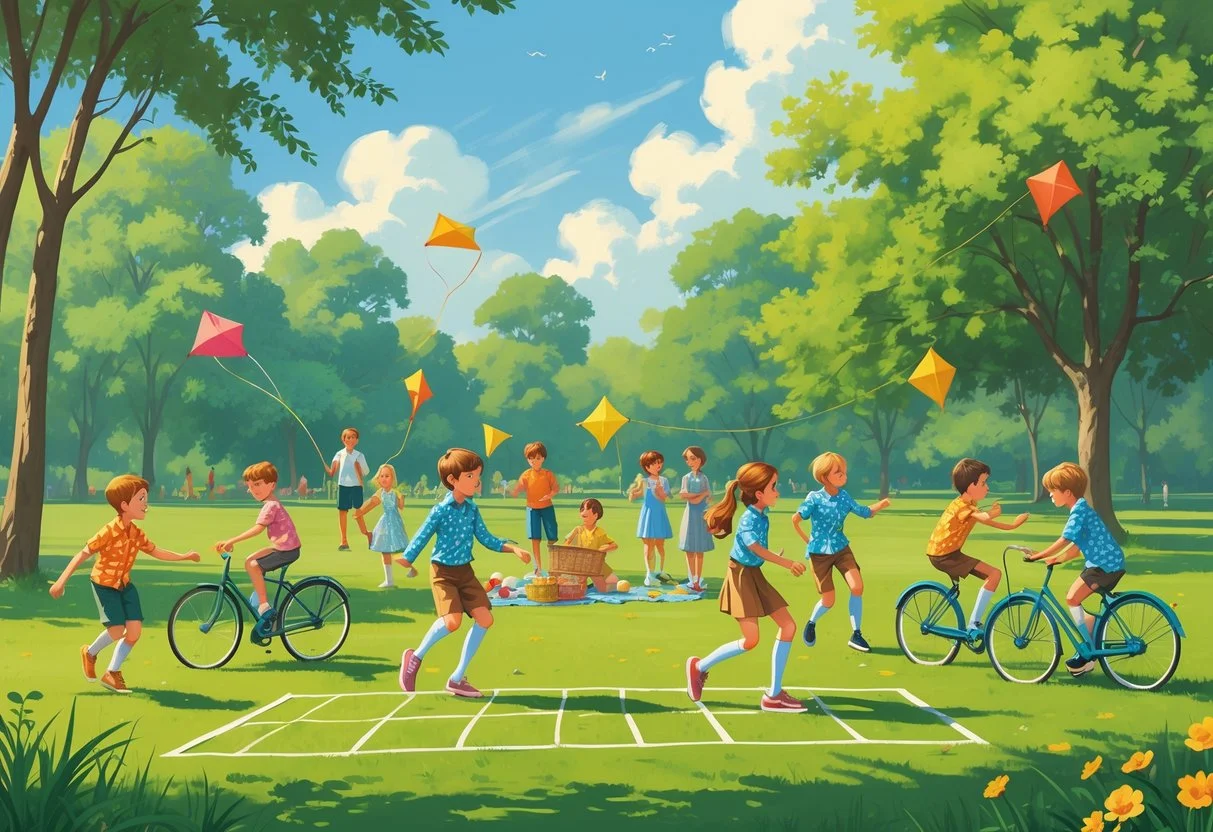
Imagine yourself dashing across the playground during Red Rover, plotting your next move in Capture the Flag, or perfecting your hopscotch technique. These games weren’t just to pass the time—they were the rhythm of childhood, the stuff you’d chat about over tea or remember fondly decades later. Every break was a chance for something unexpected.
From the strategic playground standbys to the athletic thrill of skipping games and ball sports, the 1960s had a treasure chest of outdoor adventures. Lessons about teamwork and creativity? Sure. But mostly, it was about running wild with your mates, making up rules as you went, and ending the day with grass stains and a grin.
Iconic Playground Games of the 1960s

Back then, playgrounds buzzed with games that needed little more than chalk and a handful of eager kids. These classics brought out the best in us—sometimes the worst, too, if you lost your favourite marble—but they always left a mark.
Tag and Its Variations
Tag was the king of running games. One tap and a shout of “You’re it!”—suddenly, the whole playground scattered. The chaser switched every few seconds, and everyone got a turn at both sides of the chase.
We kept things interesting with variations. Freeze tag meant you had to stand like a statue if you got caught, hoping a mate would crawl through your legs and set you free.
Chain tag could get a bit chaotic, with a growing line of hand-holding chasers snaking across the tarmac. When you got tagged, you joined the chain, and before long, half the playground was connected, laughing and tripping over each other.
Some of us tried TV tag, where you could escape by sitting and shouting the name of a telly show—though you had to think fast, or risk getting tagged anyway.
Shadow tag worked best on a sunny day. Instead of tagging you, the chaser aimed for your shadow. You’d twist and turn, trying to keep your shadow out of reach, sometimes forgetting where your own feet were going.
Hide and Seek: The Classic Chase
Hide and seek turned any playground into a world of secret spots and whispered plans. One person counted—usually way too fast—whilst the rest of us squeezed behind bins, trees, or the odd bike shed.
The seeker had to find everyone before anyone made a break for “home base,” yelling “Home free!” as they dashed past.
Sardines flipped the game on its head. One kid hid, and as each seeker found them, they’d cram into the hiding place until everyone was squashed together, giggling and hoping not to be spotted.
British playgrounds seemed made for hiding. There was always a nook or cranny—under the slide, behind the climbing frame, or tucked into a shadowy corner. The best spots? Well, you only shared those with your closest friends.
Hopscotch and Chalkboard Creativity
Hopscotch needed just a bit of chalk and a pebble. We’d draw squares—sometimes neat, sometimes a wobbly mess—on the playground, each school with its own patterns and rules.
You’d toss your marker into the first square, then hop down the course and back, balancing on one foot, trying not to step on the lines or lose your balance. If you managed it, you’d move to the next number.
Some kids got creative, drawing courses with twists and turns, adding rules like hopping backwards or spinning in certain squares. Rain would wash it all away, but that just meant a fresh start the next day.
Red Rover and Playground Rivalries
Red Rover—now that was a game that could get your heart pounding. Two teams, arms linked, facing off across the playground. “Red Rover, Red Rover, send [name] right over!” The chosen kid would charge, trying to break the chain.
If they broke through, they’d bring someone back to their team. If not, they’d join the other side. Teams shifted, alliances formed, and sometimes, well, there were a few tears.
Teachers didn’t always love Red Rover—too many bruised arms and bumped heads. But the thrill of smashing through a chain (or holding fast) made it a playground legend, even if it got banned now and then.
Skill and Strategy: Timeless Favourites

Some games were all about quick thinking and clever moves. It wasn’t just about running around—sometimes, you needed a bit of strategy and a steady hand.
Marbles: Playground Treasure
We’d carry our marbles in little drawstring bags, each one a tiny treasure. The big “shooters”—heavy glass or steel—were the real prize, perfect for knocking others out of the ring.
You’d draw a circle in the dirt, drop your marbles in, and take turns flicking your shooter, trying to knock out as many as you could. If you missed, your turn ended. But if you hit, you kept the marbles you knocked out. Winner took home the loot.
A good shot took steady hands and a bit of luck, but the best players had a knack for setting up the next move. Cat’s eyes, steelies, swirls—everyone had their favourites, and sometimes the best ones were quietly banned for being too good.
Capture the Flag: Teamwork and Tactics
We’d split into teams, each guarding a flag at opposite ends of the field. The goal? Sneak into enemy territory, grab their flag, and leg it back to your side without getting tagged.
We’d set up boundaries and a “prison” for anyone caught. Teamwork mattered—guards kept watch, runners waited for the right moment, and someone always tried to play the hero.
If you got tagged in enemy land, off to prison you went, waiting for a daring teammate to rescue you. There was always a bit of chaos, a lot of shouting, and the occasional argument over who was “really” tagged.
The best teams worked together, planning distractions and rescues. Sometimes it felt more like a battle than a game, but it always ended with everyone out of breath and grinning.
Four Square: The Battle of the Squares
Four squares chalked on the ground, a rubber ball, and a rotating cast of hopefuls. The player in square four—the “king”—served the ball, aiming to stay on top as long as possible.
Mess up—hit the ball out, let it bounce twice, or catch it—and you’d shuffle to the back of the queue. The next kid moved up, and so it went, round after round.
Everyone had their own tricks—spin serves, sneaky angles, or rules made up on the spot. The king sometimes changed things up, just because they could.
You might wait ages for your turn, so every second in the squares counted. It taught quick reflexes and a bit of cunning. And if you made it to the king’s square? Well, you’d brag about it all day.
Active Fun: Jumping, Skipping, and Ball Sports
The 1960s playground was always alive with movement. Skipping ropes slapped the tarmac, tetherballs swung wildly, and classic ball games brought everyone together—no matter how rainy or muddy it got.
Jump Rope and Skipping Games
Skipping ropes were everywhere. We’d gather in groups, two kids swinging the rope while a line of jumpers waited their turn—sometimes impatiently.
Double Dutch was the real challenge, with two ropes spinning in opposite directions. Timing was everything, and it took ages to get it right.
We chanted skipping rhymes like “Teddy Bear, Teddy Bear, turn around” or “Salt, mustard, vinegar, pepper,” the words helping us keep the rhythm and making it all a bit more fun.
Solo skipping was just as popular. We’d try tricks—criss-crossing arms, double bounces, skipping backwards—sometimes tripping over our own feet but always jumping back in.
Teachers liked skipping games. They kept everyone busy (and out of trouble), and all you needed was a bit of rope.
Tetherball: Swinging and Spinning
Tetherball poles popped up in schoolyards everywhere. Just a metal pole, a rope, and a ball—that’s all you needed.
Two players faced off, each trying to smack the ball so it wrapped the rope around the pole in their direction. You could only use your hands and arms—no grabbing the rope, no touching the pole.
Matches could be over in a flash or drag on forever as the ball whipped back and forth. It was all about quick reflexes and a bit of cheeky strategy.
Schools loved tetherball—one pole kept a whole crowd entertained, and it barely took up any space. On a sunny day, you’d always find a queue, kids waiting their turn, plotting their next victory.
Schoolyard Ball Game Traditions
Traditional ball games really thrived in schools back in the 1960s. Four Square—now that was the king of the blacktop. Just a simple court, a big rubber ball, and a rotating cast of kids eager for their turn.
You’d see that ball bouncing from square to square, each player hoping to knock out the others and claim the “king” spot. The rules? Simple enough to pick up during recess, but tricky to master.
There were plenty of other favorites, too:
- Kickball—sort of like baseball, only everyone used their feet instead of bats. Felt more democratic, somehow.
- Dodgeball—a flurry of soft balls flying, and kids diving for cover or glory.
- Wall ball—just a ball and a brick wall, but endless variations depending on who was playing.
None of these games needed much gear, but wow, they demanded energy. Teachers liked how kids learned teamwork and had to play fair—at least most of the time.
Most schools would paint the court lines right onto the tarmac, a quiet nod to how much these games mattered for exercise and just plain growing up. Looking back, it’s hard not to miss the sound of that rubber ball and the scramble for the king square.






Leave a Reply