
The bomb-damaged streets of 1950s Britain gave kids a kind of freedom that feels almost unimaginable now. While adults busied themselves rebuilding after the war, children seized the chance to turn piles of rubble into playgrounds, race bikes through empty lots, and carve out wild adventures in the shadowy, grey city.
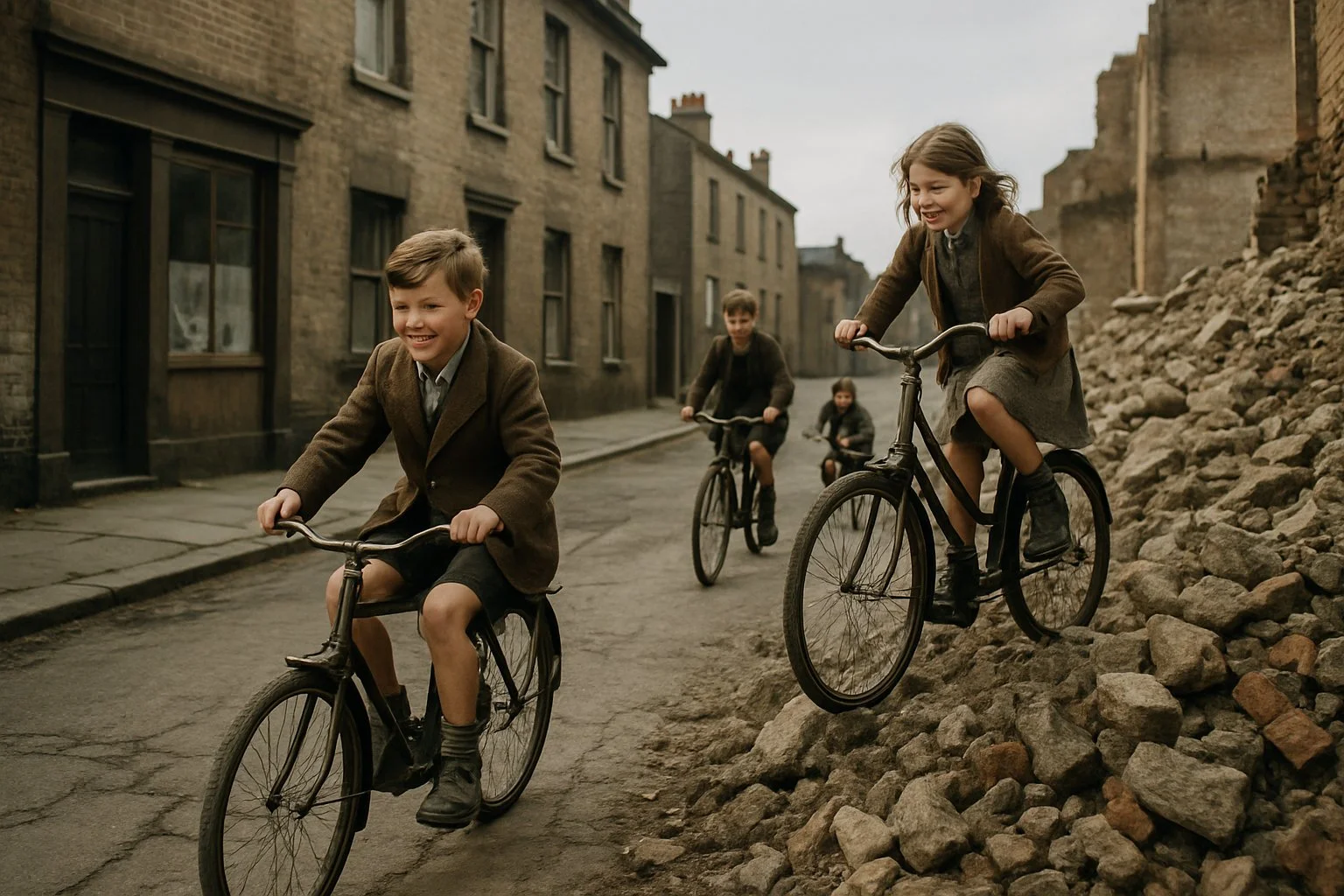
Children in 1950s urban areas roamed with a freedom that would probably horrify today’s risk-averse adults. Those battered streets became the canvas for a generation’s imagination, risk-taking, and exploration.
From the rise of cycle speedway on flattened ground to the first adventure playgrounds popping up in old bombed-out lots, the 1950s really had something different going on. Play was rougher, sure—but it was also more inventive. You can almost trace how these wild years nudged our thinking about childhood, risk, and city design.
Everyday Life for Children on 1950s Urban Streets
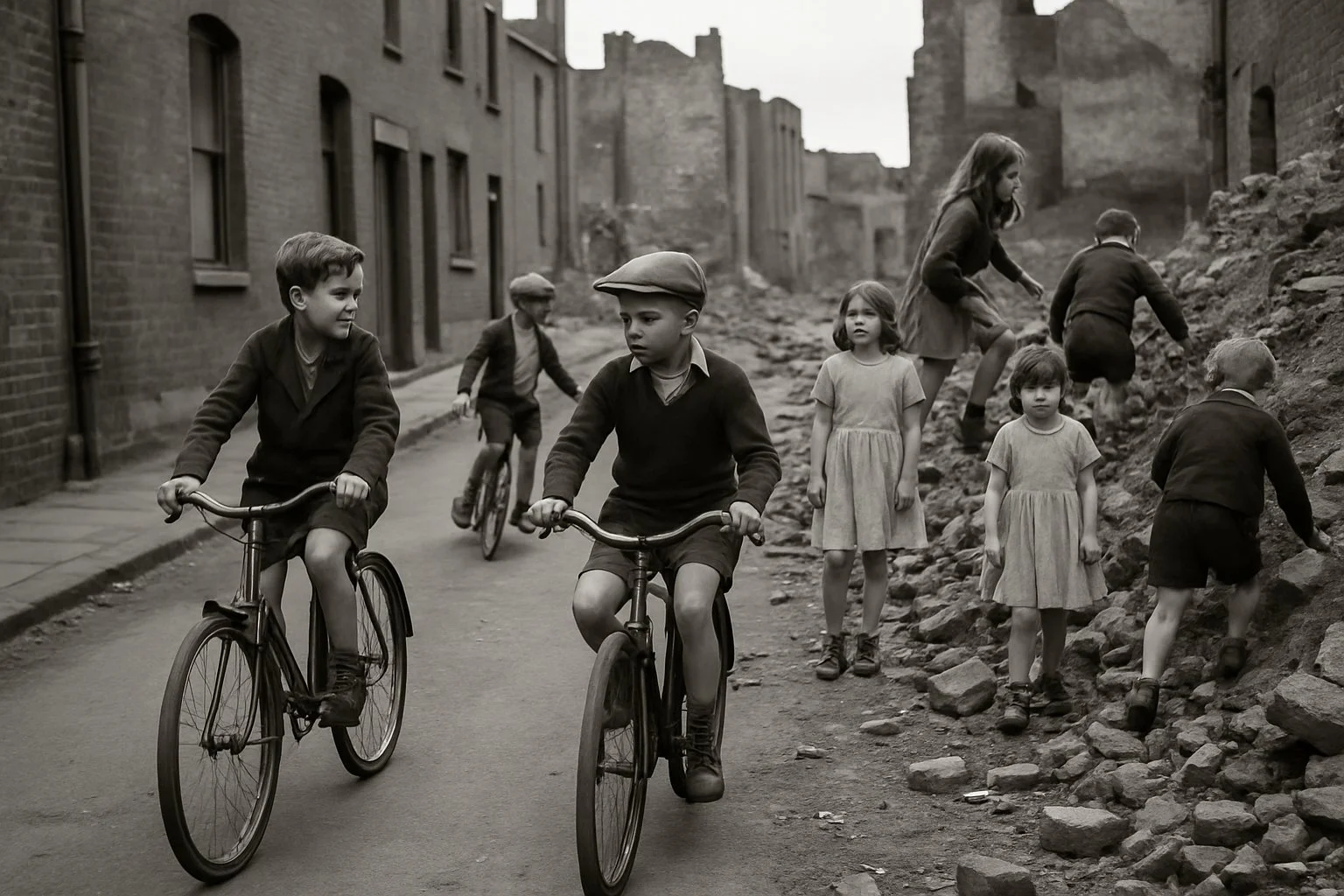
Kids back then had a kind of run-of-the-streets freedom that’s hard to picture now. With so few cars around, even the roads were fair game for games, sports, and general mischief.
Freedom and Independence in City Neighbourhoods
Children wandered their neighbourhoods with a level of independence that just doesn’t happen anymore. Parents let them out after breakfast, and sometimes you wouldn’t see your own kid until tea.
Bombsites quickly became unofficial adventure playgrounds. Those crumbling remains from the Blitz gave kids a space to build dens, poke around, and invent their own worlds. Local authorities usually just looked the other way.
Key freedoms included:
- Playing outside all day, barely checking in
- Exploring bombsites and old buildings
- Walking or biking to other neighbourhoods alone
- Choosing what to do, with no grown-ups hovering
Nobody really talked about “stranger danger.” If you got lost, you’d just ask a grown-up for help. The sense of trust was so different—everybody kept an eye out for the local kids.
Families felt a bit more secure as the economy brightened up. Parents didn’t hover or worry constantly. In those close-knit working-class neighbourhoods, everyone knew each other’s children.
Lack of Traffic and the Rise of Street Games
Streets stayed mostly empty of cars in the early ‘50s and ‘60s. That meant kids could pretty much take over the roads for whatever game struck their fancy.
Favourite street games:
- Cricket with lamp posts for wickets
- Football matches with coats for goalposts
- Tennis during Wimbledon, using any old racket
- Cycling races and bike tricks
Girls would skip rope, roll hoops, or push prams right down the middle of the street without a care. It sounds almost surreal now.
Most families didn’t own cars, so roads stayed quiet. Kids could set up elaborate games without worrying about traffic.
The “skid kids” started racing bikes on these open stretches. By the early 1950s, the National Amateur Cycle Speedway Association made it kind of official.
Typical After-School and Weekend Activities
After school, kids barely paused before heading straight outside. Indoors was for meals or, if you were unlucky, chores.
What kids got up to:
- Building dens in bombsites
- Playing cricket in summer, football in winter
- Exploring abandoned places
- Gathering for spontaneous street games
Weekends meant bigger adventures. Sometimes kids would wander off to other parts of the city, explore new parks, or track down the latest adventure playground.
By 1954, cities like Liverpool, Bristol, and London had started building adventure playgrounds. These places welcomed everyone from toddlers to teens (even those just off work).
Kids ran the show. They decided what to do, when to do it, and who to do it with. No one forced you to join in if you didn’t fancy it.
Bombsites: The Playground of Imagination and Risk
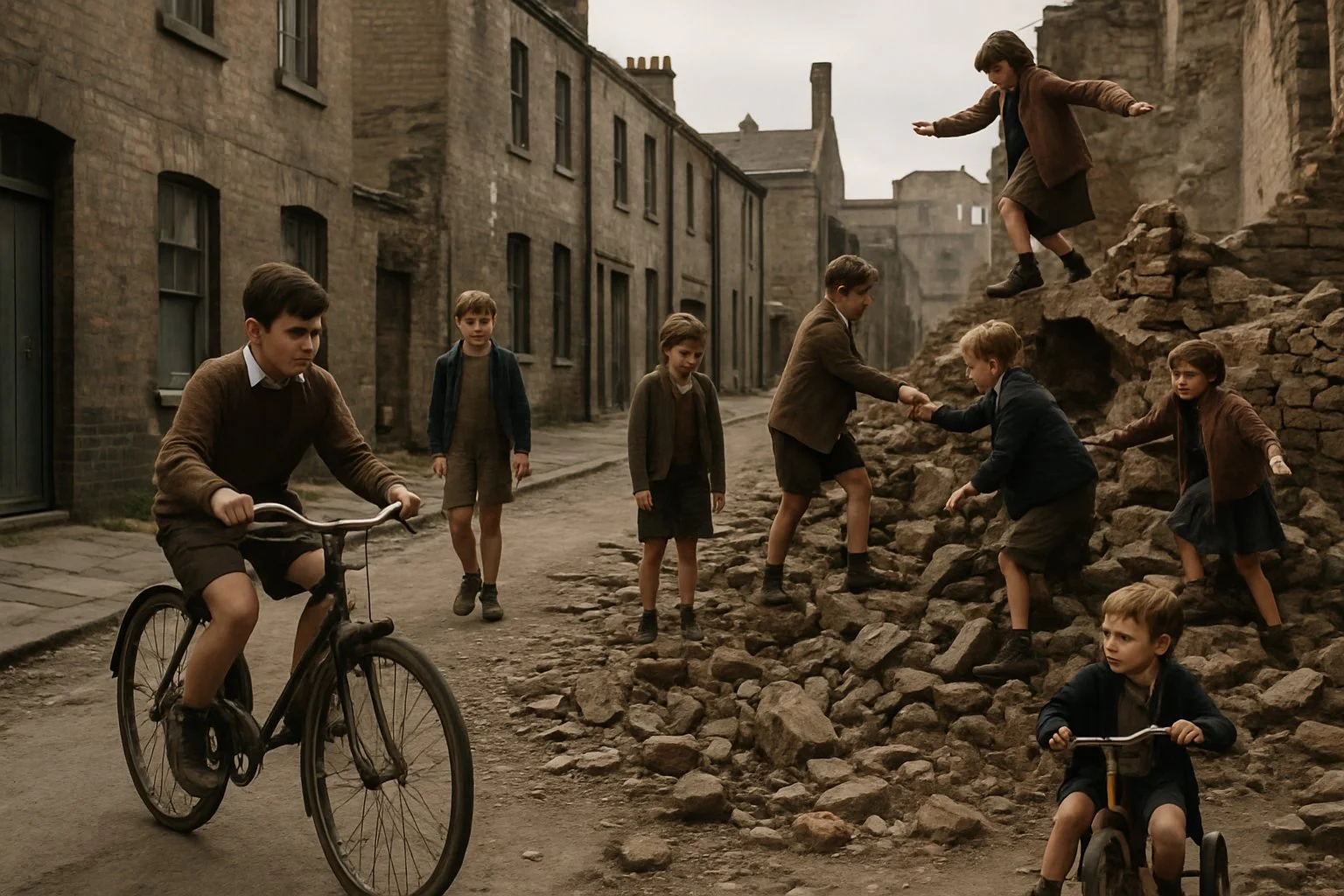
After the war, bombsites turned into wild adventure grounds. Kids found freedom to build, explore, and test their nerve. These ruined places sparked creativity, but the dangers were all too real and left a mark on everyone who grew up then.
Transforming Wartime Rubble into Play Spaces
All those bombsites scattered across Britain became more than just reminders of destruction. Kids saw possibility everywhere. Piles of bricks and twisted metal became castles, forts, or whatever you could dream up.
The rubble was raw material for imagination. Sometimes you’d see a makeshift slide built from a broken slab, or obstacle courses winding through shattered foundations.
Traditional playgrounds had nothing on this. Here, you could move things around and reinvent the place every day.
The landscape shifted constantly—weather, other kids, and time kept things unpredictable. No two days were quite the same.
Favourite bombsite adventures:
- Climbing broken walls
- Riding bikes over rough patches
- Building dens from whatever you could find
- Playing war games in the ruins
- Collecting strange bits and pieces
Building Dens and Creative Games
Den-building was king. If you found some broken wood, a sheet of corrugated iron, and a few bricks, you could build a secret base. Sometimes it was a hideout, sometimes a club HQ.
Kids got pretty handy at construction. Balancing wobbly boards, figuring out how to keep the rain out—trial and error taught you a lot.
War games were everywhere. The setting made everything feel real. Kids would act out stories they’d heard from older siblings or even invent their own.
Some kids cleared patches of bombsite and tried their hand at growing vegetables. They’d sell spuds or beans to neighbours, turning play into a kind of business.
The freedom to build—and knock down—taught you to solve problems on the fly. There’s nothing quite like learning physics by stacking bricks that could fall on your toes.
Dangers and Accidents Amongst the Ruins
Let’s be honest: these places were risky. Bombsites hid unexploded shells, unstable walls, and sharp metal everywhere.
Cuts and scrapes happened all the time. Rusty nails and jagged glass meant tetanus was a real worry.
Walls collapsed without warning. Kids fell, broke bones, got trapped. Sometimes there were gas leaks or weird chemicals left over from the war. A few kids got seriously sick from poking around where they shouldn’t.
Fires were another hazard. Someone would start a little blaze to keep warm or cook, and next thing you knew, the flames were out of control.
Typical injuries:
- Deep cuts needing stitches
- Broken arms or legs from falls
- Burns from fires or chemicals
- Eye injuries from flying bits
- Coughs from all the dust
Parental Attitudes and Community Supervision
Most parents, by today’s standards, seemed shockingly relaxed about all this. Many families squeezed into cramped flats, so parents were just glad the kids had somewhere to go—even if it was risky.
Older kids watched out for the little ones. Sometimes a nearby adult would wander over to check, but it was all pretty informal.
Some parents even encouraged bombsite play. They figured it toughened you up for whatever life threw your way.
Working-class families, especially, just accepted the risks. What else could you do? There weren’t many safe alternatives, and courage seemed as important as caution.
Parents who’d survived the Blitz themselves probably thought, “Well, it’s nothing compared to what we went through.”
Cycling Adventures and the Rise of Cycle Speedway
After the war, teenagers started turning bombsites into makeshift bike tracks, kicking off a cycling craze that swept through British cities. What started as kids racing for fun quickly grew into full-blown competitions, with clubs, homemade bikes, and a whole new youth culture.
From Makeshift Tracks to National Passion
Teens found bombsites perfect for racing. Those open, flat spaces meant you could pedal as fast as you liked, with no adults telling you to slow down.
They copied motorcycle speedway—racing around oval tracks made from whatever debris was handy. Bikes had no brakes or gears, just pure pedal power.
By 1949, tens of thousands of kids were racing. The BBC even broadcast some of the bigger races.
Newspapers like the Daily Mail and News of the World started reporting results. Even the Duke of Edinburgh supposedly became a fan.
The craze spread fast. London led the way, but soon Portsmouth, Birmingham, Newcastle, Glasgow, and Cardiff all had their own teams and tracks.
Formation of Local Bike Clubs and Races
Bike clubs sprang up wherever there was a bit of bombed-out land. East London alone had hundreds by the late ‘40s.
Teams picked wild names—the Walthamstow Wolves, Tottenham Kangaroos, Stratford Hammers. Each club had its own colours and homemade bibs.
Races between different neighbourhoods became a big deal. Some teams everyone talked about:
- Warwick Lions (Hackney)
- Beckton Aces
- Portway Penguins
- Bermondsey Greyhounds
By 1950, England raced the Netherlands in front of 10,000 spectators at Empress Hall in Earls Court.
The National Amateur Cycle Speedway Association popped up in the early ‘50s, bringing official rules and city-vs-city competitions.
Homemade Bicycles and Gear Innovations
Nobody had much money, so kids built bikes from whatever they could scrounge. Old frames, mismatched wheels, bits of gas piping for handlebars—if it worked, it raced.
Bike tweaks:
- No brakes or gears (more daring, less to break)
- Tall handlebars from gas pipes
- Frames bought for a handful of shillings
- Wheels from any bike you could find
Helmets were battered, jackets were leather, and club bibs were stitched by hand.
Bikes looked rough but did the job. Fixing them up turned a lot of kids into decent mechanics.
Parents didn’t mind the DIY approach. With rationing still on, you had to make do, and a bit of ingenuity was almost a badge of honour.
Influence of Cycle Speedway on Youth Culture
Cycle speedway gave teenagers their own scene—something that was just for them, away from parents and teachers.
Racing meant exercise, excitement, and a taste of independence. Bombsites became places where kids could let loose, away from adult rules.
What kids got out of it:
- Team spirit
- Learning to fix bikes
- Leadership (someone had to organise the club)
- Local fame for the best riders
Crowds of thousands turned up for big races. Girls came to cheer, and top riders became minor celebrities.
Some adults grumbled. Churches didn’t like Sunday races, and councils sometimes bulldozed tracks after neighbours complained about noise.
But plenty of grown-ups defended the sport, saying it kept kids out of trouble and taught them real skills.
Urban Parks: Green Havens in a Grey City
In those bleak, grey streets, parks felt like a breath of fresh air. We’d escape to climb trees, chase birds, or just run wild on grass instead of pavement. Parks weren’t just a place to play—they were where the whole community came together, sharing a bit of green in a world still marked by war.
Classic Park Activities for Young Explorers
Local parks held endless possibilities. Climbing trees was the ultimate test—nothing beat the feeling of swinging up into the branches of a big old oak or chestnut.
Hide-and-seek kept us busy for hours. Those thick rhododendron bushes and tangled hedges made perfect hiding spots.
Most parks had the basics:
- Wooden see-saws
- Metal swings (hard on the backside, but we didn’t care)
- Simple roundabouts you pushed yourself
We’d play cricket with whatever we could find, kick a football until dusk, and organise rounders when enough kids showed up.
Pond dipping was a real treat. Armed with jam jars on strings, we’d fish for tadpoles, beetles, even the odd newt. Those murky ponds were our own little worlds.
And every autumn, collecting conkers turned the park into a treasure hunt. The best horse chestnuts got drilled and strung up for legendary conker battles back home.
Nature, Wildlife, and Social Gatherings
Parks were our first real taste of nature, a world away from the city’s endless concrete. Bird watching became a favorite pastime—robins, blackbirds, and sparrows turned into old friends we’d spot again and again.
Every season brought something new to the park. Crocuses poked through the last bits of winter, autumn meant pockets full of crunchy leaves, and winter? That was for snowmen, scarves, and breath hanging in the air.
Community events were a big deal:
- Summer fêtes with coconut shies and cake stalls
- Bonfire Night with fireworks lighting up the cold sky
- Cricket matches that drew whole neighborhoods
Family picnics on lazy Sundays are hard to forget. We’d toss down threadbare blankets, mothers would dig out sandwiches, and fathers—well, they’d disappear behind their newspapers.
Walking the dog, you’d meet every pet and owner in the area. Parks turned into these little social crossroads where conversations just happened, no effort needed.
Wildlife encounters were pure magic. Squirrels darted up trees, hedgehogs rustled in the undergrowth, and there was always some new bug to chase or inspect. For young city kids, it was a whole world to discover.
The Role of Parks in Physical Wellbeing
We got our exercise just by being outside, before anyone ever talked about “organized sports.” Running wild across the grass—stamina and coordination just sort of happened.
Tree climbing was our own secret gym. It built up our arms and balance, but honestly, it just felt like fun.
Terraced houses didn’t leave much room for noisy games. The park let us run, shout, and play without worrying about breaking anything or annoying the neighbors.
Parents just knew—maybe from their own childhoods—that fresh air and sunlight mattered. Time outdoors wasn’t optional; it was part of growing up.
We’d spend hours:
- Skipping with ropes that somehow lasted all summer
- Football against battered park walls
- Racing down winding paths, daring each other to go faster
Parks gave us space to breathe, to escape cramped houses and the pressures of school. Looking back, I think that mattered as much as the physical stuff.
Seasonal sports rotated through the year. Sledging in winter, swimming in outdoor lidos when the sun finally showed up—there was always something to do.
Adventure Playgrounds and the Shaping of Modern Play
Adventure playgrounds sprang up from the rubble after WWII, turning bombed-out lots into wild places where kids could build, invent, and take chances. These places really shifted how we think about play and childhood, and honestly, their influence lingers even now.
The Origins and Ethos of Adventure Playgrounds
Marie Paneth dreamed up the idea in 1944: let kids build huts and grow veggies on London’s bombsites. It was simple, but radical.
The real spark came in 1946. Lady Allen of Hurtwood visited the Emdrup junk playground in Denmark and saw kids using scrap to make dens and forts.
She wrote about what she saw in Picture Post, wondering, “Why Not Use Our Bombsites Like This?”
The main ideas were:
- Kids ran the show—adults mostly watched from the sidelines
- Risk was part of the adventure
- Real tools, real materials, real mess
By 1948, Britain’s first “junk playground” opened on a bombed church site in Camberwell. The name changed to “adventure playground” a few years later, and soon Liverpool, Bristol, and London had their own.
These places welcomed kids who didn’t fit in elsewhere. The playworker became a new kind of adult—there to help, but only if you wanted them.
Lollard Adventure Playground: A Case Study
Lollard Adventure Playground opened in Lambeth in 1955. Kids from age two up to young adults—some who’d already started working—came to play after hours.
The rules were pretty much: do what you want. Light fires, climb walls, build whatever you could dream up. Kids figured out risk for themselves.
A typical day might mean:
- Hammering together scrap wood
- Building dens or secret hideouts
- Growing a few carrots or beans
- Staging a play or a puppet show
- Cooking over an open fire (sometimes burning the sausages)
Playworkers learned by watching the kids, not from any manual. Their job was to keep things ticking along, not to run the show.
The playground only lasted until 1960, but in those five years it proved that kids could turn rubble into something special.
For working-class families, these places were a lifeline. Safe outdoor space was rare in bombed-out neighborhoods.
From Risky Sites to Constructive Spaces
Adventure playgrounds took dangerous lots and made them the heart of the community. Before that, kids played in rubble and risked injury—or trouble with the police.
The 1960s and ’70s were the heyday for these wild, experimental spaces. Adventure playgrounds existed alongside city farms and even play buses.
Turns out, risky play actually helps kids grow:
- Physical confidence
- Judgment and risk assessment
- Problem-solving with friends
- Emotional grit
Modern playgrounds, with their plastic slides and rubber mats, feel safer but don’t really challenge older kids. Since the ’80s, councils have stuck to the “safe” option.
A few adventure playgrounds are still hanging on—Bristol’s got four, London a handful more—but they’re always fighting for funding.
Sometimes I wonder: why not use empty city shops for this kind of play? It worked with bombsites once; maybe it could again.
The Lasting Impact of 1950s Urban Play on Children’s Development
That whole make-do-and-mend spirit on 1950s streets gave us something we didn’t even realize at the time. It shaped us in ways we’re only just starting to appreciate.
Developing Resourcefulness and Independence
Kids back then made their own fun out of whatever they found. Rubble became castles, broken wood turned into swords or shields.
Having to improvise all the time taught us problem-solving in a way store-bought toys never could. If we hit a snag, we figured it out ourselves—asking an adult was the last resort.
We picked up skills like:
- Crafting toys from scraps
- Building dens in odd corners
- Inventing games with whatever was at hand
- Sharing when supplies ran short
We managed our own time, settled our own squabbles, and made our own rules. No one organized us; we just got on with it.
That independence stuck. Most of us carried those habits into adulthood, facing new challenges with the same mix of creativity and stubbornness.
Promoting Physical Activity and Exercise
Play on the streets meant you were always moving. Climbing, running, exploring—every day was a workout.
You’d see kids:
- Scrambling over bomb debris and half-built sites
- Racing each other through alleys
- Riding battered bikes cobbled together from spare parts
- Playing tag or chase until someone called you in for tea
All that activity built up our bodies naturally. Coordination, balance, muscle—nobody thought about it, but it happened just the same.
Navigating those rough city landscapes taught us to judge risk, too. We learned what was safe to climb and when to back off.
Unlike today’s scheduled sports, this exercise just happened. It was as much a part of daily life as breathing, woven into every adventure and shortcut home.
Influencing Future Approaches to Play
The street play scenes of the 1950s—kids dashing between cars, chalking hopscotch, or cobbling together forts from whatever they could find—left a mark that’s hard to overstate. Those memories nudged adventure playgrounds in a new direction as the years rolled on. Planners started to see, maybe a little reluctantly at first, just how much kids gained from making their own fun.
Adventure playground principles that emerged:
- Kids figuring things out on their own, mistakes and all
- Grown-ups hanging back, only stepping in when really needed
- Scraps, planks, and whatever nature offered becoming playthings
- Letting kids take on challenges that felt just risky enough
In the 1960s and 70s, playworkers wandered through old bombsites, watching children band together and invent whole worlds from rubble. They realized that when you gave kids space to roam and tools to tinker, they didn’t just play—they flourished.
This way of thinking tossed out the old rulebook of playgrounds with their stiff rows of swings and slides. Instead, it invited kids to shape their own territory, to build and break and start again, sometimes all in an afternoon.
Honestly, the spirit of those raucous, self-made games from the 1950s still lingers. It keeps nudging educators and designers to trust kids with a little more freedom, especially when it comes to learning and playing outside.




Leave a Reply