
The 1950s playground was alive with the sound of spinning yo-yos and the gentle scrape of stones on hopscotch squares. Before television really took over, we spent hours outdoors inventing our own fun with games that cost little more than a few coins.
These affordable toys and chalk-drawn games became the heart of playground culture, bringing together children from all backgrounds for hours of active fun.
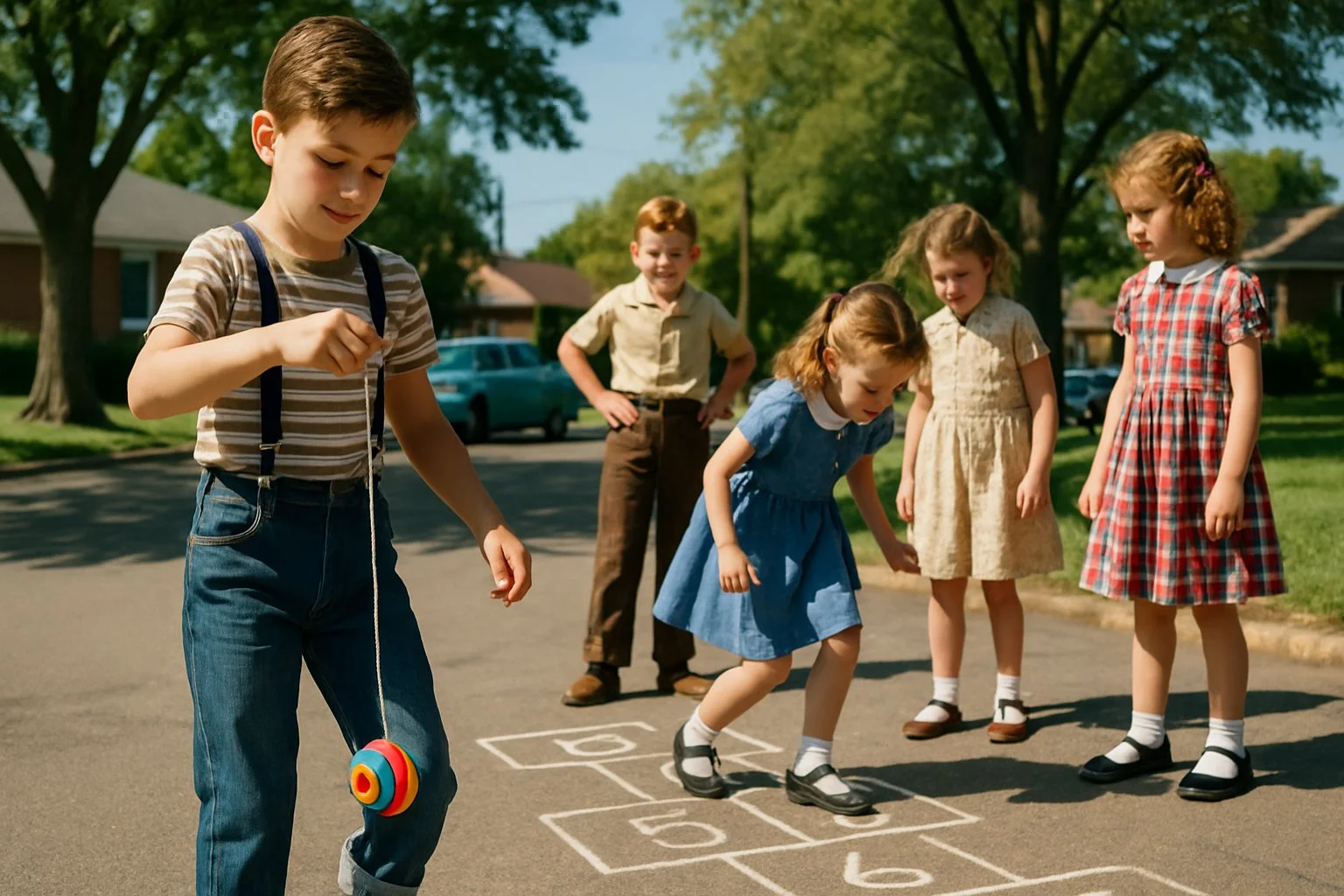
Sometimes I wonder if kids today realize just how inventive we had to be without screens at our fingertips. The playground was our world, and the rulers were those who could keep their yo-yo spinning the longest or hop through hopscotch without toppling over. These games were more than just ways to pass the time—they taught us a thing or two about patience, friendship, and, well, picking ourselves up when we fell.
That feeling of a wooden yo-yo in your hand or the careful aim for hopscotch—those little moments stitched together a whole era of childhood. Let’s wander back and see how these simple pleasures took over our playgrounds, and maybe remember a few other games that made the 1950s such a golden age for outdoor play.
The Magic of Pocket-Money Games in the 1950s
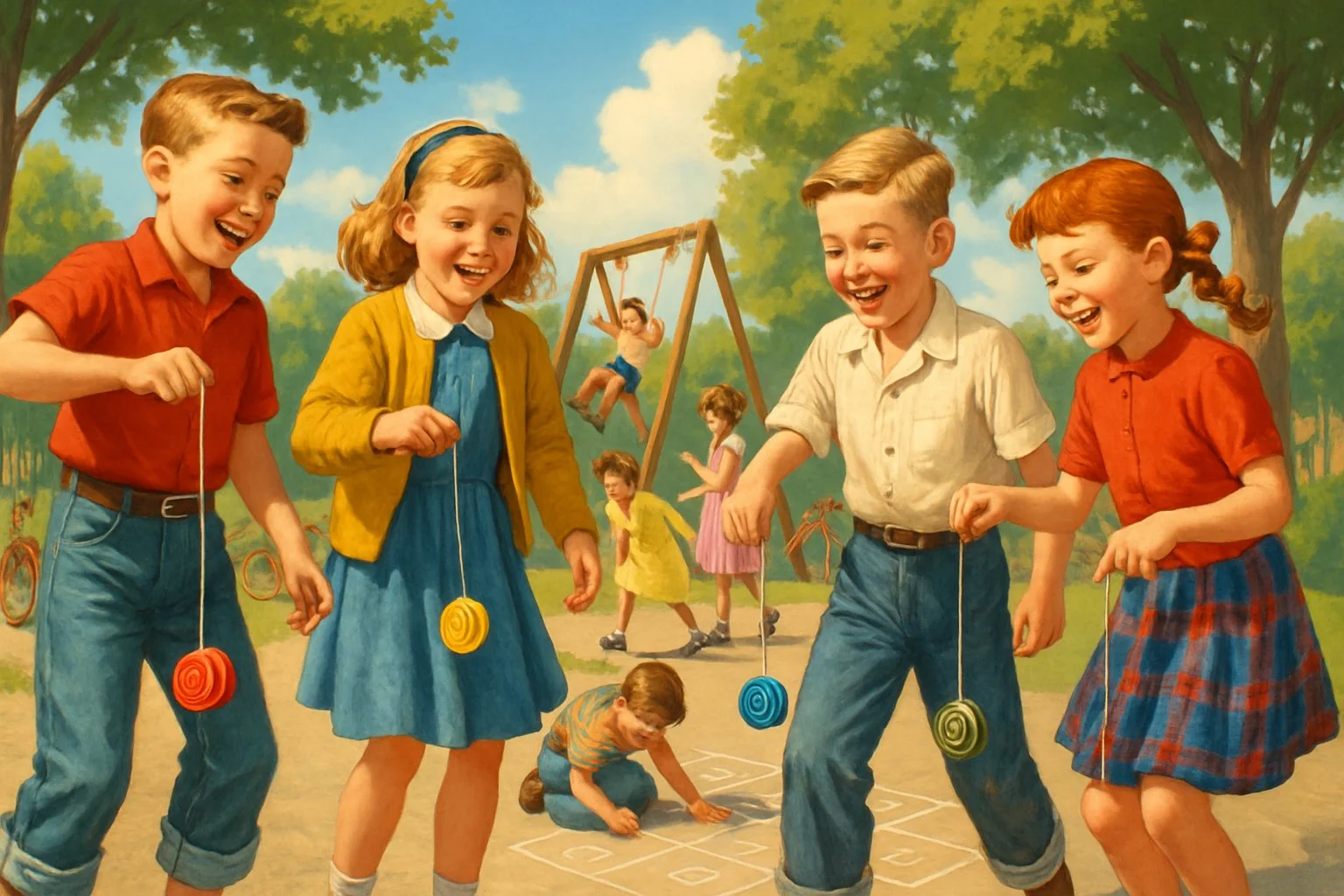
Pocket-money games really changed the way we played in the 1950s. They were cheap, easy to share, and somehow managed to turn a ragtag bunch of kids into a community—at least for the afternoon.
What Made Pocket-Money Games So Popular
Honestly, the price tag was everything. Most games cost just a few pence or shillings.
A yo-yo? Maybe sixpence. Marbles? A penny each. Chalk for hopscotch was almost always free.
Parents, still watching every penny after the war, loved these cheap options. Many families were still counting coins every week.
We could buy games with our own pocket money. Most of us got somewhere between sixpence and two shillings a week.
The rules were simple enough that anyone could jump in. Newcomers learned hopscotch in a flash. Yo-yo tricks took time, but just getting the thing to go up and down was easy.
No batteries, no complicated parts—just unwrap and play. A yo-yo was ready right from the shop. Hopscotch needed only chalk and a stone, nothing fancy.
And these things lasted. A good yo-yo could stick around for years. Marbles survived everything but the worst concrete drops.
Typical Playground Settings and Social Rituals
School playgrounds buzzed with activity, especially during breaks. We’d break off into little groups, each with its own game.
Hopscotch courts usually sat near the main building, and, if I’m honest, girls ruled those courts at lunchtime.
Boys staked out patches for marbles, drawing circles in the dirt or finding a smooth spot of concrete.
Yo-yo competitions? Those could break out anywhere. We’d show off tricks against the wall, always hoping someone was watching.
Trading was a big deal. We swapped marbles—especially those rare glass ones that somehow felt magical.
Game hierarchies just happened. The top yo-yo player would show the rest of us new tricks, and hopscotch champs set the rules.
Games changed with the seasons. Yo-yos were big in autumn; hopscotch would take over again in spring.
We even had little informal clubs for our favourite games. Those groups sometimes lasted a whole term, or at least until the next craze.
How Children Saved and Spent Their Pocket Money
Weekly allowances really depended on your family. Some kids got threepence, others as much as half a crown.
We had to budget, and it wasn’t easy—sweets competed hard with games for our coins.
Saving meant jam jars full of coins, counted and recounted almost every day.
Trips to the toy shop were a big event. We’d pore over every yo-yo and marble set, comparing and dreaming.
Sometimes we’d pool our money for something fancier, like a “professional” yo-yo.
Earning extra was common, too. We swept paths or helped with dishes to earn a few extra pennies.
Choosing what to buy took serious thought. A new yo-yo might mean skipping sweets for weeks.
Some kids just bartered instead. Trading old toys for new games with friends was almost a game in itself.
Yo-Yos: The Spinning Craze of a Generation
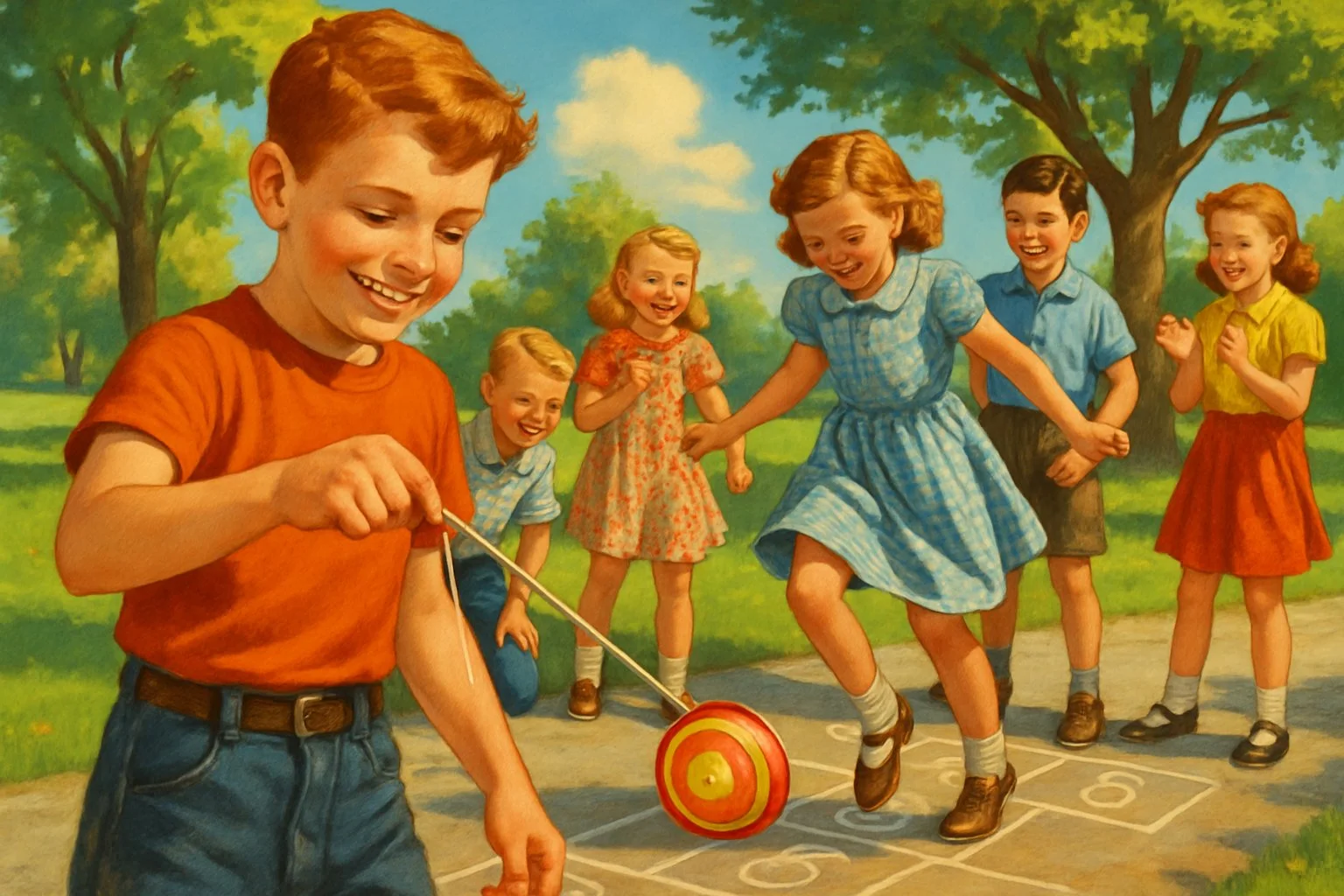
The yo-yo was the pocket-money king in the 1950s, turning playgrounds into makeshift arenas for spinning showdowns. From plain wooden disks to fancier plastic versions, these little toys fired up our imaginations and, honestly, made us feel like superstars.
Origins and Rise of Yo-Yos on British Playgrounds
We first spotted yo-yos in Britain sometime after the late ’40s. Their roots go back to the Philippines, where Pedro Flores made them famous in the 1920s.
Duncan Toys got the ball rolling in America, and then the craze hopped across the pond.
British toy shops quickly filled their shelves with yo-yos. You could pick up a basic wooden one for just a few pence.
Popular Early Brands:
- Duncan Imperial
- Festival yo-yos
- Local British makes
The playground became our training ground. Groups would form, tricks were shown off, and everyone tried to out-spin the next kid.
Teachers didn’t love them at first. All that spinning and dropping made a racket. But we always found a way to sneak in some practice during breaks or dinner time.
By 1952, it felt like every kid had at least one yo-yo. Cheap, simple, and just plain fun.
Classic Yo-Yo Tricks and Competitions
We started with the basics before moving on to the fancy stuff. “The sleeper” was usually first—getting the yo-yo to spin at the end of the string.
Essential 1950s Yo-Yo Tricks:
- Walk the Dog
- Around the World
- Rock the Baby
- Loop the Loop
- The Sleeper
“Walk the Dog” meant rolling the spinning yo-yo along the ground. We practiced on playground tarmac, and, let’s be honest, sometimes in the classroom when no one was looking.
School competitions popped up everywhere. We’d compete for longest sleeper, most loops, or best new trick.
The real pros could do “Around the World”—swinging the yo-yo in a big circle overhead. You needed perfect timing and a strong string for that one.
Regional competitions started showing up, too. Winners might get a new yo-yo or a bit of cash, which felt like a fortune.
Materials, Styles, and Collecting Yo-Yos
We mostly started with wooden yo-yos, but soon enough, plastic ones appeared. Wood felt classic, but plastic came in wild colours and spun a bit smoother.
Common 1950s Materials:
- Wood: Beech, maple, birch
- Plastic: Early Bakelite and celluloid
- String: Cotton twisted cord
Collecting different styles became a thing. Some had hand-painted designs or company logos.
Later in the decade, Coca-Cola promotional yo-yos arrived, and those were like playground gold—everyone wanted one.
We learned to look after our yo-yos. Changing strings, cleaning the axle—it mattered if you wanted to keep spinning.
The fanciest models cost up to five shillings, which was a big chunk of pocket money. But if you took care of it, a good yo-yo could last ages.
Some of us still have our old yo-yos tucked away somewhere, a reminder of all those afternoons spent chasing the perfect spin.
Hopscotch: The Chalked-Out Champion
Hopscotch ruled the playground with nothing more than a bit of chalk and a stone. It built up our balance and counting, sure, but it also gave us a place to meet, compete, and cheer each other on.
Rules and Variations of Hopscotch
The rules were easy, which was part of the charm. Draw your squares—usually 8 to 10—on the pavement with chalk.
Each player needed a small stone or marker. The first toss landed in square one, then you’d hop through the course on one foot for single squares, two feet for doubles.
Key Rules:
- Marker had to land inside the target square
- No stepping on lines or losing your balance
- Players retrieved their marker while hopping back
- Turn ended if you broke a rule
We mixed it up with different versions. Some kids kicked the marker along with their hopping foot. Others raced the clock—30 or 60 seconds to finish.
“Ownership” was a favourite with older kids. If you finished a sequence, you wrote your initials in that square. Other players had to skip those on their turn.
Courts varied, too. Some were all squares, others had circles or even diamonds.
Physical and Social Benefits for Children
Hopscotch was sneaky exercise. All that hopping built up our balance and coordination without us even noticing.
Leg muscles grew stronger, and we got better at aiming that stone. The throwing part helped our hand-eye coordination, too.
Physical Benefits:
- Balance and coordination from hopping
- Leg strength from jumping
- Hand-eye coordination from tossing the marker
- Gross motor skills—even if we didn’t know the term back then
Socially, hopscotch was a great equalizer. We took turns, learned to win and lose with a smile, and older kids often helped the younger ones.
You didn’t need to be rich. Chalk and a stone were all it took, so everyone could play.
Competition was friendly. We cheered each other on, and even the best players offered tips.
The Enduring Appeal of Hopscotch Today
Modern playgrounds still have hopscotch courts—these days painted right onto the tarmac. Schools know the game helps with maths and movement, so it keeps popping up.
Hopscotch’s simplicity is its secret weapon. No tricky rules, no fancy gear—just jump in and play.
Why Hopscotch Endures:
- Needs only chalk and a stone
- Blends learning and movement
- Works for all ages
- Good for solo or group play
Turns out, research backs up what we always felt—hopscotch is great for both your body and your brain. Teachers use it in gym and maths lessons now.
You can play indoors, too. Mats with printed courts mean rain can’t stop the fun.
Even with all the gadgets and screens, hopscotch hangs on. There’s just something about hopping from square to square, counting out loud, that never gets old.
That simple mix of challenge and fun keeps hopscotch alive. Kids still draw courts and start that familiar hop—just like we did, and probably always will.
Other Beloved 1950s Playground Games
Besides yo-yos and hopscotch, three games really shaped our playground days: skipping rope with its sing-song rhymes, conkers with their autumn battles, and marbles in all their colourful glory.
Skipping Rope Rhymes and Group Skipping
Skipping ropes were everywhere. Most of us had one tucked away in a pocket or bag.
Solo skipping was great for practicing at home—counting jumps, trying to beat your own record.
But the real magic was in group skipping. Two kids turned a long rope, and the rest of us lined up to jump in, hoping not to trip.
The rhymes made it special. We’d chant:
- “Teddy bear, teddy bear, turn around”
- “Salt, mustard, vinegar, pepper”
- “I like coffee, I like tea”
Each rhyme came with its own moves, and when someone called “pepper,” the rope would whip around faster and faster.
Double Dutch was the big challenge—two ropes, opposite directions. Only the bravest (or most coordinated) dared try.
Girls usually led the skipping games, but a few boys would join in. The playground rang with our voices and the snap of ropes.
Conkers: A Classic Autumn Challenge
Autumn meant conkers, plain and simple. We’d race to collect the shiniest horse chestnuts under the trees.
We’d poke holes through them with knitting needles, thread a string, and tie a knot.
The rules were simple. One person held their conker out, the other tried to smash it. Take turns until one cracked.
Some of us took prepping conkers very seriously—soaking them in vinegar, baking them, anything to make them tougher.
We kept score. A conker that beat three others became a “three-er.” The really good ones became legends.
Safety? Hardly crossed our minds. Sometimes you’d miss and whack your own knuckles—ouch.
Schools eventually banned conkers, but back then, they were autumn’s ultimate prize. Nothing beat the sound of a good, solid hit.
Marbles and Their Many Play Styles
Our marble collections felt like treasure. We’d stash them in little cloth bags, running our fingers over the glass and admiring the swirls of color.
There were two main ways to play: “keeps” and “friendlies.” In keeps, you got to win marbles off your mates. Friendlies meant everyone just took their own back home.
The big favorite was always ring marbles. We’d scratch a circle into the dirt, pile a bunch of marbles inside, and take turns flicking our “shooters” to try and knock them out.
| Marble Type | Description | Value |
|---|---|---|
| Cat’s eye | Clear with coloured stripe | Common |
| Steely | Metal ball bearing | Rare |
| Boulder | Large marble | Special |
Technique really mattered. We’d crouch low, thumb against forefinger, and send the marble shooting. Some kids could aim so well it was almost scary.
Break times turned into marble tournaments. The best players walked away with heavier bags and a bit of playground fame.
Marbles were as good as money. You could swap a shiny steely for a handful of regular ones. The prettiest marbles? Most of us wouldn’t dare risk those in a match.
Sports and Team Play on the Schoolyard
The 1950s playground buzzed with games that pulled everyone together. Football matches sprang up in every spare patch of grass, and the basketball hoops always drew a crowd.
Football in Every Corner
Back then, you could find a football match just about anywhere on the school grounds. We didn’t need real goalposts—just a couple of jumpers would do.
Popular football variations included:
- Wall football – using the school building as one goal
- Three-and-in – swap goalies after three goals
- Headers and volleys – all about skill shots
We organized our own games, letting anyone join in. Older kids usually showed the younger ones the ropes.
Teams formed on the fly during break. The same groups often faced off day after day. Those matches built friendships that lasted way beyond the bell.
Hoops and Group Challenges
Basketball hoops nailed to the wall became hangouts for all sorts of games. “21” was a big one—each player tried to hit exactly 21 points, and the tension always ran high.
Around the World had us taking shots from all over. Miss, and you’d have to start again—talk about nerve-wracking.
We played Horse too. One kid made a shot, the rest tried to copy it. Mess up, you got a letter. Spell “HORSE” and you were out.
Sometimes, classes squared off in shooting contests during longer breaks. Even teachers would join in, which made the whole thing feel extra special.
Board and Card Games for Rainy Days
When the weather kept us indoors, families huddled around board games like Monopoly or Snakes and Ladders. Card games like Happy Families filled rainy afternoons, and construction sets like Meccano or those new Lego bricks kept our hands busy. Paper-and-pencil games rounded things out.
Family Favourites: Monopoly, Snakes and Ladders, and More
Monopoly pretty much ruled the kitchen table. We’d argue over who got to be the top hat, and the game always seemed to last forever. It taught us a bit about money—and a lot about patience.
Snakes and Ladders was perfect for the little ones. No real strategy, just luck and a lot of giggling when someone slid down a snake.
Ludo brought everyone together. Up to four could play, racing their counters around the board. The rules were simple, but sending someone back to start always caused a bit of drama.
These games stuck around for years, ready to come out whenever the clouds rolled in.
Popular Card Games and Happy Families
Happy Families was the card game everyone seemed to have. We’d collect sets—Mr Bun the Baker, Mrs Dose the Doctor’s Wife—and try to outsmart each other. The bright pictures made it more fun than you might think.
Snap was pure chaos, just matching cards and shouting. Even the youngest could play.
Old Maid and Go Fish were classics too. They taught us a bit about bluffing and reading people. Card games were cheap, easy to pack away, and somehow never got old.
Parents joined in after tea sometimes, and those games felt like the best kind of family time.
Building with Meccano and Lego Indoors
Meccano sets were a dream. Metal strips, nuts, bolts—you could build anything if you had the patience. We’d follow the instructions for a while, then start inventing our own madcap machines.
Lego started showing up in shops in the late ’50s. Those plastic bricks were a revelation. Suddenly, you could build things that didn’t fall apart every time you moved them.
Both toys encouraged us to tinker, to puzzle things out, and to let our imaginations run wild. The best part? You could take everything apart and start again whenever you wanted.
Noughts and Crosses, Draughts, and Solo Puzzles
All you needed for Noughts and Crosses was a scrap of paper and a pencil. We’d play in the margins of notebooks or even draw grids in the dirt. Quick games meant endless rounds.
Draughts (or checkers, if you like) brought in some real strategy for older kids. Most families had a set, usually with a chess board on the other side.
Jigsaw puzzles could keep a kid busy for hours. We’d spread the pieces across the floor and slowly piece together country scenes or famous places.
Word searches and crosswords showed up in comics and annuals. They helped us stretch our brains a bit, especially on those long, grey afternoons.
Imaginative Outdoor Activities Inspired by Stories
Back then, a bit of open space was all we needed to turn the world into a stage for our favorite stories. Adventure books and radio shows fueled games that needed little more than imagination and maybe a few props.
Bows and Arrows and Pretend Adventures
We made our own bows from bendy branches and string, arrows from straight twigs with paper fletching. Homemade archery gear felt like essential kit.
Robin Hood tales sent us off into the garden or park, splitting into bands of Merry Men and Sheriff’s guards. Obstacle courses sprang up wherever we could find space.
We actually took safety pretty seriously. Arrows had cork tips, and we set up shooting zones. Nobody aimed at people—that was the golden rule.
Adventure stories from comics or radio kept the ideas coming. One day we were cowboys, the next knights or jungle explorers. Games could last for hours, the plots twisting and growing as we went.
Tree houses and dens became our castles and hideouts. We’d throw together old sheets, rope, and planks—each one had its own legend or secret reason for being built.
Influence of the Famous Five on Garden Games
Enid Blyton’s Famous Five books really changed the way we played detective outside. Suddenly, every garden shed felt like a hideout that needed a good snoop. We’d poke around, convinced there had to be a secret passage or a treasure map tucked away somewhere.
Mystery-solving activities took over our playgrounds. We spent ages scribbling out treasure hunts full of coded notes and riddles, racing to crack them before the other team did—just like Julian, Dick, Anne, and George might’ve.
Garden adventures always seemed to echo those countryside settings from the books. We’d throw together pretend picnics, then wander off into the nearest patch of woods or scramble over hills, determined to find some kind of adventure or at least invent one.
Secret clubs just sort of happened. We’d come up with passwords, pick out hidden spots for meetings, and try to invent the best handshake (not always successfully). Club rules? Of course—written in invisible ink made with lemon juice, naturally.
Those stories made us believe that ordinary places hid wild secrets. Even the dullest street felt different when you looked at it like a detective.




Leave a Reply