
After the war finally ended in 1945, British schools set about rebuilding—though, truth be told, they clung tightly to traditional teaching methods. Kids across the country learned to write with fountain pens, ink wells, and blotting paper, day in and day out.
The careful ritual of dipping those old quill pens and blotting away extra ink shaped the penmanship of a whole generation growing up in post-war Britain.
It’s funny, really, how these simple tools left such a mark on the way kids learned, especially during a time when everything else in Britain seemed to be changing.
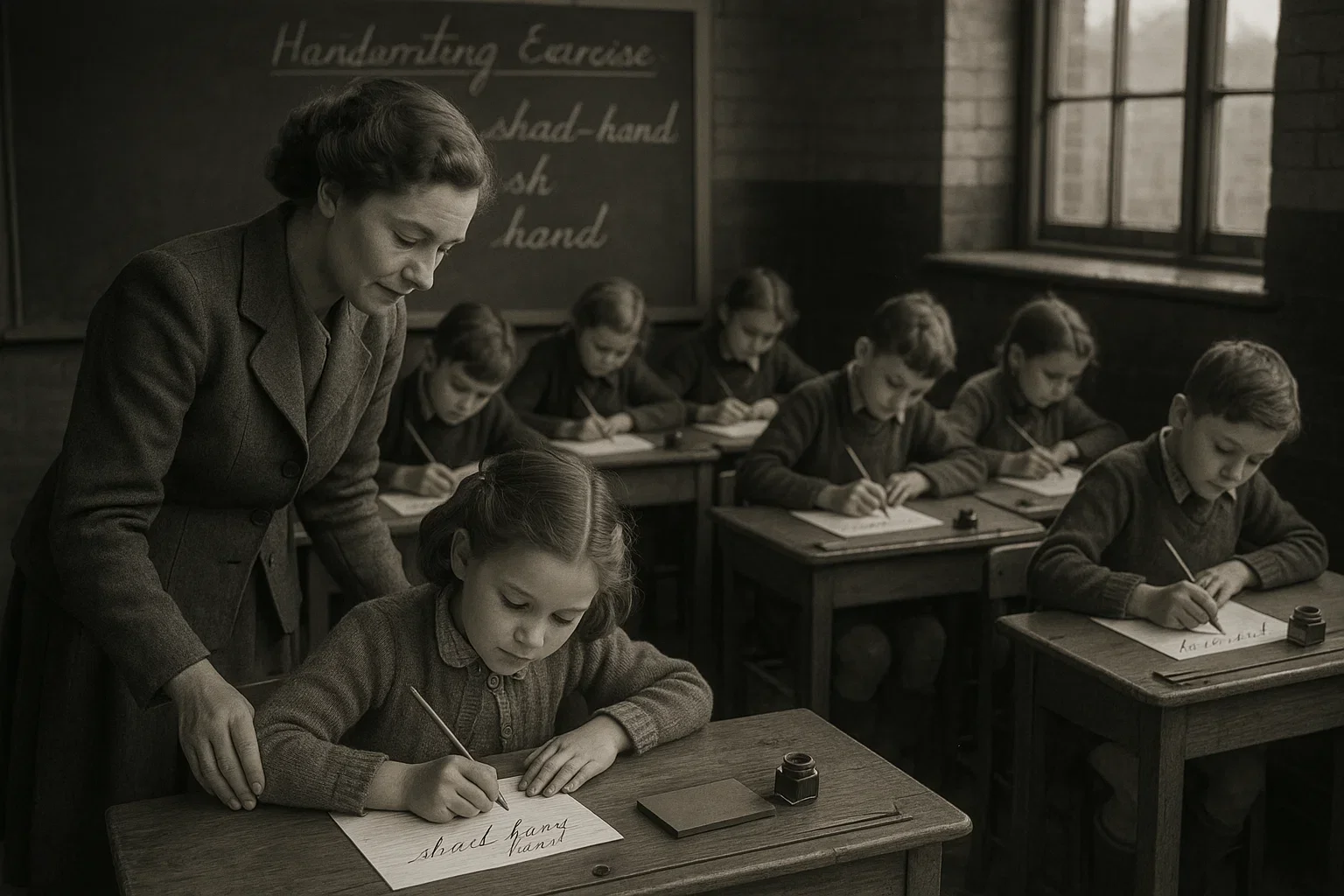
The world outside the classroom was shifting fast—society itself was in flux—but inside, teachers stuck to Victorian-era writing rituals. Kids drilled letter shapes over and over, using those time-honored implements, and the result? That unmistakable, disciplined handwriting we now associate with the post-war years.
Ink wells and blotters weren’t just classroom clutter—they were part of Britain’s tug-of-war between hanging on to old customs and inching toward something new.
Handwriting Lessons in Post-War Britain
Back then, handwriting lessons looked pretty different from what came later. Sure, ink wells and blotters were starting to fade out, but for a while, they dominated classrooms. The shift in methods reflected bigger changes in education—though, honestly, it often felt like tradition held the upper hand.
Everyday Classroom Practices
Picture a typical primary school: rows of battered wooden desks, each with a little round ink well set into the top. Every kid had a steel-nibbed pen, dipping it into a glass or ceramic pot of blue-black ink.
Teachers ran a tight ship during handwriting lessons. You’d start with basic strokes on lined paper while the teacher fussed about posture—straight back, feet flat, paper angled just so.
A typical handwriting session included:
- Warm-up strokes (those endless loops and lines)
- Practising individual letters
- Copying words from the board
- Dictation
Most kids learned the italic handwriting style—the one Alfred Fairbank championed. It had a certain elegance, with roots in Renaissance calligraphy, and teachers were big on letter joins and spacing.
Pen control took ages to master. That steel nib had a mind of its own, and even a little too much pressure meant ink splatters everywhere. Teachers seemed obsessed with neatness: even spacing, tidy joins, no smudges.
Role of Ink Wells and Blotters in Writing Instruction
Ink wells were everywhere in the 1940s and early ’50s. You had to dip just right—not too deep, not too shallow—or you’d end up with a soggy, blotted mess.
Blotting paper was a lifesaver. Usually pink or white, it soaked up puddles of ink before they smeared across your work. Kids carried little scraps of it, dabbing at their writing with a practiced hand.
Kids picked up a few key skills:
- Dipping the pen just enough
- Controlling ink flow
- Blotting gently, not scrubbing
Teachers kept a close eye on ink well hygiene. If the ink got murky, your writing suffered. The caretaker would come round once a week, topping up ink bottles—always a bit of a production.
Learning with ink wells demanded patience. Rushing meant torn pages, crossed-out words, and a stern look from the teacher. Over time, you learned to slow down, steady your hand, and take a bit of pride in the results.
Changes After the Second World War
The war itself sped up some changes. With paper shortages, schools became stingier about waste, and that shaped how teachers approached handwriting.
By the late ’40s, schools started introducing print script (“ball and stick”) for the little ones. It used simpler shapes, took less ink, and—thankfully—meant fewer blots.
Marion Richardson made waves with her child-centred approach. Instead of stiff, formal styles, she encouraged natural movements. Teachers liked her methods because, honestly, they cut down on the mess.
Some of the new approaches:
- Fountain pens made their way into some classrooms
- Pencils became common for beginners
- Letter shapes got simpler
- Teachers stopped pushing elaborate calligraphy
If you were in school around 1950, you probably swapped ink wells for a fountain pen at some point. Still, you kept a piece of blotting paper handy—fountain pens could leak just as easily.
All these tweaks reflected a bigger move toward making school a bit less rigid and a bit more forgiving.
Impact of Societal Change on Schooling

Britain after the war felt like it was turning upside down. Classrooms, once so uniform, started filling up with kids from all sorts of backgrounds. The 1944 Education Act shook up the entire system, and new arrivals from the Caribbean changed the very fabric of British schools.
Educational Reforms Post-World War Two
The 1944 Education Act was a real game-changer. Suddenly, secondary education was free for everyone, and the system split into grammar, technical, and secondary modern schools.
The dreaded 11-plus exam decided your fate at age eleven. If you aced it, off you went to grammar school. Most kids, though, landed in secondary moderns—often with fewer resources and fewer chances for advancement.
Big changes from the Act:
- School leaving age bumped up to 15
- Free meals for families who needed them
- Health checks at school
- Mandatory religious education
The system was supposed to match kids to their strengths, but, let’s be honest, it often just reinforced class lines. Middle-class kids had a smoother path to grammar schools, while working-class kids were left with fewer options.
Arrival of the Windrush Generation in British Schools
When the Empire Windrush docked in 1948, it brought hundreds of Caribbean families who would soon reshape British classrooms.
Caribbean kids arrived with strong educational backgrounds, often from church schools that held high standards. But British schools didn’t always know what to do with them.
Common hurdles:
- Gaps between curriculums
- Teachers struggling with new accents
- Cultural mismatches in teaching
- Little to no training for teachers on diversity
Teachers sometimes misunderstood Caribbean English and, unfairly, put bright kids in lower groups. Caribbean families placed a high value on education—sometimes more than local families—and got frustrated when schools didn’t recognize their children’s abilities.
Classroom Diversity and Inclusion
By the ’50s and ’60s, classrooms looked a lot more mixed. For some, it was the first time learning alongside kids from different backgrounds.
Most teachers had little preparation for this new diversity. Old textbooks still showed only white British families, leaving many kids feeling invisible.
Change came slowly—some schools started celebrating new festivals, and a few teachers made the effort to learn about Caribbean culture. Still, progress was patchy:
- Urban schools moved faster than rural ones
- Some teachers embraced change, others didn’t
- Parental involvement varied widely
Handwriting lessons, though? Those barely changed. No matter where you were from, you sat at the same desk, dipped your pen in the same ink well, and learned the same copperplate script.
Cultural Shifts and Everyday Life
Life at home was changing just as much as life at school, and the old ways of writing and learning started to fade as new technology crept in.
Family Life After the War
Your family life after 1945 probably felt a bit upside down. Fathers came back from the war to find their kids had grown up fast.
Mothers who’d spent the war in munitions factories often went back to being homemakers. That changed the way families saw education—suddenly, it became the key to getting ahead.
Family priorities shifted:
- Education became the ticket to a better life
- Parents splurged on decent writing supplies
- Kitchen table handwriting practice became a nightly ritual
- Fountain pens were treasured gifts
Don’t forget, rationing lingered until 1954. Paper and ink weren’t to be wasted. Every scrap mattered.
Parents taught kids to be careful with ink wells—spilling meant wasting money no one had to spare.
Many families moved out of bombed cities to new estates. Suddenly, you had better lighting for homework and maybe even your own desk. It wasn’t fancy, but it felt like a fresh start.
Technological Advances in Stationery
Back in the 1950s, your classroom started to welcome a few unfamiliar writing tools. Ballpoint pens, for instance, made their way over from America, even though most teachers stubbornly clung to the old ways.
Traditional vs. new writing tools:
| Traditional | New Technology |
|---|---|
| Fountain pens | Ballpoint pens |
| Glass ink wells | Cartridge pens |
| Blotting paper | Quick-dry ink |
| Steel nibs | Plastic components |
Schools switched out those fragile ceramic ink wells for sturdy plastic ones—they just lasted longer and didn’t break the budget as easily.
Most teachers wouldn’t let you near a ballpoint until you’d proven yourself with a fountain pen. Ballpoints seemed like a shortcut, almost like you were dodging the hard work.
Blotting paper got a bit of a facelift too. The newer stuff soaked up ink faster, sparing you from those dreaded smudges during big exams.
Paper finally bounced back after the war years. Exercise books turned crisp and white again, and handwriting practice didn’t feel quite so punishing. Funny how a clean sheet could make you want to try just a little harder.






Leave a Reply