
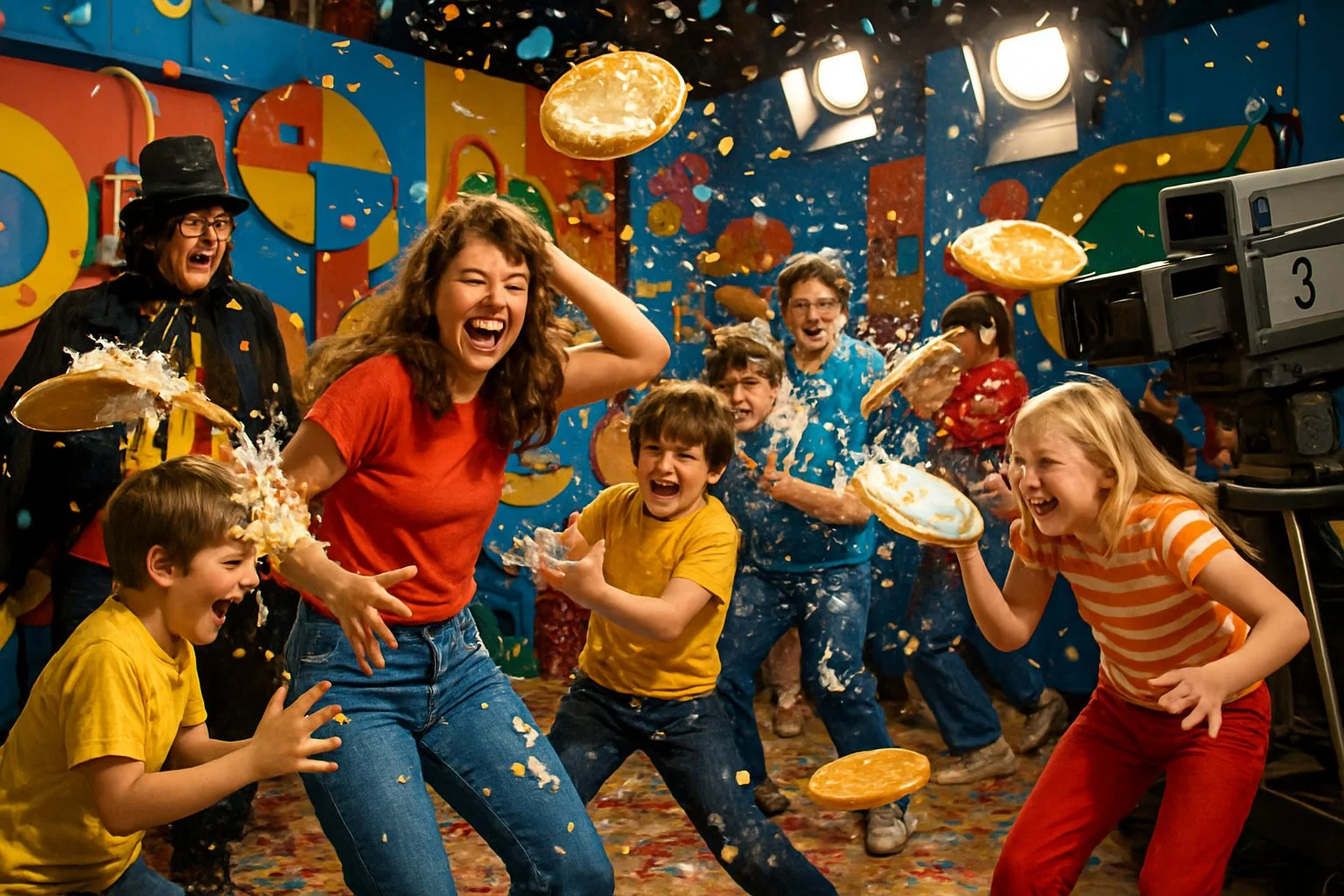
Saturday mornings in the 1970s and early 1980s meant one thing for kids across Britain: pure, chaotic television that ignored every rule in the book. Tiswas crashed onto ITV from 1974 to 1982, and honestly, it’s still famous for hurling custard pies at guests, drenching the audience, and just generally letting loose a kind of wild, messy fun that nobody had ever seen on a sleepy Saturday morning. They’d go through 120 pies and over 20 litres of shaving foam every episode—imagine the smell in that studio.
Before Tiswas, Saturday morning telly was all gentle voices and tidy crafts. Presenters would nod approvingly at children’s egg carton models. Then Tiswas stormed in and basically said, “You lot can handle a bit of chaos, right?” Suddenly, it was okay to get messy.
The show became a cult favourite and, looking back, it’s clear how much it shaped British TV. From the Phantom Flan Flinger to celebs getting absolutely covered in gunge, Tiswas was proof that kid’s TV could be wild and still brilliant.
The Unruly World of Tiswas

Tiswas yanked Saturday morning TV out of its polite rut and into the world of live, unpredictable chaos. It started off as a little Midlands experiment before exploding across the country, all slapstick and last-minute surprises.
Origins and Early Days
Tiswas first aired on 5 January 1974, just in the Midlands, and the name—”Today Is Saturday: Watch And Smile”—felt a bit like a wink. Peter Tomlinson, an ATV continuity announcer, came up with the idea after a few test runs in 1973.
Chris Tarrant and John Asher hosted those early shows, and, honestly, they were pretty tame. Studio 4 at ATV barely fit any kids, so they relied on phone-ins. The music was cheap library stuff, and Barry Stoller’s “Atomic Butterfly” set the tone. No pies back then, no water buckets either. Some folks even grumbled about missing their usual cartoons and Tarzan.
Live Broadcast Anarchy
Live TV always has that edge, but Tiswas just leaned right into it. Anything could and did happen. The show blurred the line between what was meant for kids and what adults might secretly enjoy.
Sally James, Bob Carolgees, and Lenny Henry joined the team as things got wilder. The show morphed from just linking cartoons to a full-on comedy circus. Mistakes and accidents? They just became part of the fun.
Tiswas ran until 3 April 1982. Eight years of glorious Saturday morning mayhem—hard to believe anything like it would get made now.
The Phantom Flan Flinger and Flan Fights
The Phantom Flan Flinger—what a legend. He’d just show up out of nowhere and wallop someone with a pie. No one was safe, not even the presenters.
Flan fights and slapstick messiness became the heart of Tiswas. Buckets of water, pies, and what we’d later call “gunge” flew everywhere. None of this was in the first series, but soon, you couldn’t imagine the show without it.
The mess felt spontaneous, even though it was all part of the plan. Everyone, presenter or guest, knew they might be next.
Key Personalities and Memorable Moments

The presenters made Tiswas what it was. Chris Tarrant and his team turned Saturday mornings into something you just couldn’t miss.
Chris Tarrant and the Main Presenters
Chris Tarrant took the reins from the start in January 1974. He’d been a continuity announcer, but on Tiswas, he just seemed born for the chaos. He never shied away from getting soaked or pied.
Sally James joined and quickly became just as important. She handled buckets of gunge with a kind of effortless cool—like she’d done it all her life. Parents and kids both loved her for it.
John Asher co-hosted in the early days, and Peter Tomlinson, who dreamed up the show, became a regular too. Bob Carolgees and Lenny Henry rounded out the team as Tiswas got more popular.
Iconic Characters and Sketches
The Phantom Flan Flinger—can’t overstate his impact. He’d appear, pies would fly, and nobody escaped. It was all a bit mad.
Then there was The Cage. Adults would sit in there and get absolutely drenched. Even celebrities—if they showed up, they knew what was coming.
Those sketches really smashed the old Saturday morning mould to pieces.
Bob Carolgees and Spit the Dog
Bob Carolgees brought Spit the Dog onto Tiswas, and that scruffy puppet with the pink tongue just stole the show. Spit would “spit” at everyone, keeping the mess coming.
Carolgees’s comedy with Spit was some of the funniest stuff on TV back then. Kids everywhere knew that puppet.
Lenny Henry’s Comedy Contributions
Lenny Henry kicked off his TV career on Tiswas. The live audience let him try out impressions and characters, and you could see his confidence grow every week.
He went on to bigger roles, but Tiswas really gave him his start. The show’s anything-goes attitude let him experiment and figure out what worked.
Tiswas Versus the Competition
Tiswas faced off against the old guard of children’s TV—shows that liked crafts and well-behaved presenters. And of course, there was the BBC’s big Saturday rival. Tiswas’s chaotic style couldn’t have been more different.
Magpie and Blue Peter
Blue Peter and Magpie were all about making things out of washing-up bottles and sticky tape. The presenters were polite, the tone was gentle, and everything was a bit… safe.
Tiswas just didn’t bother with any of that. Kids became part of the mess, and the presenters didn’t coddle anyone. They’d bark and joke, not coo.
That difference made Tiswas stand out. Where Blue Peter and Magpie offered calm, Tiswas brought the noise. Kids loved it. There was no need to be creative with cardboard tubes—you just got to watch mayhem unfold.
Multicoloured Swap Shop
The BBC’s Swap Shop aired at the same time, so the two shows went head-to-head. Swap Shop was more traditional: toy swaps, music acts, and a calmer vibe.
Tiswas didn’t always win the ratings battle, especially when it wasn’t fully networked. But the fans it had were die-hard. The pies and gunge became its signature.
The Influence on Going Live and Beyond
Tiswas set the blueprint for later Saturday morning shows. Going Live and others pinched elements of the chaos and energy. Tiswas proved you didn’t have to play it safe.
Its eight-year run from 1974 to 1982 changed how people thought about Saturday mornings. Later shows borrowed the idea that kids wanted excitement, not just education.
The Legacy and Spin-Offs
Tiswas left more behind than just sticky memories. It inspired spin-offs and showed how regional programming could shake up national TV.
O.T.T and Adult Audiences
Adults and students loved Tiswas too—maybe even more than the kids. That led ATV to try O.T.T. (“Over The Top”), a late-night, adults-only version.
Chris Tarrant and the gang brought their anarchic spirit to O.T.T., but somehow, it just didn’t click the same way. Maybe the magic only worked on Saturday mornings, when the mess felt like rebellion.
There was also Saturday Stayback, another attempt at recapturing the Tiswas vibe. Neither spin-off hit the heights of the original, proving some TV moments just can’t be bottled twice.
ATV and Regional Influence
ATV made Tiswas right there in its Birmingham studios at the ATV Centre. Back then, the show was just a Midlands thing—local TV for local kids. For ages, the rest of the ITV regions seemed hesitant to jump on board, as if they weren’t quite sure what to make of all the chaos.
Granada and Southern Television finally picked up the show in 1979, dragging their feet a bit, while Tyne Tees and Ulster waited until the last series in 1981 to start airing it. This patchwork rollout really shows how independent—and sometimes stubborn—ITV companies could be during the ’70s and early ’80s.
Looking back, it’s kind of wild to think that Birmingham, of all places, ended up sparking such a shift in children’s TV. Tiswas didn’t just compete with the big London productions; it gave BBC’s Swap Shop a real run for its money, and maybe even rattled a few cages along the way.






Leave a Reply