
The 1960s brought one of the biggest changes to British education that you can imagine.
Grammar schools that picked students based on test scores gave way to comprehensive schools that welcomed everyone, creating a completely different school system for millions of children.
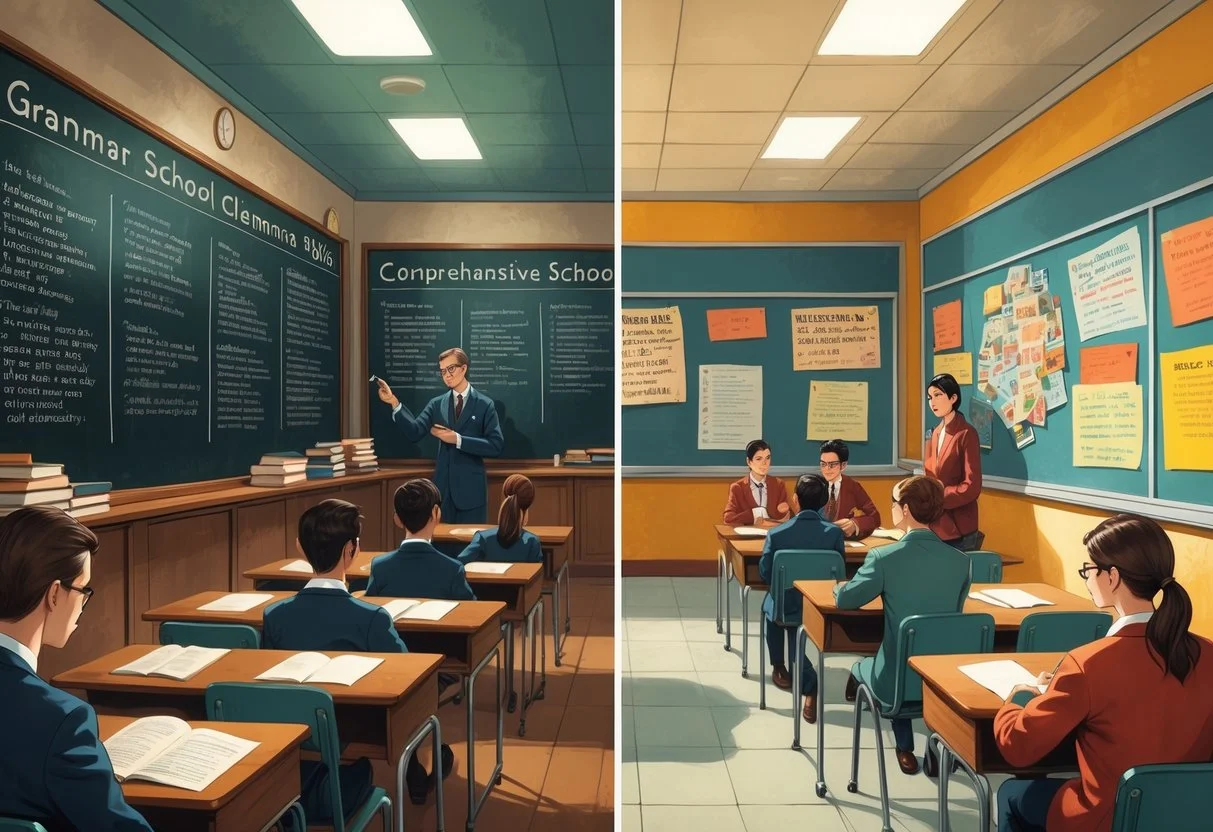
So why did Britain make such a huge shift in how it educated young people? The change didn’t just fall from the sky. Social scientists pointed out that grammar schools mostly helped middle-class kids, leaving working-class pupils behind. Meanwhile, new thinking about human potential suggested that sorting children into different schools at age 11 just wasted too much talent.
The move from selective grammar schools to inclusive comprehensive schools sparked debates that, honestly, still rumble on. If you want to understand why British schools are the way they are—and why education is such a hot topic in politics—this is where it all started.
The Structure of Secondary Education Before the 1960s

After the war, Britain built a rigid three-tier system that sorted kids by academic ability at age 11. It sounded like a promise of equal opportunity, but in reality, it just drew sharper lines between social classes. Different schools, different expectations, different futures.
The Tripartite System and Its Foundations
The Tripartite System split secondary education into three types. Each one pointed you in a different direction.
Grammar schools were for the academically gifted. Latin, sciences, literature—if you were there, you were probably heading for university or a white-collar job.
Secondary modern schools took in most kids. You’d get practical lessons, basic skills, and leave at 15, maybe for a trade or factory work.
Secondary technical schools—well, they were supposed to teach technical and vocational skills, but not many actually opened. Most people never saw one.
If you went to grammar school, odds were you’d end up in higher education. Secondary modern kids usually left for the workforce at 15. This wasn’t just about ability; it was a reflection of how society saw intelligence—academic, practical, or technical, and not much in between.
Role of the 1944 Education Act
The 1944 Education Act—people called it the Butler Act—finally made secondary education free for everyone. Before that, many families had to pay, which seems wild now.
Now, everyone had to stay in school until 15. No more leaving early for a job. Rich or poor, it didn’t matter.
The Act did a few big things:
- Made secondary education free
- Set up the three school types
- Gave local authorities power to run schools
- Raised the leaving age to 15
It promised “education according to age, ability and aptitude.” That phrase justified sorting kids, supposedly to give everyone the education they needed. People thought it was a step forward, especially for working-class children, but it still kept the tracks separate—and not equal.
Selection and the 11 Plus Examination
The 11 Plus exam decided your fate. You sat it in your last year of primary school, usually at 10 or 11.
The test covered English, maths, and general reasoning. Some places threw in intelligence tests for good measure.
Depending on your score:
- High: grammar school
- Lower: secondary modern
- Very low: sometimes remedial education
Only about a quarter of kids passed. Most went to secondary moderns, but it depended on where you lived.
Middle-class kids kept doing better. Was it really about intelligence? Or was it about background and who could afford extra help? Families with more money bought practice books, paid for tutoring, and nudged the odds in their favor.
Forces Driving Educational Change in Britain

Three big forces collided and changed everything in the 1960s: Labour’s political push, growing criticism of the old selective system, and the Ministry of Education getting directly involved.
Political Influence: Labour Government and Local Authorities
When Labour won in 1964, Harold Wilson came in with a clear plan to shake up schools. Labour believed selective education just kept the class system going, shutting out working-class kids.
Comprehensive schools, they argued, would help build a fairer society. The eleven-plus, they said, made decisions about kids’ lives way too early.
Local authorities—especially Labour-run ones—were already moving in that direction. London, Liverpool, Coventry: they were among the first to start phasing out grammar schools.
The national government gave these councils the cover they needed to push ahead. But it was really the local politics that decided how fast things changed. Conservative councils often dug in their heels; Labour ones jumped at the chance.
Critiques of Selection and Social Division
Researchers in the 1960s started poking holes in the fairness of selective schooling. Studies kept showing that middle-class kids had a better shot at passing the eleven-plus.
Grammar schools only took about 20% of pupils. The rest went to secondary moderns, which had fewer resources and lower expectations.
Problems with selection kept piling up:
- Tests that favored the middle class
- Major differences in grammar school places from region to region
- Hardly any way to move between school types
- Secondary moderns got a bad reputation
The Ministry of Education started to notice that comprehensives in places like Anglesey and the Isle of Man were actually getting better results for average kids. That gave critics more ammunition.
Parents began to ask: why should one test at age eleven decide everything? The pressure on politicians, both local and national, just kept building.
The Role of the Ministry of Education
The Ministry of Education didn’t just sit back. Sir Edward Boyle, the Conservative minister before 1964, had already started questioning selection.
When Labour took over, the ministry got more proactive. Anthony Crosland, the new education secretary, sent out Circular 10/65 in 1965, basically asking all local education authorities to come up with plans for comprehensive schools.
Ministry officials helped councils sketch out new catchment areas and figure out how to build bigger schools.
With the ministry’s support, councils found it easier to stand up to grammar school defenders. The national framework gave them the confidence to make tough decisions.
They didn’t force immediate change; instead, they nudged things along, letting local authorities move at their own pace—but always with that pressure to go comprehensive.
The Rise and Implementation of Comprehensive Education
Comprehensive education in the 1960s was Britain’s answer to educational inequality. Instead of sorting kids by ability, comprehensives opened their doors to everyone. But it wasn’t simple—politics, bureaucracy, and stubborn resistance made sure of that.
The Move Towards Comprehensive Schools
By the late 1950s, local authorities started to question the 11-plus. This test, given to kids around age 10½, decided if you’d get into grammar or secondary modern.
Teachers started to see the cracks. How could a test at that age predict what a kid would be like at 16 or 18? And if you lived in the wrong area, you just had less chance of getting into a grammar school.
Problems with the old system were obvious:
- Testing kids so young just didn’t work
- Where you lived mattered more than ability
- Secondary moderns didn’t offer much academically
- The whole thing deepened social divides
By the early ‘60s, nearly half of local authorities had started to try out comprehensive schemes. The results? Not perfect, but promising—mixed-ability schools could work.
Labour, seeing the tide turning, made comprehensive education official party policy. It was about fairness, about ending the old system that split kids apart at 11.
Circular 10/65 and its Impact
In July 1965, Anthony Crosland sent out Circular 10/65, and honestly, everything started moving faster after that. It asked every local authority to draw up plans for comprehensive secondary education.
The circular didn’t force anyone, but the pressure was clear. It listed six different ways to reorganize, so councils could pick what fit best.
Those six models included:
- Comprehensive schools for ages 11-18
- Two-tier systems with middle schools
- Sixth-form colleges paired with 11-16 schools
If your council wanted to keep grammar schools, they had to explain why. Suddenly, the burden was on defenders of the old system.
The effect? Massive. In 1965, fewer than 10% of secondary pupils were in comprehensives. By 1975, it was 68%. By 1980, almost 90% of state secondary kids went to comprehensives. That’s a tidal wave of change.
Resistance and Challenges
But not everyone cheered. Grammar school fans argued those schools gave bright working-class kids a shot at success.
Conservative politicians and many middle-class parents worried that standards would drop. They feared mixing all abilities would hold back the brightest.
Where did the pushback come from?
- Grammar school heads and teachers
- Middle-class parents, especially in posh areas
- Conservative-run councils
- Some teacher unions, wary of big changes
The switch wasn’t easy. A lot of old school buildings just didn’t fit the new model. Some places ended up with messy compromises—grammar schools hanging on next to new comprehensives.
Education policy swung back and forth depending on who ran the council. The result? A patchwork system, with some areas moving fast and others dragging their feet.
Transition from Grammar and Secondary Modern Schools
Switching to comprehensives wasn’t just a matter of changing signs over the door. Schools merged, new buildings went up, teachers had to rethink how they taught.
Often, grammar schools became comprehensives in name but kept their old buildings and staff. Secondary moderns sometimes merged with grammars or became part of larger comprehensives.
How did places handle the shift?
- Merging grammar and secondary modern schools
- Converting grammars into comprehensives
- Building brand-new comprehensive schools
Teachers, especially those used to grammar school classes, had to get used to mixed-ability teaching. It was a tough adjustment.
Some councils eased in, starting with the youngest year groups. Others flipped the switch all at once. The whole process could be confusing for parents—and honestly, for everyone.
By the mid-1970s, most of the country had made the leap. Comprehensives were now the main way kids experienced secondary education in England and Wales.
New Educational Opportunities and Long-Term Effects
The comprehensive reforms sparked major changes beyond state schools, creating new pathways for adult learners and expanding university access whilst independent schools adapted their strategies.
Growth of Independent and Direct Grant Schools
Independent schools really found their moment as parents started looking for something other than the new comprehensive system. Plenty of grammar schools, faced with the choice, just went independent instead of joining the comprehensive ranks.
If you were around then, you’d have noticed the educational landscape shifting right under your feet. Schools that once belonged to the state system suddenly started charging fees, sidestepping the comprehensive trend altogether.
Direct grant schools—now there’s a term that brings back memories. These schools straddled the line: they got government money but could charge fees to some students. When the Labour government pulled the plug on that funding in the ’70s, loads of them just went fully independent. It felt like the end of an era.
More families started sending their kids to independent schools. If parents wanted selective education and couldn’t get it for free anymore, well, they just paid up—if they could.
This whole setup? It sort of built a two-tier system. Wealthier families kept access to selective schools, while everyone else made do with comprehensives. Fair? Maybe not, but that’s how it played out.
Expansion of Higher Education
University places absolutely exploded in the 1960s, and you could feel the excitement in the air. The Robbins Report of 1963—now that was a big deal—pushed for massive growth to keep up with all the new demand.
Suddenly, you had all these new universities springing up across Britain. York, Sussex, Warwick—names that felt brand new at the time—opened up and welcomed thousands more students. It was a real shift.
The goal was to give comprehensive school pupils a shot at university, not just those from grammar schools.
A few numbers that stick in the mind:
- University places doubled between 1960 and 1970
- Student numbers jumped from 130,000 to over 230,000
- Seven new universities started up
It’s kind of wild to think how suddenly university doors swung open for so many who’d never have had the chance before.
The Establishment of the Open University
The Open University arrived in 1971, and honestly, it felt like something out of science fiction. Using TV, radio, and those chunky correspondence courses, it reached people who’d never set foot in a traditional university.
You didn’t even need formal qualifications to get in. Suddenly, adults who’d left school at 15 or 16—especially from working-class backgrounds—could give higher education another go.
The very first broadcast went out in January 1971. Students could study part-time, fitting it around jobs or family life. It wasn’t always easy, but it was possible.
The Open University brought:
- Degree courses open to anyone, no entry requirements
- Study on your own schedule
- Distance learning packs, sometimes a bit battered by the post
- Summer schools for hands-on work (and maybe a bit of fun)
Looking back, it’s hard not to feel a bit of awe. Suddenly, education wasn’t just for the young or the privileged. Even if you’d missed out on grammar school, you could still chase a degree, no matter where you started.
Enduring Legacy of the 1960s Reforms
Back in the day, the comprehensive system really took over secondary education in Britain. By 1990, most kids found themselves at comprehensives instead of the old grammar schools.
You can still spot the fingerprints of those reforms all over the place. The education system’s mostly comprehensive now, though, sure, a handful of grammar schools still hang on in some corners.
Lasting changes included:
- Mixed-ability teaching methods
- Broader curriculum options
- Increased social mobility opportunities
- Greater access to further education
Those reforms nudged things toward a more inclusive system, even as the whole selection versus comprehensive debate keeps bubbling up in policy talks.
University attendance? That’s a whole story in itself. Back in 1960, only about 5% made it to university, but now it’s soared past 30%. Hard not to feel a bit sentimental about how those 1960s changes set the stage for all that.






Leave a Reply