
The Two Ronnies’ “Four Candles” sketch—now that’s a slice of British telly that just won’t fade, is it? And then you’ve got The Beatles wrapping up “The End” with that line about love and what you take and make… well, it’s the sort of thing that sticks in your head for decades.
At first, they seem like odd bedfellows—one’s all giggles and puns in a dusty old shop, the other’s waxing philosophical about life and love. Yet, somehow, both have wormed their way into the British psyche, woven into the fabric of what it means to grow up and laugh here.
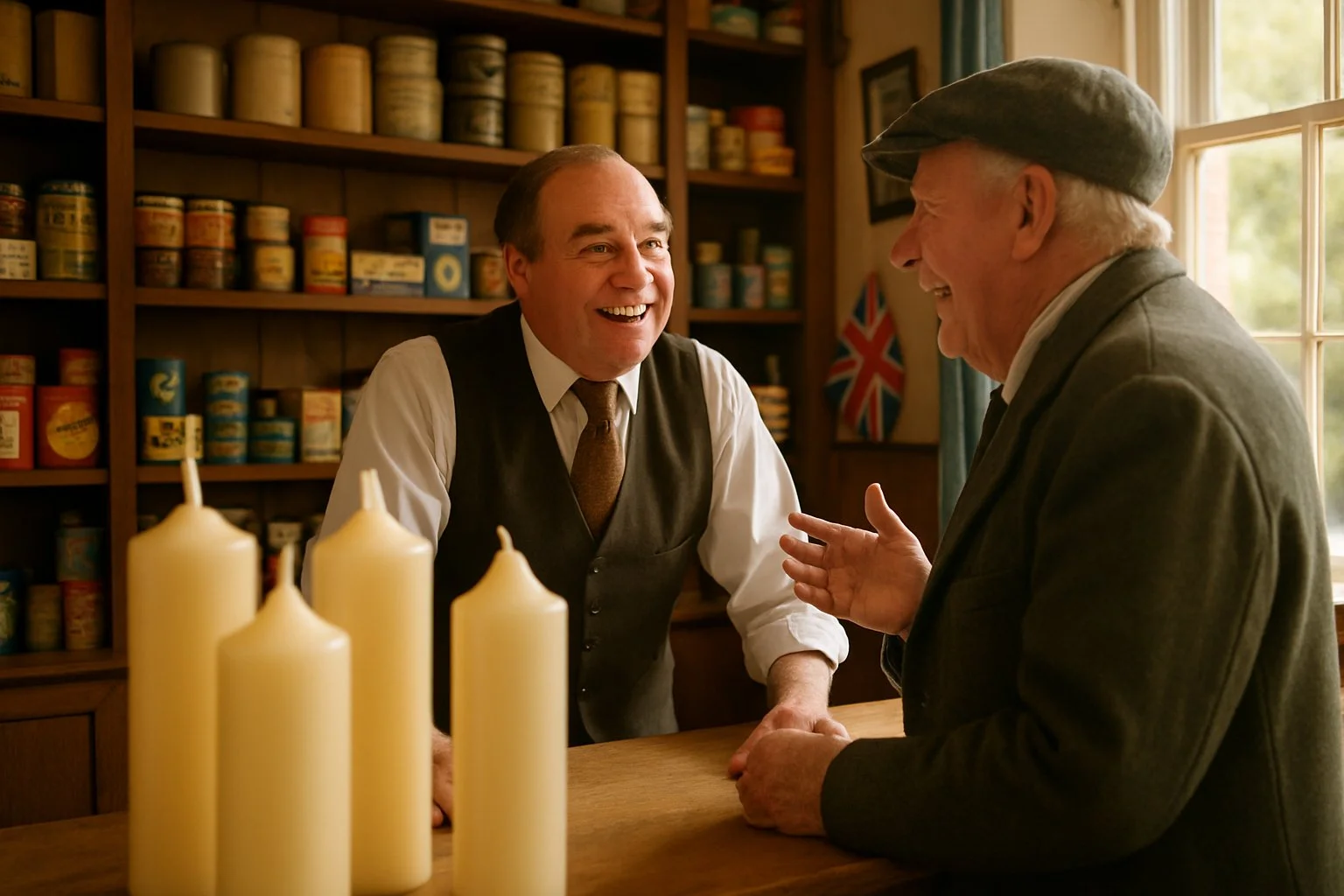
There’s something about The Two Ronnies and The Beatles—maybe it’s the way they managed to reach past their own time and medium, becoming shorthand for a kind of shared memory. Ronnie Barker and Ronnie Corbett poked gentle fun at everyday British muddles, while The Beatles somehow captured the big truths in three-minute pop songs. Neither needed to be mean-spirited to get a laugh or a tear; they just leaned into warmth and wit.
Let’s poke around a bit—what made “Four Candles” so perfect? And why does that Beatles sign-off still feel so wise, even now? Maybe we’ll stumble on why these old favourites haven’t worn out their welcome.
The Two Ronnies: Four Candles and Enduring Laughter

“Four Candles”—just saying it conjures up the sound of Barker’s exasperated sighs and Corbett’s innocent confusion. It’s a masterclass in misunderstanding, built from the simplest of setups: a customer walks into a shop, asks for something, and the poor shopkeeper can’t quite keep up.
Origins of the Four Candles Sketch
Ronnie Barker, hiding behind his Gerald Wiley pen name, wrote “Four Candles” and it first aired back in September 1976 during the fifth series. Barker played the frazzled hardware shop owner; Corbett, the customer who never quite got to the point.
Honestly, the beauty of it is how little it tries to do. A bloke asks for “four candles”—but, of course, he means “fork handles.” Then “plugs”—but not the ones for the sink, or maybe he does? It’s the sort of confusion that could only happen in a shop stacked to the rafters with bits and bobs.
The setting felt just right. Hardware shops, with their endless shelves of oddities, offer plenty of room for words to tangle. Barker always had a knack for this sort of verbal gymnastics—he made it look easy, but it’s anything but.
Comedy Style and Writing Techniques
The sketch leaned on that classic double act formula. Barker’s shopkeeper gets more and more wound up, while Corbett’s customer stays blissfully oblivious. That’s where the laughs really live.
Timing? Absolutely crucial. Each gag lands with a rhythm you could almost tap your foot to: ask, produce, confusion, try again. You know what’s coming, but you can’t help but grin when it arrives.
A few tricks they used:
- Homophones and near-homophones (“four candles”/”fork handles”—still gets me)
- Barely any physical comedy—it’s all in the words and faces
- Ratcheting up the frustration with every exchange
- Clean, family-friendly humour that never needed to shock
Barker kept things tight—no fancy sets, no wild plots. Just two men, a counter, and a script sharper than a new hacksaw blade.
National Impact on British Humour
People started quoting the sketch almost straight away. You’d hear “four candles” at the shops, in the pub, even in the playground—everyone wanted to be in on the joke.
TV polls still rate it among the top comedy sketches ever made. In 2004, it even snagged the title of Britain’s favourite. You can see its fingerprints all over modern comedy—proof that you don’t need to go blue or big to make people laugh.
It’s relatable, isn’t it? Anyone who’s ever muddled through a conversation at the shops knows that feeling. The Two Ronnies just held up a mirror and let us laugh at ourselves. Decades on, it still works.
‘And in the End the Love You Take…’: The Beatles’ Lasting Legacy

There’s that last line on Abbey Road—”And in the end, the love you take is equal to the love you make.” People have scribbled it in yearbooks, sung it at weddings, maybe even tattooed it somewhere regrettable. It marked the end of The Beatles as a band, but somehow, it feels like a beginning, too.
Meaning and Significance of the Lyric
Paul McCartney penned that line for “The End,” the final song all four Beatles recorded together. The message is simple, almost too neat: you get back what you put out. It’s about kindness, really—a gentle nudge to be better to each other.
Abbey Road came out in September 1969, though Let It Be dropped later. Still, Abbey Road was the swan song—the last time John, Paul, George, and Ringo all played together in that famous studio.
It hit especially hard because the band was on the rocks. The Get Back sessions had been tense, and by the time they cut Abbey Road, everyone knew the writing was on the wall.
Abbey Road and the Pursuit of Closure
Abbey Road felt like the send-off The Beatles deserved, especially after the messiness of Get Back. They wanted to bow out on a high, and George Martin helped them pull it together.
Side two, with its medley, flows like a river—one song into the next, all leading up to “The End.” Ringo finally gets a drum solo, and the others trade guitar licks. It’s almost like they’re saying goodbye, each in their own way.
They recorded it in the summer of ’69 at Abbey Road Studios. The atmosphere was calmer than before, though not exactly rosy. Yoko was there, Linda too—life had changed, and you can hear it in the music.
Iconic Last Moments: The Beatles’ Final Recordings
Technically, “Her Majesty” sneaks in after “The End,” but let’s be honest—everyone knows where the real finish line is.
The very last Beatles recording session happened in January 1970 at John Lennon’s Tittenhurst Park. They overdubbed “I Me Mine” for Let It Be, but John didn’t show up for that one.
In April 1970, Paul called it quits, and that was that. They all went solo, but fans kept coming back to that last bit of wisdom on Abbey Road—a proper farewell, if ever there was one.
Connecting Comedy and Culture: When The Two Ronnies Met The Beatles
The 1970s—what a time, eh? Two giants of British entertainment, both reflecting the quirks and moods of the nation in their own way. The Two Ronnies and The Beatles might’ve worked in different worlds, but they both had their finger on the pulse of what made Britain tick.
Cultural Crossroads in 1970s Britain
By the time The Two Ronnies hit the air in 1971, The Beatles had already changed everything. Liverpool’s finest started out in smoky clubs, strumming skiffle and rock ‘n’ roll, before transforming into the world’s most famous band under Epstein and Martin.
The Two Ronnies arrived just as Beatlemania was settling into legend. Both duos were proof that British creativity could charm the world. Barker and Corbett channelled the music hall spirit, while The Beatles went from civic gigs to wild experiments at Apple Records.
You’d catch The Two Ronnies dropping musical nods in their sketches, knowing full well the audience would catch the references. After all, everyone had grown up with The Beatles by then.
British Comedy as Social Commentary
The Two Ronnies held up a funhouse mirror to Britain, poking at accents, class, and everyday confusion. “Four Candles” stands out for the way it turned a simple misunderstanding into a national joke. The Beatles did something similar with their lyrics—sometimes cheeky, sometimes thoughtful, always unmistakably British.
Both acts made the ordinary feel special. The Beatles wrote songs about bus stops and lonely hearts; The Two Ronnies found gold in corner shops and newsagents. It’s the small stuff, really, that sticks with you.
Shared Themes and Enduring Influence
That Beatles lyric—”the love you take is equal to the love you make”—feels like a mission statement for both groups. The Two Ronnies, too, seemed determined to give as much joy as they got, never resorting to cheap shots.
What they shared:
- Wordplay and craft—whether in song or sketch, every line mattered
- Broad appeal—kids, grandparents, everyone could join in
- A sense of Britishness—celebrating and gently teasing the nation
They proved you could make something clever and lasting without losing your roots—or your sense of humour.
British Pop Culture Moments Inspired by The Beatles and The Two Ronnies
It’s hard to overstate how much The Beatles and The Two Ronnies shaped British culture. Their influence is everywhere—TV, music, even the way we joke with each other.
Music, Television, and the Nation’s Heart
The Beatles changed the way British musicians thought about albums. Revolver and Sgt. Pepper turned the studio into a playground. Bands like Led Zeppelin took notes, blending genres and pushing boundaries.
Rubber Soul and A Hard Day’s Night showed you could be both popular and ambitious. From The Quarry Men to The White Album, their journey became a blueprint for anyone dreaming big but wanting to stay true to themselves.
The Two Ronnies did something similar for comedy. Their sketches set the standard for what British TV could be—must-watch, week after week. Just like The Beatles’ TV spots in the ’60s, their show became a family ritual, another thread in the national story.
Parodies, Tributes, and Reinterpretations
British comedy shows couldn’t resist referencing both The Beatles and The Two Ronnies in their sketches. That wordplay and visual humor from “Four Candles”—it just stuck. Comedians picked up on the misdirection and rapid-fire jokes, almost like they couldn’t help themselves; it seeped into the DNA of British comedy.
Musicians, too, kept tipping their hats to The Beatles, covering their songs and twisting their catalogue into something new. Their closing sentiments—those little lyrical flourishes—ended up everywhere: graduation speeches, TV documentaries, you name it. Albums like Please Please Me and Magical Mystery Tour still call out to artists hungry for that old psychedelic spark or a taste of something experimental.
Kenneth Womack, over at Bloomsbury Academic, dove into how these moments shaped British identity. It’s funny—you’ll even catch echoes of that influence in school halls and senior class rituals, places you wouldn’t expect.






Leave a Reply