
Walking into a 1950s British classroom was like stepping into a world where the teacher’s word was law and punishment came fast—usually with a sharp sting.
Corporal punishment, especially caning, was just an everyday part of school discipline back then. Teachers had a whole arsenal, from rulers rapped across knuckles to the dreaded formal caning for the more serious stuff.
If you messed up, you braced yourself for “six of the best” with a cane or maybe a mountain of lines to write until your fingers ached.
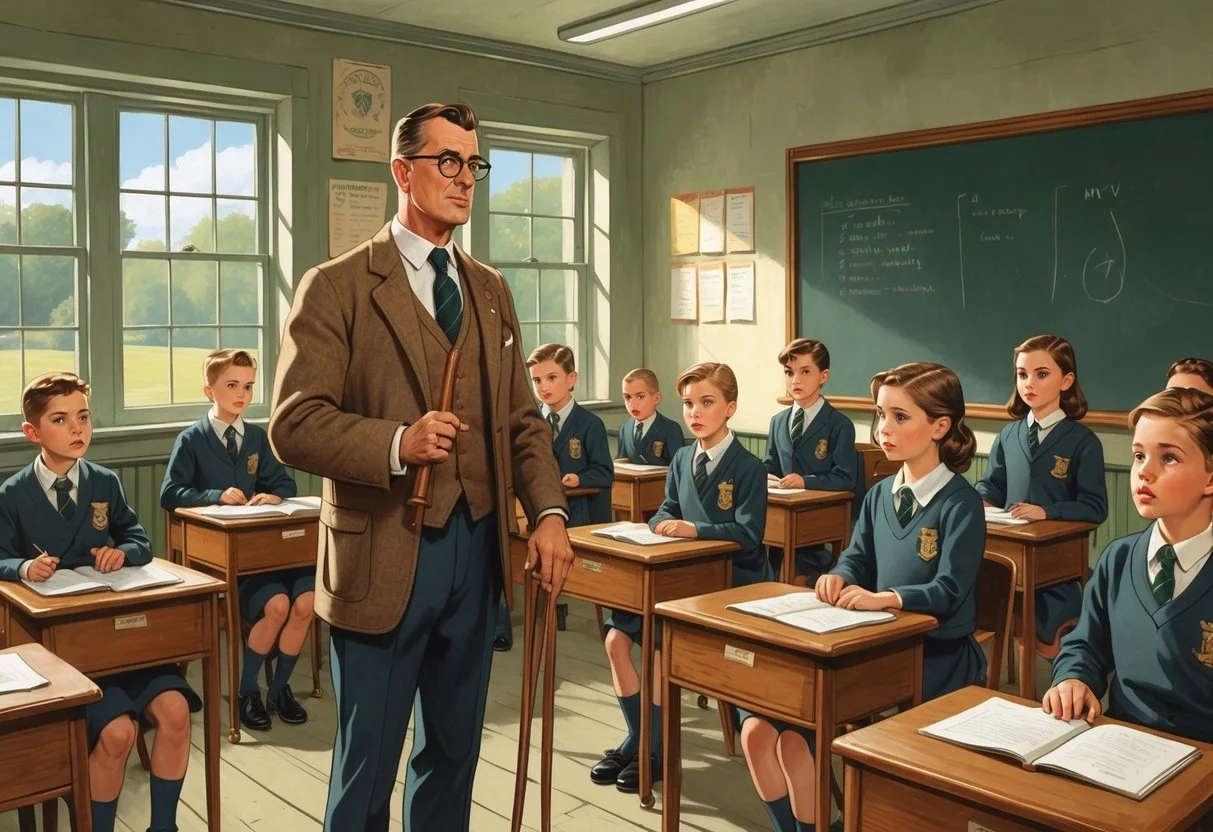
But discipline wasn’t just about the physical side. The whole school day was built on strict rules, formal greetings, and a clear pecking order that demanded respect—no questions asked. Teachers had plenty of tricks, from the dunce’s cap to after-school detentions, and every kid knew where they stood.
It’s a window into a time when traditional authority still reigned, but you could already sense the winds of change. People were starting to wonder if maybe, just maybe, kids deserved a gentler hand.
Corporal Punishment and the Cane in 1950s British Schools
Physical punishment ran the show when it came to school discipline in the 1950s. Teachers kept order with canes, and kids faced all sorts of consequences for stepping out of line.
Prevalence and Legal Standing of Corporal Punishment
If you went to school in 1950s Britain, corporal punishment was just part of the deal. It was legal, and pretty much everyone—parents, teachers, society—saw it as normal.
Most schools kept punishment books, jotting down every caning. Those old logs make it clear: boys bore the brunt of physical punishments. Girls usually got off lighter, maybe just a quick whack with a ruler.
Key facts about 1950s school punishment:
- Legal in all schools
- Backed by most parents
- Boys punished more than girls
- Schools kept detailed records
The government didn’t question teachers’ authority. They could use physical punishment as they saw fit, whether you were in a state school or a private one.
Parents actually expected schools to be strict. They figured a bit of pain built character and set you straight.
The Practice and Ritual of Caning
The cane was the classic tool in those days. Teachers handed out “six of the best”—six brisk lashes with a skinny wooden cane.
Kids got caned for big offenses or if they kept repeating the same mistakes. Usually, the teacher would call you up to the front or send you to the headmaster. The punishment happened right there, in front of everyone, so nobody missed the lesson.
Common reasons for caning:
- Being late again and again
- Not keeping up with schoolwork
- Mouthing off or being disrespectful
- Getting into fights
It all followed a set routine. You’d be summoned, the teacher would explain what you’d done, and then you’d get your stripes.
Some schools even had special canes just for discipline—designed to sting, and they left their mark.
Different Types of School Punishments
The cane wasn’t the only thing to worry about. Teachers had a whole menu of punishments to keep kids in line.
Physical punishments included:
- Ruler smacks on the knuckles
- Leather straps
- Paddles
- Birching (though that was rare)
Non-physical punishments:
- Writing lines until your hand went numb
- Wearing the “dunce’s hat” in the corner
- Detention after school
- Standing for ages
Writing lines—now, that was a grind. You’d copy the same sentence over and over, sometimes 500 times, supposedly to improve your handwriting but mostly just to make you think twice next time. The dunce’s hat was the ultimate humiliation—everyone knew you’d messed up.
Some schools made kids parade around the classroom shackled together—an odd one, meant to tire you out instead of hurting you.
Teachers sometimes stacked punishments. A caning might be followed by detention and a stack of lines for good measure.
Role of Teachers and Prefects in Discipline
Teachers ran the show when it came to discipline. They didn’t need to ask parents or anyone higher up before doling out punishment. Headmasters handled the worst cases—the serious canings.
In secondary schools, senior prefects (older students) got to dish out minor punishments too. They’d assign lines, detention, or maybe even a light smack.
Authority hierarchy in schools:
- Headmaster – toughest punishments
- Teachers – daily discipline
- Senior prefects – minor stuff
- Pupils – just along for the ride
Instant obedience was the rule. If you argued, you just made things worse for yourself.
Teachers didn’t get special training in discipline; they learned on the job, picking up tricks from older colleagues. Most truly believed strictness produced better adults.
Daily Discipline and Classroom Rules

Schools in the 1950s ran on strict codes that covered every detail of student life. The rules dictated everything—how you greeted teachers, what you wore, even how you sat at your desk.
Common School Rules and Expectations
Your school day started with a chorus of “good morning, sir” or “good morning, madam”—no exceptions.
The teacher’s bell was king. When it rang, you stopped talking. Period. That little nickel bell set the pace for everything.
Basic classroom expectations:
- Stand up when an adult walks in
- Raise your hand to speak
- Keep your desk neat
- Walk quietly in the halls
- Only talk when allowed
Step out of line and you’d be standing in the corner before you knew it. More serious stuff? That meant staying after school or taking home extra homework.
The Role of School Uniform and Order
Your school uniform wasn’t just about looking smart—it was about discipline. Uniforms leveled the playing field and kept everyone looking sharp.
Boys usually wore:
- White shirt and school tie
- Grey shorts or trousers
- Blazer with the badge
- Black shoes, always polished
Girls’ uniforms:
- White blouse with school colors
- Regulation pleated skirt
- Jumper or cardigan
- Black shoes with tiny heels
Teachers checked how you looked every day. Scruffy hair, dirty shoes, or the wrong jumper? You’d get sent home to fix it, no questions asked.
Uniforms weren’t just clothes—they reminded you that you represented the school, in and out of class.
Mixed Schools and Gender Differences in Discipline
Mixed schools handled boys and girls differently. Boys got tougher physical punishment, especially for repeat offenses.
Girls’ grammar schools were a bit gentler. The rules were there, but most girls followed them without much fuss. Teachers expected girls to be quieter and more obedient.
Gender-specific expectations:
| Boys | Girls |
|---|---|
| More physical punishment | Verbal corrections preferred |
| Tougher discipline | Focus on good behavior |
| Harsher for fighting | Stricter dress code |
In mixed schools, boys and girls could get different punishments for the same thing. The thinking was that each gender needed a different approach—looking back, it feels a bit odd, doesn’t it?
Your experience changed a lot depending on whether you went to a single-sex or mixed school. Each had its own way of keeping order.
Alternatives to Caning: Other Punishments and Rewards
The cane was the big threat, but teachers leaned on detention and lines for the everyday stuff. By the late ‘50s, some schools even started using rewards to encourage good behaviour—a bit of carrot with the stick.
Detention and Lines
Detention meant you were stuck at school after everyone else left. Teachers gave it out for talking in class, missing homework, or giving cheek.
Lines were another favorite. You’d write the same sentence over and over—sometimes hundreds of times. “I must not talk in class” or “I will respect my teachers” filled countless exercise books.
Sometimes, teachers made you don a dunce’s hat and sit in the corner. It was embarrassing, and everyone knew you’d messed up.
Rewards for Good Behaviour
Some schools had reward systems alongside all the punishments. You could earn house points for good work or being helpful.
The house system put you on a team, and your good deeds racked up points for your house—everyone wanted their team to win.
Teachers handed out merit marks or gold stars for top-notch work. These showed up on your report card, making your parents proud (hopefully).
If you kept your nose clean, you might get picked as a prefect, monitor, or class captain. Those jobs came with a bit of status and a few perks, like handing out books or keeping order.
Controversy, Campaigns, and Social Impact
By the time the ‘60s and ‘70s rolled around, people started to push back. Child welfare became a hot topic, and debates about corporal punishment got louder. Campaigns sprang up, and eventually, the cane disappeared from state schools by 1986.
Debates Over Child Abuse and Changing Attitudes
After the war, people started thinking differently about kids and what they needed. Experts and psychologists began to question whether smacking children really worked, or if it just left scars you couldn’t see.
Some said caning caused lasting harm—fear, anxiety, maybe worse. They pointed out that sometimes, punishment was more about a teacher losing their temper than teaching a lesson.
Key concerns raised:
- Injuries from too much force
- Psychological trauma
- Who should be allowed to punish?
- No consistent rules between schools
Parents’ attitudes changed, especially in the middle classes. More and more, they argued that schools should educate, not punish.
That old idea of in loco parentis—teachers acting as parents—started to look shaky. Should teachers really have the same rights as mums and dads? People weren’t so sure anymore.
Society of Teachers Opposed to Physical Punishment (STOPP)
STOPP popped up in 1968, the first real pushback against school corporal punishment. It was a gathering of teachers, parents, and folks genuinely worried about kids—people who just couldn’t stand by and watch the old ways go unchallenged.
You’d have caught STOPP ruffling feathers in the education world in all sorts of ways. They dug up research, showing just how much damage caning could do to a child’s mind and spirit. They listened—really listened—to students who’d been on the receiving end, collecting stories that sometimes made your heart ache.
STOPP’s main activities included:
- Lobbying government officials and education authorities
- Publishing reports on corporal punishment abuse
- Supporting families who wanted to challenge schools legally
- Educating the public about alternative discipline methods
They shone a light on cases where punishment crossed the line, documenting not just bruises but the kind of emotional scars that lingered. STOPP didn’t shy away from saying that teachers sometimes singled out certain students—maybe the quiet ones, or just the kids who didn’t quite fit in.
Looking back, it’s hard not to feel a little grateful for their stubbornness. They helped turn the tide, giving a voice to those who’d always felt too small to speak up against school authority.
The End of Corporal Punishment in State Schools
Funny how the final push to end corporal punishment didn’t exactly come from the government, but from a tangle of legal challenges. That 1982 European Court of Human Rights ruling—hard to forget—basically said parents could say no to physical punishment for their kids.
Then Parliament stepped in, and by 1986, corporal punishment was out in all state schools. If you were around then, you’d have felt the shift in England and Wales almost overnight.
The timeline of abolition:
- 1982: European Court ruling backed up parental rights
- 1986: Ban rolled out in state schools
- 1998: Swept through all schools, private ones included
Of course, it didn’t all change with the stroke of a pen. Some schools just kept paddling along, ignoring the new rules for a while. Teachers’ unions didn’t exactly speak with one voice—some folks cheered the change, others grumbled about losing what they called a vital tool for discipline.
Teachers and students both had to adjust. Suddenly, schools needed new ways to keep order, and a wave of training programs sprang up. Detention, positive reinforcement, sticker charts—these became the new normal. It wasn’t always smooth, but looking back, it’s wild to think how quickly everything flipped.







Leave a Reply