
Space hopper races—weren’t they just the highlight of every backyard gathering in the 1970s? You’d see a line of kids perched on those bright orange bouncy balls, knuckles white on the handles, hearts pounding, all set to launch themselves across the grass.
Ordinary gardens transformed into hilarious, bouncing battlegrounds, with scraped knees and wild, unstoppable laughter pretty much guaranteed.
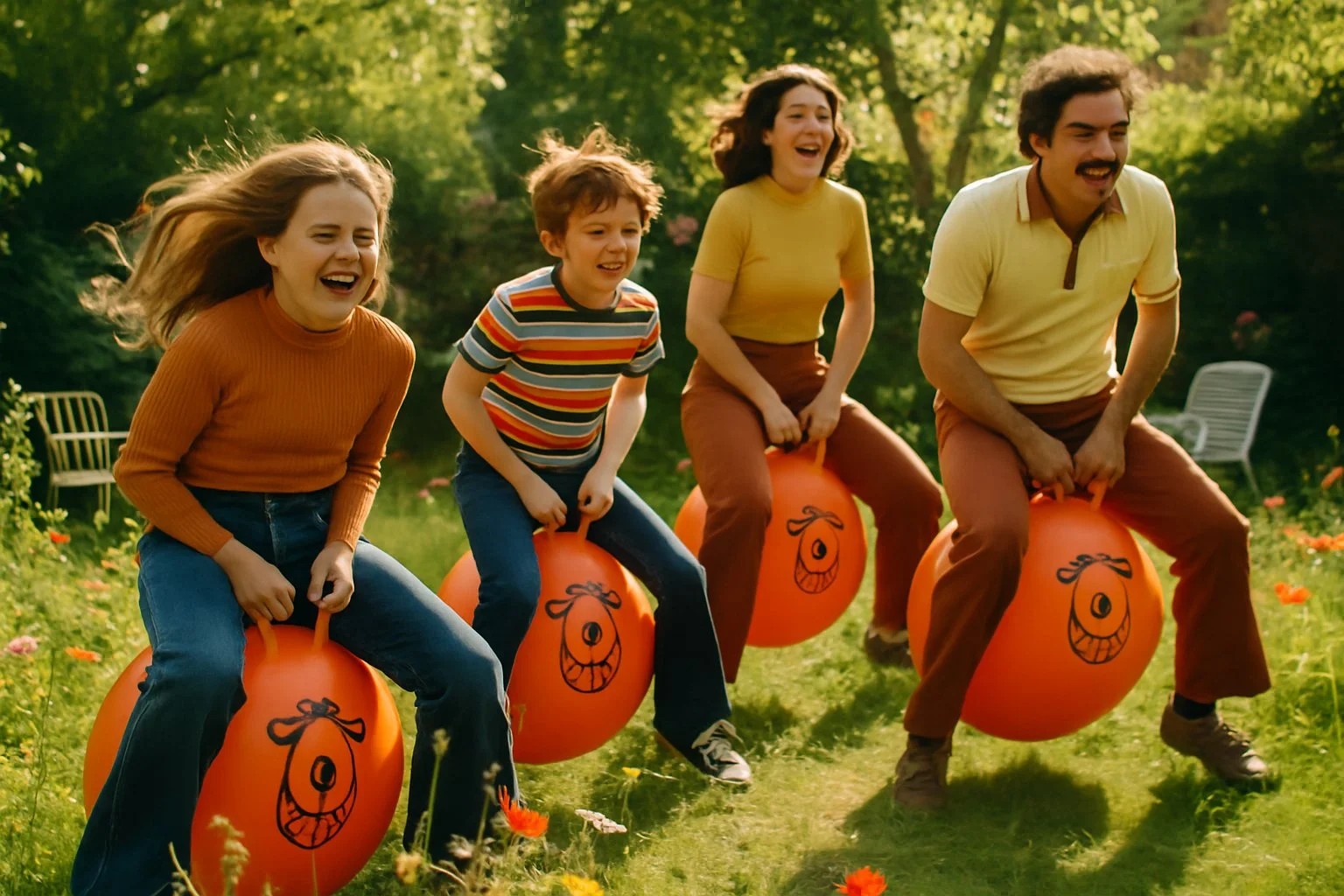
If you ever sat on one of those giant rubber balls, you know the wobbly thrill of bouncing toward some hastily marked finish line. Those goofy-faced orange hoppers just became part of the scenery, didn’t they? Everyone wanted one, and every patch of grass suddenly looked like a potential racetrack.
Let’s take a little trip back to those bouncing days—how space hoppers started as an Italian oddity and somehow became the heart of British garden chaos. There’s something about these inflatable toys that stuck with us, and honestly, they still haven’t lost their charm.
The Origins of Space Hoppers

Space hoppers didn’t just show up in British gardens out of nowhere. In 1968, an Italian inventor had the idea, and a year later, the UK got its first taste of the bouncy madness under a handful of different names.
Aquilino Cosani and the Pon-Pon
Aquilino Cosani, already known for the Swiss Ball, came up with the Space Hopper in Italy back in ’68. He ran a company called Ledragomma, and when he patented this new creation, he called it the Pon-Pon. The concept: a giant rubber ball with handles, perfect for bouncing around without flying off.
Cosani’s Pon-Pon was basically an exercise ball repurposed for play, with a handy valve for inflation. Early ones were red or blue, about 20 inches across—big enough for a kid to get up some speed.
1969: Arrival in the UK
Mettoy spotted something special in Cosani’s idea and brought space hoppers to Britain in the summer of 1969. The Cambridge Evening News even called them a “trend” that November.
The first UK hoppers? Not orange, but blue. Wembley, another company, jumped in too, with products like the Ridable Bouncing Ball and Hoppity Hop. These early versions had a ring handle on top, not the now-familiar “horns.” Kids would grip the ring and do their best not to topple over.
From Pon-Pon to Hoppity Hop
The name game was wild at first. Maybe you remember hearing about:
- Hoppity Hop
- Hop Ball
- Kangaroo Ball
- Moon Hopper
- Skippyball
Eventually, Mettoy gave the toy its signature look: bright orange, two ribbed horn-like handles, and a painted-on face. That goofy grin and the easy-to-grip horns made it a must-have. Suddenly, every kid’s garden had one, and the orange ball became a true icon.
Space Hopper Races: Iconic 1970s Garden Chaos

Space hopper races—just the phrase brings back noisy, sunlit afternoons. Those orange balls, black handles, and the wild energy of a bunch of kids turned simple backyards into arenas of pure, bouncy mayhem all across Britain.
Why Orange Balls and Black Handles?
Mettoy kicked things off in ’69 with blue hoppers, but the orange-and-black combo became the look everyone remembers. That orange? You could spot it from down the street, glowing against the grass. It just fit the vibe of the times—bold, bright, impossible to ignore.
Black handles weren’t just for looks; they didn’t show grime as much and were easier to hold. And let’s not forget those painted faces—each hopper felt like a cheeky little friend. Once this design caught on, it stuck. Even now, you picture orange and black when you think “space hopper.”
Organising Races in Back Gardens
You didn’t need much to get a race going—just a flat bit of grass, a couple of hoppers, and some eager kids. Mark out a start and finish line (jumpers, canes, whatever was handy), and off you went.
School sports days, street parties, even the Silver Jubilee in ’77—space hopper races were everywhere. Winning meant staying upright while bouncing at full tilt, which, let’s be honest, was harder than it looked.
People wiped out all the time. The rubber was forgiving, so most spills just led to more laughter. Races got wild—kids veered off course, toppled sideways, and somehow, nobody seemed to mind.
Unforgettable Childhood Memories
Those races didn’t just fill afternoons; they stuck in your mind. The challenge, the silliness, the way your legs burned as you tried to out-bounce your mates—there’s nothing quite like it.
Parents would watch from the sidelines, cheering and laughing. Even the less sporty kids could join in and shine for once. The space hopper wasn’t just a toy; it was a ticket to shared chaos and memories you’d remember for decades.
Cultural Impact of the Space Hopper Phenomenon
It’s kind of wild how the space hopper, born from an Italian exercise ball, ended up a symbol of 1970s British childhood. Those orange balls didn’t just fill gardens—they became part of the culture, the backdrop to playgrounds, family gatherings, and pretty much every community event you can think of.
Space Hoppers in British Popular Culture
By the early ’70s, orange space hoppers with those silly faces were everywhere. Kids bounced down pavements, across parks—sometimes even in the house if parents weren’t looking.
TV adverts hyped them up as if they’d replace bikes and cars. (If only! Most of us were out of breath after a dozen bounces.) Newspapers covered charity races in Hyde Park, and somehow, space hoppers even bounced their way into the early rave scene—yep, Glastonbury and Birmingham’s trance events had their share of orange balls in the crowd. It’s strange, but that connection with counterculture just made them even cooler.
Nostalgia and Family Traditions
If you grew up in the ’70s, the smell of that rubber and the wobbly challenge of staying upright probably still brings a smile. Plenty of parents now buy hoppers for their own kids, hoping to pass along a slice of their own childhood. Garden parties back then? Almost guaranteed to have a bouncing competition or two.
You’d race siblings, cousins, anyone willing, just to see who could stay on the longest or bounce the furthest. Those simple games turned into family stories that get told years later, sometimes with a little embellishment.
Even now, adults hunt down retro hoppers, hoping to recapture that feeling—just for a bit.
World Records and Community Events
Space hopper races weren’t just a backyard thing. Community centres and toy shops started organising proper competitions. Streets closed off, neighbours gathered, and suddenly you were lining up at the start, nerves jangling, hands clamped tight on those black handles.
People of all ages joined in—charity races, fun days, whatever excuse folks could find. The unpredictable bounces and frequent wipeouts made it a spectacle for everyone watching.
Influence on Playground Games
Space hoppers changed how kids played in the ’70s. Suddenly, playgrounds had new games: relay races, obstacle courses, even bouncing tag. The toy forced you to learn balance and coordination (though most of us just learned how to fall with style).
Kids invented their own challenges—jumping over cones, racing around trees, you name it. The competitive spirit didn’t stop at official races; it just became part of everyday play.
Modern Day Space Hopper Fun
Believe it or not, space hoppers are still around, and they’re not just for kids anymore. Adults have rediscovered the joy (and the workout) of bouncing on those bright orange balls. The design hasn’t changed much, but the materials are tougher and the nostalgia is real.
Adult Space Hoppers and Retro Revivals
Today’s space hoppers? They’re bigger—60cm for grown-ups, still orange, still with those silly faces and antenna handles. The rubber’s stronger, so you won’t pop one just by reliving your youth.
People buy them for all sorts of reasons—nostalgia, fitness, garden parties, or just to make the neighbours laugh. There’s something irresistible about the retro look. Most come with a foot pump, so you can get bouncing in no time, and they deflate easily when you need to stash them away.
Maybe it’s just me, but some toys never really lose their magic.
Fitness, Entertainment, and Novelty Uses
Space hoppers—remember those?—actually give you a pretty solid low-impact workout. When you’re bouncing around, your core kicks in, your balance gets a challenge, and you sneak in some decent cardio. It’s a throwback way to exercise that doesn’t feel so much like exercise, if you ask me.
People find all sorts of uses for these things: organised races, backyard games, or just messing about solo. You’ll spot them at outdoor fairs, team-building days (where someone’s always a bit too competitive), and of course, at kids’ birthday parties. Some folks even risk it indoors when the weather’s grim—hopefully on carpets, not hardwood.
You end up using your legs, core, and arms together to keep from toppling over. It’s exercise, sure, but it’s got that silly, joyful edge that makes you forget you’re actually working out.






Leave a Reply