
Glam rock crashed into the British music scene in the early 1970s, all sequins, swagger, and a sort of cosmic mischief.
Those were the days, weren’t they? Marc Bolan strutting across our telly screens, feather boas trailing, glitter catching the lamplight—suddenly, our living rooms became impromptu stages.
We could all pretend, just for a moment, that we were rock gods, too.
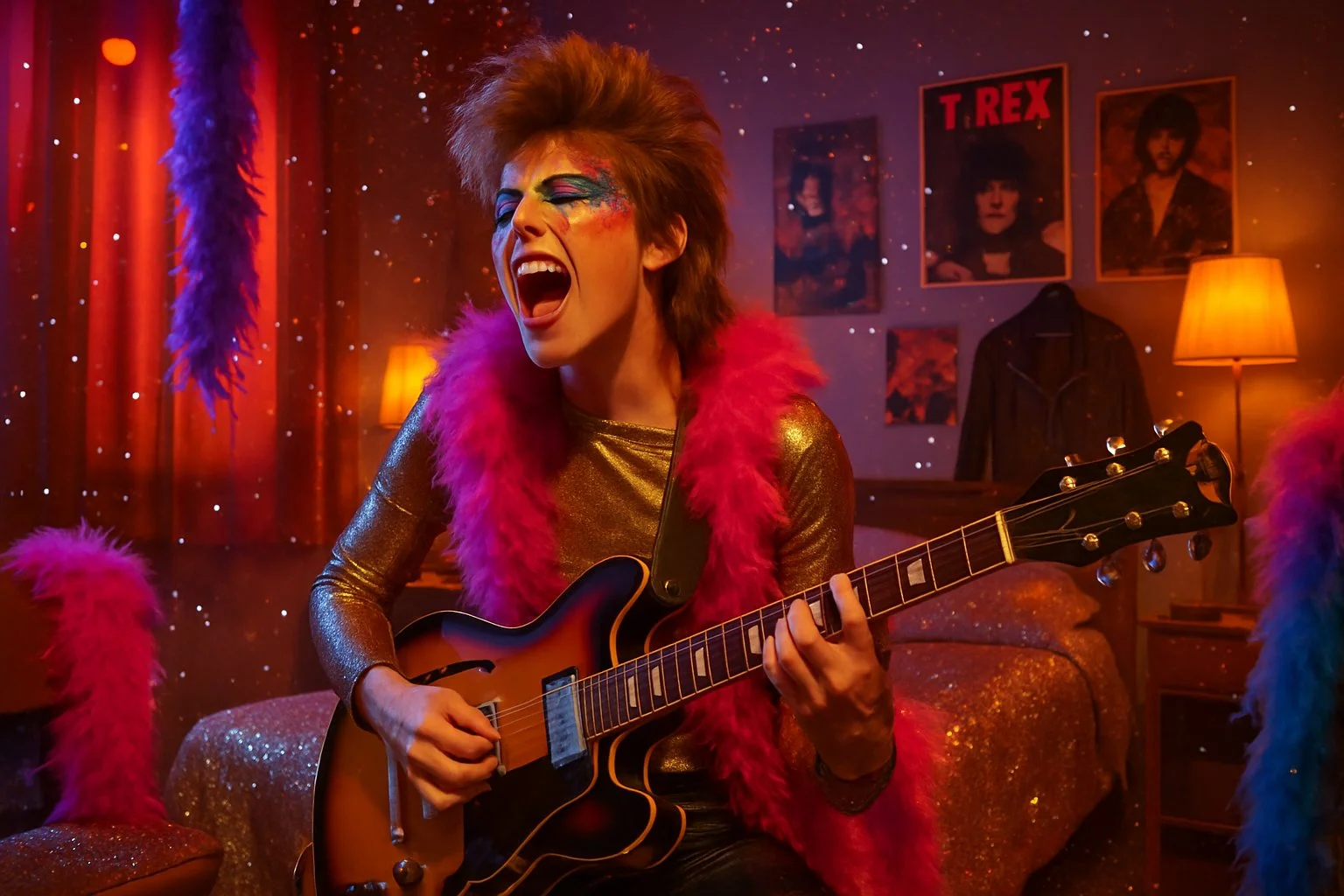
Glam rock had this uncanny way of fusing toe-tapping pop hooks with over-the-top drama. It was perfect for those wild, half-imagined concerts in your bedroom—hairbrush microphone in hand, mates howling along, the carpet your only audience.
It’s funny how that escapist spirit still lingers. Bolan’s mystical magnetism, the signature styles—there’s just something about it that makes you want to throw on a scarf and lose yourself in the music, even now. Whether you’re a die-hard fan or you’ve just stumbled across a glitter-soaked anthem, glam practically dares you to let loose at home.
The Glittering Essence of Glam Rock

Back in the early ’70s, glam rock didn’t just tweak pop culture—it flipped it on its head. This was more than music; it was theatre, rebellion, and a bit of cheeky fun all rolled into one. Bands dressed up in wild costumes, mixed catchy hooks with loud guitars, and challenged every rule in the book.
Defining Glam Rock’s Sonic and Visual Identity
You couldn’t miss glam rock’s look. Artists went all in—sparkling jumpsuits, platform boots tall enough to give you vertigo, and makeup that’d make your gran blush.
- Sequined costumes and jumpsuits
- Towering boots
- Dramatic, sometimes outlandish, makeup
- Feather boas and all sorts of shiny accessories
Musically, they mashed up pop and hard rock. You’d get these simple, infectious choruses, then suddenly a guitar riff would crash in and take things somewhere unexpected. Songs would leap between keys, keeping you guessing.
And the gender-bending? That was a revelation. Guys in makeup, women in tuxedos—everyone playing with expectations, and honestly, it made the whole scene feel electric.
Origins and Key Influences
Glam rock didn’t just appear out of nowhere. Psychedelic rock and folk music laid the groundwork, but glam artists took those roots and ran wild. A lot of them started out in other genres, then found their true selves under the glitter.
Blues snuck in, too. You can hear it in the bones of so many glam tracks—old blues numbers, but with a theatrical twist and a lot more eyeliner.
Most of this was happening in Britain, right at the start of the ’70s. Musicians wanted something bigger, bolder, a bit more escapist. Art rock’s experimental streak nudged glam bands to try new things, but they never lost their knack for a good pop tune.
The Rise of the Glam Rock Era
Around 1970, glam rock really caught fire. Suddenly, these bands were everywhere—on the radio, on TV, topping the charts. Audiences just couldn’t get enough.
T. Rex made the leap first. Their album Electric Warrior marked the moment when psychedelic folk gave way to full-blown glam. Other bands quickly followed suit.
TV loved glam rock. The wild costumes and theatrical performances looked incredible on camera, so the movement spread fast. Even folks who didn’t care for the music couldn’t look away.
Glam rock blurred the lines—underground met mainstream, and suddenly, alternative music had a seat at the big kids’ table.
Bedroom Concerts: Embracing Glam at Home

There’s something magical about turning your bedroom into a glittery stage. All you need is the right playlist, a few props, and maybe a bit of imagination. Suddenly, it’s 1973 again, and you’re headlining your own private concert.
Turning Bedrooms Into Stages: The DIY Experience
Start with the lights. Coloured bulbs—purple, pink, whatever you can find—set the mood. String up fairy lights, toss in a disco ball (or just hang some tinsel), and you’re halfway there.
- Purple or pink bulbs for that moody glow
- Fairy lights, everywhere
- Anything shiny—disco balls, metallic wrapping paper, even a mirror
Clear some space in the middle of the floor. That’s your stage. If you can, hang something shimmery behind you—metallic curtains, a silver blanket, whatever’s handy. It’s not about perfection; it’s about catching the light and feeling like a star.
- Silver or gold emergency blankets work in a pinch
- Sequined fabric or streamers from the craft shop
- Layer things up for extra sparkle
Get the sound right, too. If you’ve got more than one speaker, scatter them around. The music should surround you, not just blare from a corner.
Must-Have Glam Rock Songs for Home Performances
No bedroom concert is complete without the right tunes. These songs never fail to get the blood pumping:
T. Rex essentials:
- “Get It On (Bang a Gong)”
- “20th Century Boy”
- “Children of the Revolution”
David Bowie’s catalogue is a goldmine. “All the Young Dudes” has that swagger, and “Ziggy Stardust” turns any room into another galaxy.
Sweet’s “Ballroom Blitz” is pure adrenaline. Slade’s “Cum On Feel the Noize”—well, try not to shout along, I dare you.
A few more must-haves:
- “Love Is the Drug” by Roxy Music
- “Virginia Plain” by Roxy Music
- “Block Buster!” by The Sweet
Mix up the tempo—fast numbers, slow ballads, whatever fits your mood. Gives you a chance to swap costumes or just catch your breath.
Iconic Bedroom Props: Feather Boas, Glitter, and More
You can’t do glam without a feather boa. Drape it around your neck, twirl it, fling it at your imaginary crowd—it’s an instant confidence boost.
Pick a colour: white, black, hot pink, whatever feels right. The more dramatic, the better. Glitter is non-negotiable. Dab it on your cheeks, dust it over your hair, let it get everywhere (just maybe warn your housemates first).
Other props that never go out of style:
- Platform shoes or boots (if you’re brave)
- Temporary metallic tattoos
- Giant sunglasses
- Anything sparkly—rings, necklaces, bracelets
Costume go-tos:
| Item | Effect |
|---|---|
| Velvet jackets | Instant rock star vibes |
| Metallic trousers | Reflects every bit of light |
| Scarves | For dramatic flourishes |
| Statement belts | Ties the whole look together |
Don’t forget the makeup. Go heavy on the eyes, add some shimmer, maybe a bold lipstick if you’re feeling it. The goal isn’t subtlety—it’s transformation.
T. Rex Tracks and Marc Bolan’s Legacy
Marc Bolan, once a folkie, turned himself into the ultimate glam icon. He gave us anthems like “Get It On” and “Children of the Revolution,” and his glittering, theatrical style still echoes through music decades later.
Marc Bolan: Glam’s Charismatic Frontman
Marc Bolan started out as Mark Feld, a kid from Hackney. He first played acoustic folk with Tyrannosaurus Rex—then, almost overnight, he electrified his sound and became T. Rex.
By the early ’70s, Bolan had reinvented himself. The folk singer vanished, replaced by a star in satin trousers and glitter-dusted cheeks.
He rocked:
- Silver sailor suits
- Feather boas galore
- Playful androgyny
- A stage presence that was pure magic
His TV performances were the stuff of legend. That “Children of the Revolution” spot with Elton John—if you’ve seen it, you know. Bolan inspired a whole generation to chase fantasy and flamboyance.
He was as big as the Beatles for a while, at least among British teens. It’s hard to overstate how much he made people dream.
Essential T. Rex Songs and Their Impact
T. Rex really hit their stride between 1970 and 1973. Those years gave us the songs that defined glam—and, honestly, still hold up.
- “Ride a White Swan” – The one that started it all
- “Get It On (Bang a Gong)” – The international smash
- “Hot Love” – Six weeks at the top in the UK
- “Telegram Sam” – Boogie rock at its best
- “20th Century Boy” – Raw, wild, and ahead of its time
“Electric Warrior” (1971) was their masterpiece. Even the critics can’t help but gush about it. “The Slider” (1972) kept the hits coming, and both albums showed off Bolan’s knack for blending rock, folk, and pure electric energy.
T. Rex’s melodies stick with you, and Bolan’s voice—equal parts sly and sweet—made every song feel personal.
The Enduring Influence of T. Rex
T. Rex’s fingerprints are all over modern music. Bolan’s mix of theatre and hooks inspired everyone from punk bands to the latest indie kids.
For a while, they were as beloved as the Stones—maybe even more so, if you ask the right crowd.
- They pioneered theatrical rock shows
- Blended folk and electric sounds
- Helped spark punk’s raw energy
- Inspired glam and alternative bands for decades
Fans still gather at the Bolan Tree, leaving flowers and glitter. It’s a strange, touching tribute—proof that his spell hasn’t faded.
Covers, tributes, and wild stories keep Bolan’s legend alive. He opened doors for anyone bold enough to be themselves on stage, no matter how weird or wonderful.
Other Pioneers: Glam Rock’s Shining Stars
Marc Bolan might’ve lit the fuse, but he wasn’t alone. David Bowie took glam to the stars, and Queen turned it into pure spectacle.
David Bowie and the Ziggy Stardust Revolution
David Bowie didn’t just join glam rock—he reshaped it. Ziggy Stardust, with his flaming hair and alien swagger, became the face of a whole new era.
When Bowie arrived in 1972, he was more than a singer—he was a character, an idea, maybe even a prophecy. The Rise and Fall of Ziggy Stardust and the Spiders from Mars was a concept album before most people knew what that meant.
Bowie never stood still. He didn’t just wear glitter—he became someone else entirely with each album. Songs like “Starman” and “Suffragette City” mixed pop charm with otherworldly drama.
His impact? It’s everywhere. Punk, new wave, modern pop—they all owe something to Bowie’s fearless reinvention.
Queen’s Flamboyance and Musical Magic
Queen took glam’s drama and cranked it up. Freddie Mercury—what a frontman. His voice could fill stadiums, and his stage costumes were legendary.
Early Queen albums fused heavy riffs with operatic vocals. “Killer Queen” is a masterclass in glam sophistication.
Mercury wore everything from leather to flowing robes, and every look felt iconic. The band’s harmonies and arrangements were more complex than most glam acts, but they never lost sight of the fun.
Their concerts? Pure spectacle. Mercury worked the crowd like nobody else, and Queen’s energy paved the way for the era of stadium rock.
The Theatrical Power of Slade and Mott the Hoople
Slade brought a working-class punch to glam. “Cum On Feel the Noize” and “Mama Weer All Crazee Now”—those songs were made for shouting along.
They wore mirrored hats, platform boots, and spelled their song titles however they pleased. It was all part of the fun.
Mott the Hoople, with a little help from Bowie, found their glam side and gave us “All the Young Dudes.” That song became a rallying cry for a whole generation.
These bands proved glam rock could be loud, raw, and a bit rough around the edges. It wasn’t just art-school experiments; it was music for everyone who wanted to dance or just feel a little less ordinary.
Signature Glam Rock Style and Fashion
Glam rock changed the way people dressed—forever, I’d argue. Suddenly, androgynous looks, wild makeup, and glittery costumes weren’t just for the stage. They seeped into everyday life, challenging old ideas and opening up a world of possibilities for anyone brave enough to shine.
Androgynous Fashion and Gender Expression
Marc Bolan really kicked off that androgynous vibe that glam rock is famous for. He didn’t just stick to the usual—he’d throw on a fur blazer or a feathery scarf, swiping ideas straight from women’s closets.
Then there was David Bowie, who just ran with it. During his Ziggy Stardust phase, he showed up on “The Man Who Sold the World” album cover in a ballgown. That was wild back then—nobody expected a rock star to do that. It made people wonder, “Wait, men can do that?”
Key androgynous elements included:
- Flowing sleeves and silhouettes
- Chokers and delicate jewellery
- Fitted clothing that blurred masculine lines
- Romantic fabrics like velvet and silk
Marc Bolan in T. Rex showed everyone that tight trousers and a sprinkle of glitter could be their own kind of rebellion. His style just clicked with kids who were bored with the same old jeans-and-t-shirt routine.
They didn’t just look cool—they made you question what “masculine” even meant. Suddenly, fans felt like they could try anything, mixing up clothes and styles however they wanted.
Glitter, Makeup, and Stage Outfits
If you had to pick one thing that screamed glam rock, it’s gotta be glitter. Marc Bolan dabbed sparkly makeup on his cheeks and wore jackets that caught every stage light. It was half music, half magic show.
Essential glam rock elements:
- Platform boots for added height
- Feather boas as accessories
- Bright, clashing colours and prints
- Vinyl and leather materials
- Sequined jumpsuits
You can’t forget Bowie’s orange hair or those painted nails—he looked like he’d just stepped out of a comic book. That 1973 vinyl jumpsuit by Kansai Yamamoto? Pure art, honestly.
Mick Jagger went from preppy to pure spectacle. His Ossie Clarke grey velvet jumpsuit is still one of those outfits people remember, even decades later.
And the makeup—wow. Bold eyes, face paint, all that glitter—made these musicians feel larger than life, like they’d stepped out of a dream. Audiences couldn’t look away.
Impact on Mainstream and Modern Fashion
Glam rock didn’t just stay on stage. It spilled out into everyday life and shook up how people thought about clothes. Suddenly, rules felt like suggestions.
Remember those platform shoes? Everyone wanted a pair, and not just for a minute—those things stuck around. Disco, punk, even pop stars years later borrowed glam’s love of metallics and sparkle.
Today, you can spot glam rock’s fingerprints everywhere. Harry Styles, for example, totally channels that Mick Jagger romantic-but-edgy thing—it’s like glam never left.
Bowie and Bolan, with all their gender-bending, opened doors for designers to play with gender in fashion. Now, you see whole collections that don’t care about “men’s” or “women’s”—just clothes for whoever wants them.
Lasting influences include:
- Acceptance of men wearing makeup
- Bold, theatrical stage costumes
- Gender-neutral fashion lines
- Glitter and metallic finishes in everyday wear
That DIY attitude—sewing on your own patches, mixing thrift finds with high fashion—still encourages people to ignore the rules and just wear what feels right.
Classic Tracks, Bands, and Hidden Gems
Glam rock’s legacy is all over the radio, from ‘Virginia Plain’ to ‘Tiger Feet’. Roxy Music and Alice Cooper didn’t just follow trends—they made their own. Not every song hit number one, but plenty became secret classics fans still love.
Chart-Topping Anthems and Their Stories
‘Tiger Feet’ by Mud? That was everywhere in 1974. The beat was so infectious you couldn’t help but stomp along, especially if you were a kid with a feather boa in the living room.
Sweet’s ‘The Ballroom Blitz’ has its own wild story. The band wrote it after a gig went off the rails—fans throwing bottles and chaos everywhere. Somehow, that madness turned into a glam anthem.
David Bowie’s ‘Starman’—that’s the one that really introduced Ziggy Stardust. The whole spacey, theatrical vibe just fit. Ask any glam fan and they’ll probably say it’s the song that sums up the era.
T. Rex’s ‘Cosmic Dancer’ and ‘Ride A White Swan’—those are the ones that make you realize glam came from somewhere psychedelic and got shinier. Marc Bolan’s guitar and those mystical lyrics… it’s a sound that’s hard to pin down but easy to love.
And then Slade with ‘Cum on Feel the Noize’. The spelling? Totally on purpose, just to make sure nobody confused them with the other bands.
Roxy Music, ELO, and Alice Cooper’s Contributions
Roxy Music brought a certain class to glam rock. ‘Virginia Plain’ was catchy but arty, and Bryan Ferry’s voice just glided over everything. It was a little less raw, a little more polished.
They kept evolving, too. ‘Love is the Drug’ showed they could do slick pop without losing their edge. Brian Eno’s early synth work gave their sound that futuristic shimmer glam fans still talk about.
ELO took the genre somewhere new. Jeff Lynne blended rock with strings and big arrangements, and their concerts were more like spectacles—lights, costumes, the works.
Alice Cooper leaned into the shock factor. Fake executions, giant snakes, horror makeup—his shows were legendary. ‘School’s Out’ became every teenager’s anthem for rebellion.
Cooper’s over-the-top style rubbed off on a lot of later performers. He made it clear: in glam rock, the show was just as important as the songs. That sense of spectacle? Still hard to top.
Notable Deep Cuts and Cult Favourites
’48 Crash’ by Suzi Quatro really should’ve been a bigger deal. That driving bass, her swagger—she just owned it. Back then, you hardly saw women in glam rock, so her tracks always felt like something rare and a bit rebellious.
Sparks rolled out ‘This Town Ain’t Big Enough for Both of Us’, and honestly, that song’s just odd in the best way. Those wild lyrics, the over-the-top vocals—no wonder it’s a favorite for folks who like their glam a little left of center.
Brian Eno wandered off into his own world with solo stuff like ‘Baby’s On Fire’. He took glam and twisted it into something experimental and weirdly beautiful. You can almost picture listening to it alone, late at night, letting those strange sounds sink in.
New York Dolls crashed onto the scene with ‘Personality Crisis’, dragging all that raw, messy American punk energy into glam. The production’s rough around the edges, but that just makes it feel more real somehow. British glam always seemed a bit shinier, didn’t it?
Mott the Hoople’s ‘All the Way from Memphis’ spins these stories about rock life that feel almost like old friends reminiscing. They never really bought into the glitzy side of glam—there’s something honest and down-to-earth in their sound that just sticks with you.






Leave a Reply