
Picture London in 1951, still battered and patchworked from the war, when this wild, silvery 300-foot tower suddenly floated above the Thames like a sci-fi daydream.
The Skylon became the towering symbol of Britain’s ambitious Festival of Britain, a nation’s almost desperate attempt to conjure up a brighter future after years of rationing and devastation.
This wasn’t some humdrum monument—it looked like it shouldn’t even be standing, dangling from cables in a way that made people stop, squint, and mutter, “How on earth…?”
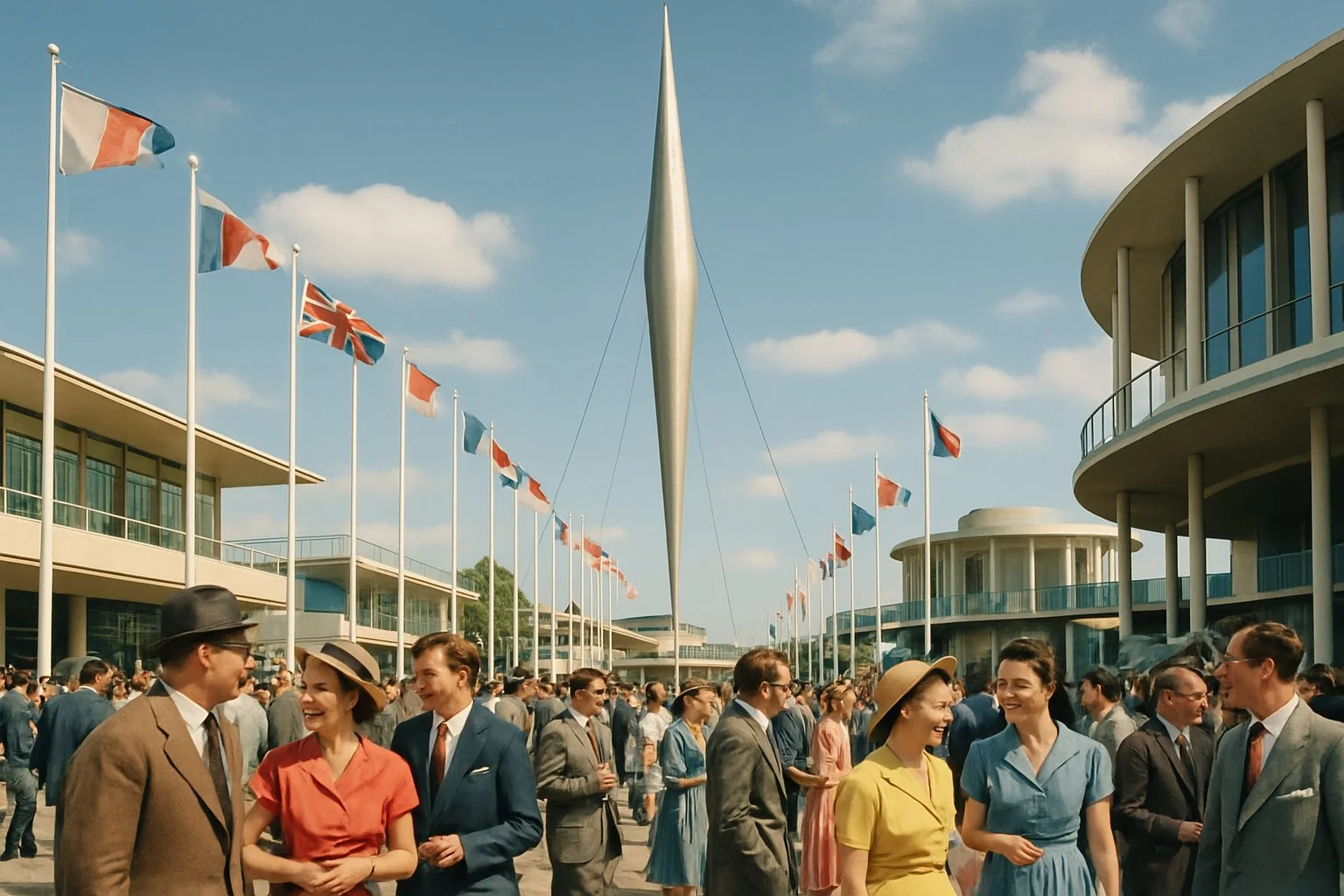
Funny how quickly we forget how gutsy this moment was. The Festival of Britain turned London’s South Bank into a playground of modernist architecture and wild, futuristic dreams. From the hulking Dome of Discovery to the crisp new Royal Festival Hall, the whole thing hollered optimism at a time when plenty of folks still queued for rationed basics.
But what became of all that hope? The Skylon only lasted a year—scrapped, melted down, and, legend has it, reborn as paperweights. Sometimes I wonder if that ambitious vision of modernity ever really landed, or if we’re still quietly nursing a hangover from those giddy, post-war dreams.
Skylon: The Futuristic Symbol of Hope
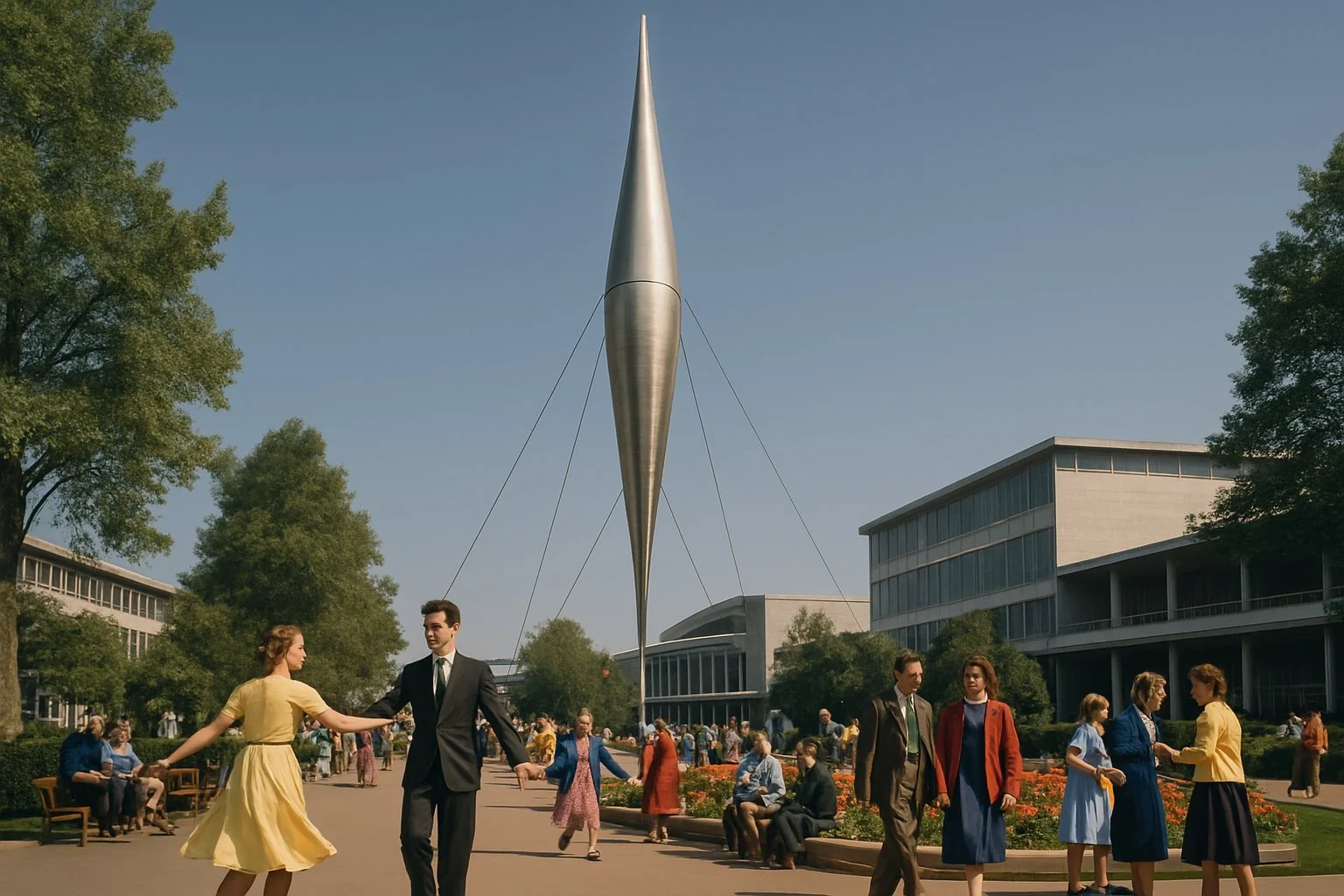
The Skylon was Britain’s most audacious architectural gamble in 1951, shooting 300 feet into the London sky with its slender, cigar-shaped steel frame that looked like it was hovering above the Thames. This thing transformed the South Bank, glowing at night and pulling in millions of curious visitors.
Design and Engineering Marvel
The Skylon felt like a leap into a future we’d only glimpsed in pulp magazines. Nearly 90 metres tall, with pointed ends at top and bottom, its tensegrity design was a first for Britain.
Three steel beams, rigged with taut cables, held the whole thing aloft. You could walk right up and see: nothing but air between the ground and the lowest point. It was a magician’s trick, only made of steel.
Jacko Moya and Philip Powell, both young and still a bit green, dreamed up this marvel. Their vision mixed sharp engineering with a dash of showmanship. The steel lattice frame narrowed to a point at each end, giving it that unmistakable silhouette.
Painter Brothers built the whole thing—100 tonnes, but it looked as delicate as a model airplane. They pushed construction techniques to the edge, really, and somehow made it work in 1951.
The Skylon’s Place on the South Bank
We set the Skylon right along the Thames, smack in the middle of the Festival of Britain. That South Bank spot let millions wander up and gawk at this futuristic needle.
The thing changed the skyline overnight. Instantly, it became the festival’s calling card—Britain’s “look at us now” moment after the war.
Its placement was no accident; it drew everyone in, made them crane their necks and wonder how it stayed up. The riverfront backdrop just made it pop.
But then, in 1952, the Skylon was gone. Demolishing it was cheaper than moving it, which feels a bit tragic in hindsight.
Night-Time Spectacle and Public Reception
At night, the Skylon really came alive. We lit it up so it glowed against the city’s gloom, visible for miles along the river.
People loved it. The crowds kept coming, snapping photos, making it the festival’s most popular backdrop.
It even inspired a national in-joke: folks said it was just like Britain’s economy—“no visible means of support.” That sort of playful ribbing meant the Skylon had wormed its way into the country’s heart.
The night-time glow drew crowds, all eager to see this impossible thing pierce the darkness. It stood for everything the festival wanted to be: bold, hopeful, a bit reckless.
Festival of Britain: Visions, Venues and Modernity
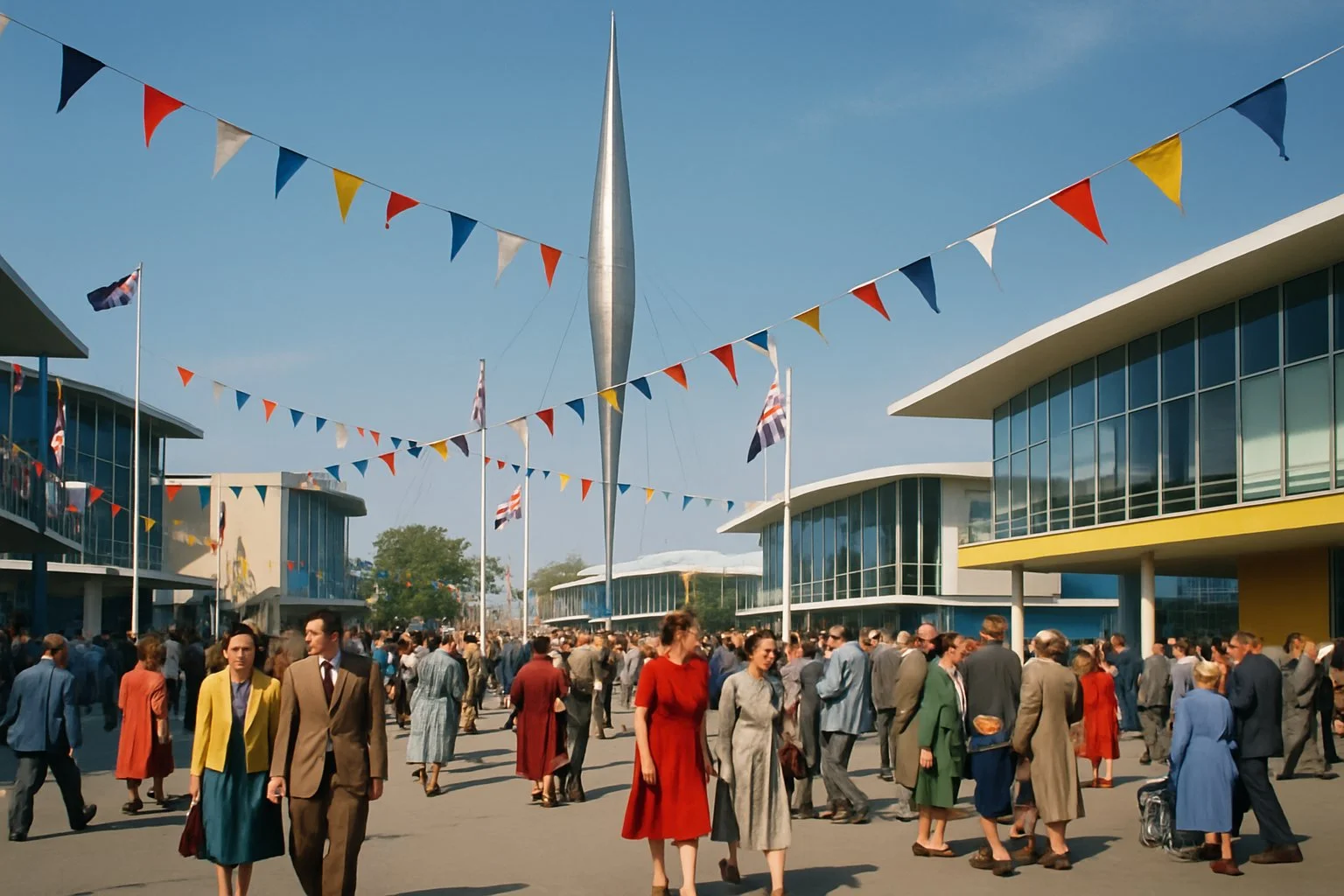
The Festival of Britain was a gutsy, almost defiant shout that Britain still mattered. It turned the South Bank into a showcase for modern architecture and design, a kind of open-air promise that the future could be bright.
Purpose and Post-War Context
The Festival was Britain’s answer to six long years of war and rationing. Kicking off in 1951, exactly a century after the Great Exhibition, it aimed to rebuild national pride and put British achievements back in the spotlight.
Running from May to September, the government threw its weight behind it. The slogan, “Land and its People,” said it all—telling Britain’s story, warts and all.
We were still patching up bomb sites and ration books. The festival tried to show us a future worth believing in, even as the country was broke and the empire was fading.
The South Bank site drew 8.5 million visitors, and the Pleasure Gardens at Battersea lured another 8 million. If nothing else, that proved people were hungry for hope and a bit of spectacle.
Key Architectural Landmarks
The South Bank’s new landmarks were pure post-war optimism. The Royal Festival Hall was the only one built to last, meant for concerts and culture long after the bunting came down.
The Dome of Discovery was a monster—biggest aluminium dome in the world at the time, packed with science and tech exhibits. It was a flex, showing off British engineering.
But the Skylon was the star. Floating above the site, it looked like nothing else. Critics joked it was like the British economy—“no visible means of support”—but it really did feel like reaching for something higher.
Other pavilions dotted the grounds:
- Sea and Ships Pavilion (Basil Spence designed it)
- Lion and Unicorn Pavilion
- Power and Production Pavilion
- The ’51 Bar and Fairway Café
Instead of neat rows, the buildings clustered around a wonky square—breaking with the old exhibition style.
A National ‘Tonic’: Art, Science, and Design
The festival earned its “tonic to the nation” nickname by showing off British creativity at every turn. Science, art, manufacturing—they all got their moment.
Design details popped up everywhere: zig-zag railings, atom-like decorations. Those little touches stuck around British architecture for years.
The exhibition told a story of progress—engineering, manufacturing, art, all pointing toward a modern future.
After years of drabness, the bright colours and bold buildings felt like a breath of fresh air. The festival was meant to cheer us up, and honestly, it worked for a while.
Most of it vanished after the 1951 election, when the Conservatives swept in and Churchill ordered the site cleared. Only the Royal Festival Hall dodged the wrecking ball. Still, you can spot festival-inspired design all over the country if you look closely.
Royal Festival Hall and the South Bank Renaissance
The Royal Festival Hall pulled the South Bank out of its postwar slump, turning a bombed-out patch into a cultural hub. Its 1951 opening kicked off decades of creative energy and urban renewal that still hums today.
Architectural Innovation and Legacy
The Royal Festival Hall was Britain’s boldest post-war building. When Clement Attlee laid the foundation in 1949, he said it would prove we weren’t “just a nation of shopkeepers.”
Key Features:
- 2,700 seats, with acoustics that set a new standard
- Modernist concrete and glass
- Reinforced concrete frames—a first
- That egg-box ceiling for perfect sound
It’s the only permanent survivor of the 1951 festival. In 1981, it became the first post-war building to get Grade I listing.
Robert Matthew led the council’s team, with young designers like Leslie Martin shaping the hall’s brutalist look—a style that would define the South Bank for years.
Cultural Impact and Concerts
The Royal Festival Hall quickly became London’s top concert venue. King George VI opened it on 3 May 1951, and Sir Adrian Boult and Sir Malcolm Sargent led the first performance.
Big names flocked in. Toscanini’s 1952 concerts drew 60,000 ticket requests—people even camped overnight in the foyer, hoping for a spot.
Memorable Moments:
- 1958: Ravi Shankar’s first of many appearances
- 1960: Eurovision Song Contest broadcast from here
- 1965: Stravinsky’s last London show
- 1972: Elton John debuts “Rocket Man” live
The hall welcomed everything—classical, experimental, you name it. It never got stuffy.
Urban Regeneration
The Royal Festival Hall sparked a transformation. By 1967, new brutalist neighbors like the Hayward Gallery and Queen Elizabeth Hall joined it, expanding the area’s arts scene.
In 1983, we opened the foyers to the public every day, not just before shows. Suddenly, the South Bank belonged to everyone—exhibitions, shops, restaurants, and all.
That openness made the South Bank London’s unofficial living room. In the ’70s, skaters took over the Undercroft, turning the concrete into Britain’s skateboarding HQ.
Today, millions wander the South Bank, from the London Eye down to Tower Bridge. But the Royal Festival Hall still feels like the heart of it all—a reminder that bold ideas can reshape a whole neighborhood.
Dome of Discovery: Ambition Under a Giant Roof
The Dome of Discovery was the festival’s most daring structure, stretching 365 feet across the South Bank with eight themed galleries celebrating British innovation. Its prefab aluminium shell was cutting-edge, and the crowds poured in, eager for a glimpse of the future.
Exhibition Themes
Inside, the Dome took visitors on a wild tour from the ground up to the stars.
The Land and The Earth kicked things off, all about geology and exploration.
Polar highlighted British feats in the Arctic and Antarctic. The Sea celebrated our maritime roots.
Sky focused on aviation and weather, while Outer Space tapped into the era’s rocket obsession.
The Physical World covered physics and chemistry breakthroughs. The Living World looked at biology and medicine.
The whole dome hammered home the idea that “British initiative in exploration and discovery is as strong as it ever was.” It was meant to boost national confidence, and for a while, maybe it did.
Keith Vaughan painted a 50-foot mural for the dome. No photos survive—just some sketches in old auction catalogues.
Engineering Feats
At 365 feet across and 93 feet tall, the Dome was the world’s biggest in 1951.
Ralph Tubbs designed it so parts could be built off-site and then slotted together—pretty clever for the time.
Freeman Fox & Partners handled the engineering, with Oleg Kerensky and Gilbert Roberts leading the charge. They used new aluminium construction techniques.
Horseley Ironworks of Tipton got the building contract. They passed some work to Structural and Mechanical Development Engineers in Slough.
Costain Group poured the concrete base. The aluminium frame was pure modernism and showed off British engineering muscle.
A dramatic escalator led you inside, setting the tone right away—this was the future, or at least a good try at it.
That prefab approach worked. Crews got the dome up fast, meeting the festival’s tight schedule.
Public Engagement
The dome drew huge crowds all summer.
Visitors entered on that grand escalator. Inside, galleries buzzed with hands-on exhibits—science, tech, and a dash of wonder.
The Dome, along with the Skylon, became an instant icon. They helped make modernist architecture something the public could get excited about.
People, still living with ration books and bomb scars, found hope in the dome’s optimistic vision.
The building’s family-friendly layout welcomed everyone. Interactive displays made complicated science feel accessible.
Photos and news stories spread the dome’s fame well beyond London. It popped up in regional papers and magazines everywhere.
When the dome came down in 1952, people were furious. Many saw it as senseless vandalism, not just the end of a temporary exhibit.
Afterlife of the Skylon and Forgotten Marquees
After the Festival of Britain wrapped up in 1952, the Skylon’s story got muddled in rumor and politics. Its demolition sparked decades of urban legends, and all that’s left are a few scraps—faint reminders of a time when Britain dared to dream big, if only for a moment.
Demolition and Urban Myths
Winston Churchill wanted the Skylon gone in 1952, seeing it as this awkward relic of Labour’s big post-war dreams. The demolition cost—£30,000—felt like a bit much for a government still counting every penny.
George Cohen, Sons and Company, a scrap metal outfit, actually took the thing apart over in Canning Town. That’s all there was to it. But the public? They weren’t having such a dull ending.
Rumours started flying. Some folks swore the Skylon was:
- Chucked into the River Lea
- Buried under Jubilee Gardens
- Tossed in the Thames
- Turned into tourist trinkets
In 2011, BBC Radio 4 finally dug up the truth. Turns out, almost all of it just got scrapped. A few bits, though, ended up as commemorative paper knives—tiny mementos from a big dream.
Memorials and Traces Left Behind
Not much of the Skylon’s left these days. The Museum of London keeps the base, and a few private collectors have managed to hold onto the wind cups.
Those aluminium paper knives are probably the closest we’ll ever get to the real thing now. They’ve got these little inscriptions: “Made from the aluminium alloy roof sheets which covered the Dome of Discovery at the Festival of Britain, South Bank.” Strange to think of holding history in your hand like that.
You can still wander by where the Skylon once stood, if you’re feeling nostalgic. It’s just there on the South Bank, tucked between the London Eye and Hungerford Bridge, right by Jubilee Gardens where the old Dome of Discovery used to be.
The Skylon’s Modern Legacy
Oddly enough, the Skylon’s name keeps popping up. In 2007, D&D London opened a restaurant called Skylon on the third floor of Royal Festival Hall, taking over from The People’s Palace. Not quite the same, but hey, it’s something.
People still campaign to bring the Skylon back. There’s just something about it—maybe the optimism, maybe the sheer weirdness—that sticks in the mind.
The Skylon’s influence even wandered beyond Britain. A handful of bands and artists picked up the name, seeing it as this badge of creative hope and that peculiar post-war energy.
You’ll spot nods to the Festival of Britain in the South Bank’s modern architecture, but none of it really dares like the Skylon did. Nothing else quite shouts “the future!” in the same way.
Post-War Optimism and Cultural Hangover
The Festival of Britain really did light a spark—people genuinely hoped for something brighter. But after 1951, it all got a bit tangled. The media and public memory have twisted the festival’s story over the years, often holding it up next to the Great Exhibition of 1851, as if to say, “Look what we used to do.”
Dreams versus Post-Festival Realities
The festival painted a future that felt just out of reach. Folks wandered through those shiny exhibitions, dreaming of tomorrow, while rationing dragged on until 1954.
What the Festival Promised:
- Modern homes packed with gadgets
- New industry, new jobs
- A bold, forward-thinking nation
- Science making life better for everyone
What Actually Happened:
- Housing shortages dragged on through the ‘50s
- The economy limped along, uneven and slow
- Most of those futuristic designs never made it into real homes
The Skylon ended up as a kind of symbol for all that. It soared, briefly, then disappeared almost as soon as the festival closed.
Working-class families showed up expecting a glimpse of their own future. Instead, they trudged back to bombed-out streets and the same old austerity.
The Royal Festival Hall stuck around, but mostly as a venue for the middle classes, not the open, democratic space people had hoped for.
Media, Memory and Changing Perceptions
British newspapers at first went all in, calling the festival a triumph of national spirit. The Times gushed about “British genius,” and local papers ran stories on communities pitching in.
By the 1960s, though, the mood shifted. Critics saw the festival as a bit of faded optimism from an empire on the wane. Writers started calling the South Bank “concrete brutalism” instead of “modern wonder.”
Changing Media Narratives:
- 1950s: Recovery and hope
- 1960s: Out-of-date optimism
- 1970s: Nostalgic for better days
- 1980s onwards: A kind of founding myth for British modernism
TV documentaries in later years leaned hard into nostalgia, playing up the community spirit and quietly sidestepping the tough times that followed.
Social historians these days talk about a “cultural hangover” from all those bright promises. The hope was real, but looking back, maybe it was a bit early for a country still piecing itself together.
Comparisons with the Great Exhibition of 1851
The Festival of Britain deliberately echoed the Great Exhibition of 1851, but the times couldn’t have been more different. Prince Albert’s grand affair flaunted Britain at the peak of imperial swagger, while 1951 found the country searching for some kind of renewed purpose—maybe even a sense of itself.
Key Differences:
| Great Exhibition 1851 | Festival of Britain 1951 |
|---|---|
| Celebrated empire and industry | Promoted post-war recovery |
| Crystal Palace housed global exhibits | South Bank focused on British achievements |
| Profitable commercial venture | Government-funded cultural project |
| Permanent Crystal Palace legacy | Mostly temporary structures |
The Crystal Palace really captured that Victorian faith in progress and empire. You’d walk through its endless halls, marveling at treasures from every corner of the Empire—a bit overwhelming, honestly, but unforgettable.
In 1951, the festival felt more like a deep breath and a look inward. We highlighted British contributions to world civilisation, quietly proud but less interested in shouting about dominance. Maybe we were a little weary, but there was a certain determination in the air.
The Great Exhibition rode a wave of real economic growth, while the Festival of Britain sort of hoped to spark one. It’s funny—looking back, the Crystal Palace burning down in 1936 almost felt like the end of an era. By ’51, we tried to build new monuments for a different world, but when the Skylon came down, you had to wonder if we were really ready to let go of the past.




Leave a Reply