
Fawlty Towers still holds a special place in the hearts of anyone who grew up with British TV, partly because it showed us just how funny a well-timed insult or a bit of chaos could be. Basil Fawlty’s volcanic rants and his arsenal of creative put-downs became legendary. The staff and guests, meanwhile, often just played dumb or pretended they hadn’t heard a thing. There’s something brilliant about the way the show balanced swearing, sarcasm, and those deliberate misunderstandings—it all felt a bit naughty, but somehow still proper.
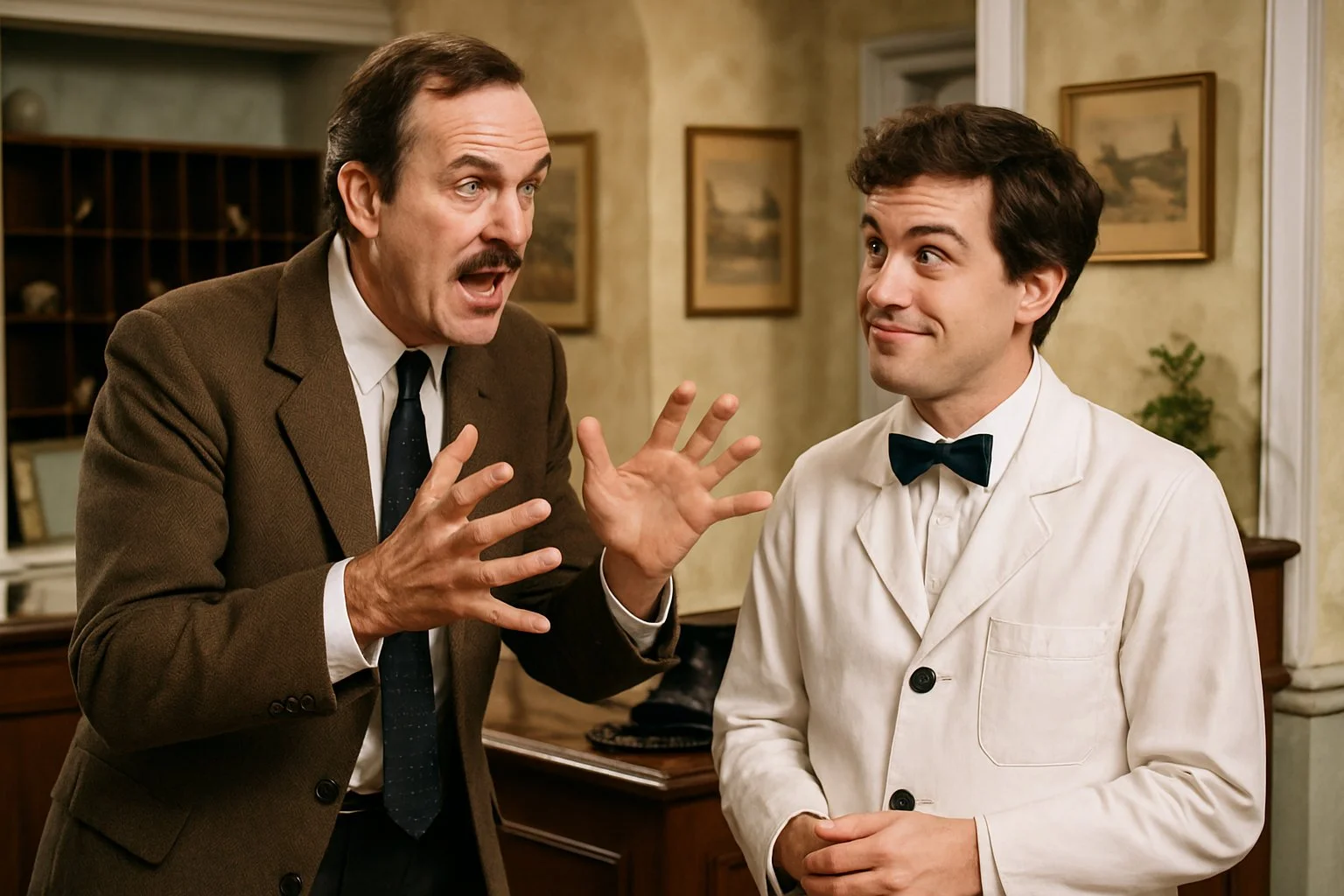
Kids would listen in, picking up Basil’s colourful phrases without really knowing what they meant. The whole language barrier with Manuel, the hapless Spanish waiter, added another layer—everyone could just claim they’d misheard, which kept things just about family-friendly while letting the show get away with more than most. If you grew up in a house where Fawlty Towers was on, you probably remember parents laughing at jokes you only half understood and then telling you not to repeat them at school. That’s the kind of boundary-pushing that felt exciting, even if we didn’t know why.
The interplay between Basil’s razor-sharp tongue and the confusion it left in its wake is what makes the show stick in the mind. His arguments with Sybil, the exasperation with guests, and the endless cycle of swearing and miscommunication—somehow it all adds up to something that still feels fresh, even decades later.
Basil Fawlty’s Swearing: Wit, Frustration, and Comic Timing

Basil didn’t just swear—he turned it into an art form. His insults, loaded with British wit and a healthy dose of snobbery, always seemed to come out at just the right moment. John Cleese, with his impeccable timing and physical presence, could make even the mildest swear word sound like the funniest thing you’d ever heard.
The Art of British Insults in Fawlty Towers
Basil’s insults weren’t just about being rude; they were about showing off, trying desperately to seem more refined than he was. He’d mutter things under his breath when guests annoyed him, all while keeping up that forced, brittle smile.
He loved to attack people’s intelligence or their social standing, calling someone a “cloth-eared bint” or making sly digs about their background. It was all part of his endless quest to seem like he belonged somewhere higher up the social ladder.
Who usually got Basil’s sharp tongue?
- Guests with simple, innocent requests
- Poor Manuel, the Spanish waiter
- Sybil, his wife (though usually in a mutter)
- Anyone he thought was beneath him (which, let’s be honest, was most people)
Classic Basil Outbursts and Their Origins
Basil’s explosions always started small—something minor would go wrong, he’d try to fix it in the cheapest or quickest way possible, and then, inevitably, it would all blow up in his face. That scene where he beats his own car with a tree branch? Pure, escalating frustration.
The show built up the tension, letting us watch Basil unravel before finally snapping in a way that felt both inevitable and hilarious. His job forced him to serve people he couldn’t stand, and he just couldn’t hide his contempt. That constant push and pull—wanting to be posh, hating the people he served—fueled every meltdown.
Influence of John Cleese’s Performance
John Cleese didn’t just play Basil; he inhabited him. The way he’d stretch his lanky frame, throw his arms around, or contort his face—he turned every insult into physical comedy gold.
Cleese knew exactly when to shout and when to mutter, squeezing every drop of humour from Basil’s misery. His background in physical comedy made every tantrum bigger and funnier, but it was the little things—the sneers, the clipped tones for “proper” guests, the snarls for everyone else—that really made Basil’s insults sting.
Pretending Not to Understand: Manuel, Polly, and the Language Barrier

Manuel’s struggles with English and Polly’s half-hearted attempts to translate gave us some of the show’s best moments. The language barrier wasn’t just a running gag—it was a way for everyone to dodge responsibility and stir up even more confusion.
Manuel from Barcelona: Language Gags and Confusion
Andrew Sachs turned Manuel into the world’s most lovable disaster. He’d mix up words, misunderstand Basil’s frantic instructions, and generally make things worse. Remember the whole butter/donkey mix-up? Basil tried to explain “butter,” Manuel ended up teaching him “donkey” in Spanish, and neither had a clue what was happening.
But sometimes you got the feeling Manuel was playing it up, using his language struggles to dodge Basil’s wrath. His innocent “Qué?” could buy him a few seconds or even get guests on his side.
Polly Sherman: Translator, Instigator, and Comic Foil
Polly, played by Connie Booth, was the only one who seemed to have her head screwed on. She’d translate between Manuel and everyone else, but let’s be honest—she didn’t always help. Sometimes she’d let Manuel flounder just to get out of extra work or to mess with Basil. She knew exactly what was going on but picked her moments to jump in.
That gave her a sneaky sort of power. Depending on her mood, she could smooth things over or let them spiral out of control.
Cultural Stereotypes and Running Gags
Manuel’s character became the heart of all those language jokes. His mix-ups and Mrs Richards’ inability to hear made for endless confusion. There’s no denying the show leaned into the “confused foreigner” stereotype, but Manuel’s genuine sweetness softened it a bit. He was always trying, even if he was hopeless.
And let’s face it—we’ve all been there, lost in translation or struggling to get our point across in another language. That’s part of why it worked so well.
Fawlty Towers’ Supporting Cast and Iconic Set Pieces
It wasn’t just Basil’s meltdowns that made the show. The supporting cast—Sybil, Major Gowen, the shifty builder O’Reilly, and a parade of unforgettable guests—turned everyday hotel life into pure comedy.
Sybil Fawlty: The Sharp Tongue Behind the Scenes
Sybil ruled the hotel from behind her desk, rarely breaking a sweat. She’d be on the phone or reading magazines while Basil ran himself ragged.
Her “Oh, I know” summed up her attitude perfectly—she always seemed one step ahead of Basil’s schemes. He’d try to keep things from her, but she saw right through him.
He dreaded her more than any guest complaint. One sharp “Basil!” from across the lobby could stop him in his tracks.
Their marriage was a war zone disguised as hotel management, with Sybil holding the purse strings and Basil forever plotting, never winning.
Major Gowen, The Builders, and O’Reilly
Major Gowen, the resident relic, wandered the hotel in a fog of nostalgia and confusion. His stories rambled on, often veering into territory that felt awkward even back then.
When Basil hired O’Reilly to do repairs on the cheap, disaster was guaranteed. Doorknobs fell off, walls crumbled, and yet Basil kept calling him back—classic self-sabotage.
These characters highlighted Basil’s terrible judgement. He’d put up with the Major’s outdated views and O’Reilly’s bungling, all in the name of keeping up appearances.
Tibbs, Lord Melbury, and Unforgettable Guests
Miss Tibbs and Miss Gatsby, the fluttery permanent residents, treated the hotel like their own private club. Tibbs giggled at everything; Gatsby complained non-stop. They were always there, always in the background.
Lord Melbury, supposedly aristocratic, turned out to be a fraud. Basil, blinded by snobbery, fell for it completely while ignoring real guests.
Other standouts—Mrs. Peignoir (the accidental grope), Mr. Hutchinson (witness to Basil’s fire drill meltdown), and Ronald Heath (mistaken for a hotel inspector)—each brought out a new level of Basil’s panic and pretension. The show knew that for chaos to work, you need a few straight-laced guests to bounce off.
How Swearing and Misunderstanding Shape the Fawlty Towers Legacy
Basil’s legendary temper and Manuel’s endless confusion made for a kind of comedy that mixed mild swearing with total mayhem. It’s no wonder these have become touchstones of British humour.
The Setting: Hotel, Bar, and Dining Room Chaos
The hotel itself was the perfect backdrop for all this madness. The dining room? That was ground zero. Guests expected proper service, but what they got was Basil’s barely contained rage.
Whenever Basil tried to act posh—especially when a “VIP” like Melbury showed up—things fell apart fast. The dining room brought everyone together, so the chaos just multiplied.
There was nowhere for Basil to hide. He’d mutter curses, thinking guests couldn’t hear, while Manuel’s misunderstandings turned even the simplest requests into slapstick disasters.
Physical Comedy: Dining Room Door and Garden Gnome
Honestly, that dining room door deserved a credit in the show. Basil slammed through it, kicked it open, or used it to hide from guests—sometimes all in the same episode. It was comedy you didn’t need words to get.
The garden gnome scene—Basil battering his car with a branch—became one of those moments everyone remembers. Physical comedy like that softened the sting of his insults and made the swearing feel lighter, more forgivable. The slapstick let families laugh together, even when the dialogue got a little spicy.
Fawlty Towers never needed to go full blue to get a laugh. It danced right up to the line, winked, and somehow made even the most chaotic moments feel like home.
Impact on British Comedy and Popular Culture
Back in 1982, Fawlty Towers snagged a Queen’s Award for Export Achievement for a couple of its training film episodes. It really showed the world that you could do character-driven comedy—keep the language pretty tame—and still get laughs everywhere. Basil Fawlty, with all his fluster and fury, even picked up the title of the most “Monstrous Boss on British TV” from UK Gold in 2003. Not exactly a trophy you’d put on the mantel, but still—iconic in its own way.
You can see the show’s fingerprints all over later British sitcoms. Writers realized you could let a character stew and snap for just a dozen episodes, and it’d be enough—no need to drop F-bombs every other line. The Gleneagles hotel in Torquay, where John Cleese got his spark, sort of became this legendary place thanks to the show, even if most folks never set foot there.
Stage plays and remakes kept popping up over the years; guess you can’t keep a good format down. Teachers even use old episodes to give students a taste of British culture and language—imagine learning English from Basil’s rants! There’s something about those outbursts that still feels honest, not just lines on a page. Even now, the laughter just sneaks up on you, like you’re right there in the lobby, watching the chaos unfold.






Leave a Reply