
Growing up in 1970s Britain—well, that was something else. The country was in flux, and for kids, every day seemed to bring a new twist.
You had this blend of old-school manners and wild new freedoms, and honestly, it made for a childhood that doesn’t quite exist anymore.
Let’s take a wander back and see how school life shifted: the uniforms, the lessons, even the way teachers talked to you. Entertainment? That was changing fast too—suddenly, we had more options than ever, and parents seemed a bit less strict about letting us roam. It’s funny to think how much independence we had compared to today.
Britain’s streets started looking different as families from all sorts of backgrounds arrived, especially in the cities. With colour TV and those clunky first video games popping up, kids in the 70s were living through a moment that still shapes how we remember being young.
School Life and Education in 1970s Britain

Schools in the 70s felt like they were turning upside down. Comprehensive schools started taking over, and suddenly you had to stay in school until you were 16. Teachers began experimenting with new ways to teach, ditching some of the old strictness.
The Switch to Comprehensive Schools
Comprehensive schools started to dominate secondary education. In 1970, most kids still went to grammar, technical, or secondary modern schools, but by 1972, comprehensive schools had way more pupils—over 119,000 more girls and 131,000 more boys than the old secondary moderns. That’s a wild jump in just a couple of years.
Kids aged 11-18 all landed in the same school, no more 11-plus exam stress just to get into a grammar. It didn’t matter where you came from or how you did on some test—you just went to the local comp and got on with it.
Raising the School Leaving Age to 16
In 1972, the Education Act bumped the school leaving age up from 15 to 16. Before that, loads of kids left at 15 to work or start training. Suddenly, we all had to stick around for another year.
That same year, the Education Work Experience Act let students spend part of their last year out in the real world, trying actual jobs. It was pretty forward-thinking, giving us a taste of work life before we’d even left school.
With these changes, teenagers found themselves with more time to figure things out—what they were good at, what they wanted to do next. It felt like the world was opening up, just a bit.
Changes in Classrooms and Learning Resources
Some things from earlier decades faded away. Free school milk for kids over seven? Gone. Before that, everyone got a third of a pint every day, which sounds odd now but was just part of life.
Sex education started to get a bit more real, too. Biology books finally showed what was what, and teachers talked more openly about relationships in lessons. The classrooms loosened up. Teachers weren’t quite so strict, and you could actually have a laugh sometimes.
Schools were slowly gearing up for even bigger changes that would hit in the 80s, but you could already feel things shifting.
Children’s Fashion Trends in the 1970s

If you were a kid in the 70s, your wardrobe was probably a riot of colour and weird shapes. Flared trousers were everywhere—seriously, you couldn’t escape them. Pop stars like The Jackson 5 and The Osmonds set the trends, and we all tried to copy them, even if our mums rolled their eyes.
Flared Trousers and Popular Styles
Those bell-bottom jeans—tight at the waist and then exploding out at the ankles—were the thing. Boys, girls, didn’t matter. You’d see them at school and in the playground, in denim, corduroy, and any colour you could imagine.
There were wide collars, platform shoes that made you feel about a foot taller, loud jumpers, and denim jackets covered in patches. The patterns? Stripes, polka dots, wild psychedelic swirls—sometimes it looked like a rainbow exploded in the high street.
Unisex clothes started to make sense, too. Dungarees, t-shirts, tracksuits—didn’t matter if you were a boy or a girl, you just wore what you liked.
Influence of Pop Music on Kid’s Fashion
Pop music was everything. If you saw it on Top of the Pops, you wanted it. The Jackson 5’s bright shirts and giant flares, The Osmonds’ squeaky-clean look, David Bowie’s glitter and wild colours, or the Bay City Rollers with their tartan—everyone picked their favourite and tried to copy it.
Even TV shows like The Brady Bunch gave girls ideas—maxi dresses took off after they showed up on screen. And if your parents were feeling generous, you might get Sesame Street pyjamas or a jumper with Big Bird on it.
Everyday Life for Kids in the 1970s
Kids in the 70s had a kind of freedom that’s hard to imagine now. We played outside for hours, watched colour telly for the first time, and started noticing that family life was changing as more mums went to work.
Playing Outside and Favourite Toys
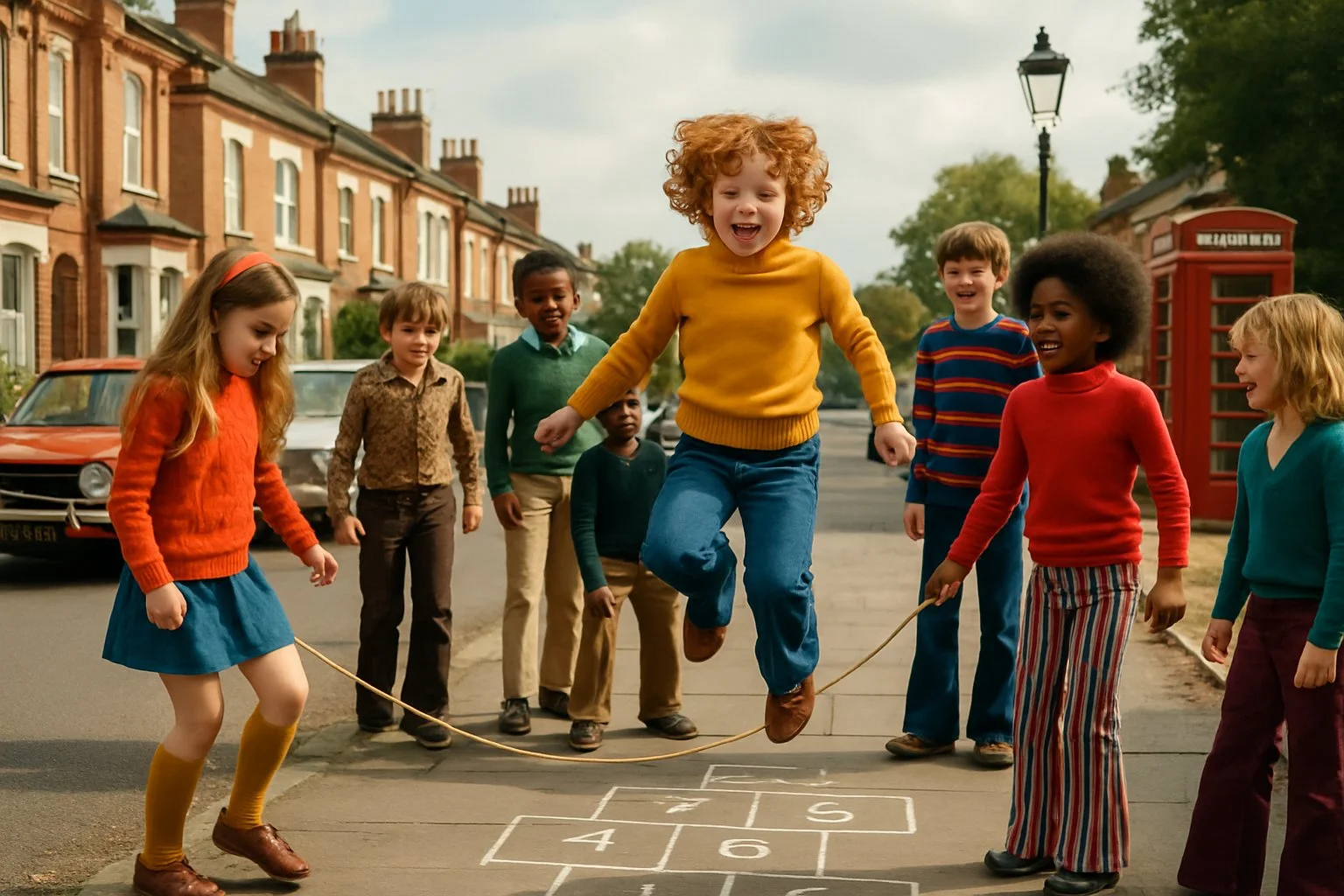
We lived outdoors. Parents just let us go—“be back for tea!”—and off we’d run. Hopscotch, marbles, British Bulldog, you name it, we played it right there on the pavement.
What did we drag along? Space Hoppers, those ridiculous orange bouncy balls; Raleigh Chopper bikes with the banana seats and high handlebars (if you got one for Christmas, you were royalty); skipping ropes, yo-yos, footballs, cricket bats—our gardens and streets were our playgrounds.
After Star Wars hit in ’77, it was all about the toys. Lightsabres, action figures, Darth Vader masks—suddenly, every back garden was a galaxy far, far away.
We built dens out of whatever we could find—old sheets, cardboard boxes, bits of wood. Those hideouts felt like secret worlds, away from grown-ups.
Television and Popular Programmes
Colour TV finally made it into most living rooms, and it was like seeing the world in a new way. Before that, everything was black and white—hard to believe now.
We’d crowd around the telly at set times, because if you missed your show, tough luck. No catch-up, no video recorders (well, hardly anyone had them). You just waited and hoped for a repeat.
Blue Peter was a staple, and Tiswas made Saturday mornings wild. The Magic Roundabout and Jackanory were must-sees, especially if you liked a bedtime story.
Saturday mornings became family time, with cartoons and variety shows over breakfast. Everyone watched the same stuff, so you always had something to talk about at school.
And then there were those first video games—Pong, mostly. Hooked up to the telly, it was clunky and basic, but we thought it was magic.
Changing Family Roles
Home life was shifting. More mums started working, so the old family routines got a bit scrambled. A lot of us became “latchkey kids,” letting ourselves in after school and fending for ourselves until our parents got home.
Dads pitched in more with chores, and kids took on extra jobs around the house. Meal times got less formal—sometimes you just grabbed a sandwich and ate in front of the TV. Single-parent families were becoming more common, too.
We learned to make our own snacks, start our homework, and keep ourselves entertained. It made us independent, but I won’t pretend it never got lonely.
Weekends mattered more. Parents tried to make up for busy weekdays with day trips, family games, or a walk in the park. Those moments stick with you.
1970s Entertainment: Music, Films, and Sport
Entertainment in the 70s? It was wild and unpredictable. Punk exploded, The Beatles vanished, and films got darker and grittier. Even sport had its ups and downs.
Children’s Music and Iconic Bands
Music was everywhere, and it shaped our lives. Play School was huge—everyone knew the songs. The theme tune still gets stuck in my head sometimes.
The Beatles splitting up in 1970 was a national shock, but then Bowie, Queen, and punk bands like the Sex Pistols came along. Punk was loud, messy, and felt like something grown-ups just didn’t get.
Some big moments:
- The Beatles’ breakup in 1970
- Bowie becoming a legend
- Punk taking over London
- Disco arriving from the States
- Queen’s “Bohemian Rhapsody” in 1975
Top of the Pops was essential viewing on Thursday nights—whole families watched together, even if your dad pretended not to care.
The Cinema Boom: Top Films
Films in the 70s weren’t like the cheerful stuff from the 60s. Suddenly, you had movies about real life, with all its messiness and struggles.
Directors started tackling tough subjects, showing what life was like for ordinary people, especially in working-class areas. Maybe it wasn’t always cheerful, but it felt honest.
British actors started making it big overseas, and going to the cinema became a regular weekend treat. You’d see families queueing up outside the local picture house, rain or shine.
Sporting Heroes and Events
Sport was a mixed bag. Football was still king, but hooliganism started to creep in, making some matches feel a bit dodgy. Families sometimes stopped going because it just didn’t feel safe.
Still, we had heroes to cheer for. England’s cricket team had their moments, British athletes shone at the Olympics, and tennis fans will never forget Virginia Wade winning Wimbledon in ’77.
Boxing was a Saturday night staple on TV, and racing—horses or Formula One—always drew a crowd. Sport in the 70s could thrill you or let you down, sometimes both in the same afternoon.
Living Conditions and Neighbourhoods
Where you lived in the 70s really shaped your childhood. Council estates popped up everywhere, and neighbourhoods started to look and feel different as new communities formed.
Typical Homes and Streets
Most kids grew up in terraced houses or council flats. Lots of families moved into new council estates, with modern flats, local shops, and playing fields just around the corner. Some places finally got central heating, but plenty still had outside loos—imagine that in winter.
Kids ruled the streets, riding their Raleigh Choppers and playing games in the road. There were fewer cars, so it felt safer to just be out there.
Colour TVs were becoming a fixture in living rooms, but you’d still find old houses with coal fires and basic kitchens. It was a mix of old and new.
Impact of Social Changes and Policies
Immigration from the Commonwealth changed the look and feel of British cities. Black and Asian families brought new cultures, foods, and traditions, and suddenly schools were more diverse than ever.
The government built more council homes to replace crumbling old slums, and some families finally got better places to live. Not everywhere benefited, though—some inner-city areas became crowded and run-down, with not enough for kids to do.
Important Social Changes and Events
The 1970s packed in a lot of change for kids. New laws aimed to protect us, welfare programmes improved, and then you had those big moments—like the Queen’s Silver Jubilee—that brought everyone together, even if just for a street party and some dodgy sandwiches.
Children’s Rights and Welfare Improvements
Back in the 1970s, the government really shook things up for kids and their families. There were new welfare benefits cropping up, and suddenly, a lot more families got the help they needed.
Key welfare improvements included:
- Child allowances went straight into mothers’ hands and, honestly, that made a world of difference.
- Pension rights stretched to cover another 100,000 folks—no small thing.
- Families could get a new attendance allowance, which, for some, felt long overdue.
- Kids with special needs finally got a bit more of the support they deserved.
And then there was the Equal Pay Act of 1970. That one—well, it meant mothers finally had a shot at wages that felt fair. It’s hard to overstate how much that extra bit of income helped when it came to looking after the kids.
Healthcare for children took a turn for the better, too. The NHS started rolling out more services just for young people. More kids got their check-ups and vaccinations—no more slipping through the cracks.
Notable Historical Events That Affected Kids
A handful of big moments in the 1970s really shook up childhood. When the UK switched to decimal currency in 1971, kids suddenly had to wrap their heads around a brand new way of counting coins and paying for sweets. Teachers did their best, but it was a headache at first.
Major events children experienced:
- 1976: That legendary heatwave—scorching days, endless sun, and the kind of summer that still pops up in conversations.
- 1977: The Queen’s Silver Jubilee—whole neighborhoods coming together for street parties, bunting everywhere.
- 1976: Concorde taking off on its first commercial flight—felt like something out of a sci-fi comic.
The Silver Jubilee stands out. For kids, all those street parties and the shiny commemorative coins felt like a real treat. There was a sense of excitement in the air, a kind of pride, even if we didn’t totally grasp the significance.
Strikes were just part of life. When dustmen or postal workers walked out, families had to muddle through. Kids might’ve missed out on letters from pen pals, or watched rubbish pile up on the pavement, wondering how long it would last. It was all a bit chaotic, but somehow, we got used to it.






Leave a Reply