
Picture this: it’s May 1964, and Britain’s seaside towns are about to become battlegrounds for one of the most famous youth culture clashes in history.
Two tribes couldn’t have been more different—smartly dressed Mods zipping around on their Vespa scooters, and leather-clad Rockers roaring past on powerful motorcycles.
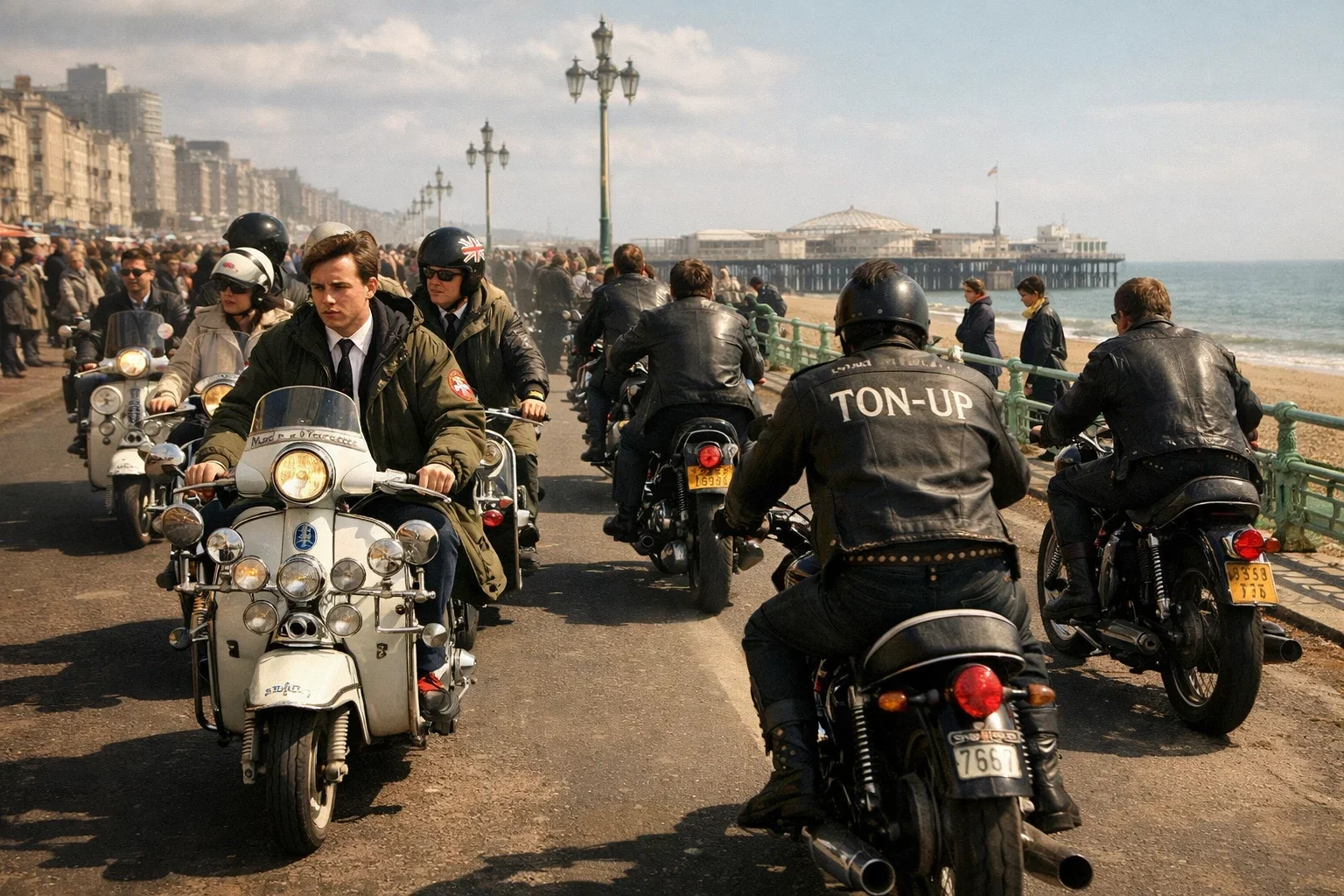
The Bank Holiday weekend of May 1964 saw violent clashes between Mods and Rockers in seaside towns like Brighton, Margate, and Clacton, with gangs using deck chairs as weapons and causing riots that shocked the nation.
What started as cultural differences between these two subcultures exploded into full-scale warfare that grabbed headlines and sparked a moral panic about British youth.
We’ll explore how these opposing tribes emerged from Britain’s social landscape, what drove them to such bitter rivalry, and why their battles became legendary. From the origins of their distinct styles and sounds to the media frenzy that followed, this clash represents a pivotal moment when youth culture took centre stage in Britain’s social consciousness.
The Origins of Mods and Rockers

The mods and rockers burst onto the scene thanks to a wild mix of post-war prosperity, teenage freedom, and a streak of rebellion that swept through England during the late ’50s and early ’60s. These rival youth tribes carved out identities shaped by economic growth, seaside leisure, and the first wave of British teenagers who actually had money to burn.
Rise of British Youth Subcultures
By the late 1950s, something had shifted. Teenagers in Britain finally had a space of their own—no longer just mini-adults, but a whole new breed with jobs, cash, and a taste for fun. They could spend on clothes, music, and, of course, wheels—whether that meant a rumbling motorcycle or a sleek scooter.
Rockers showed up first, around 1958, obsessed with American rock and roll—Eddie Cochran, Gene Vincent, all that. The 1953 film The Wild One with Marlon Brando? That was their blueprint for cool.
Mods came along a bit later, around 1960, with a whole different vibe. Modern jazz, soul, and sharp fashion ruled their world. They wanted to look crisp, stand apart from their parents, and spent a small fortune on Italian suits and tidy haircuts.
Both groups wanted to escape the dull, gray world of their parents. They used fashion and music to draw lines in the sand, and each had their own ideas about what it meant to be stylish or cool.
Baby Boomers and Post-War England
The first baby boomers, born after WWII, hit their teens in the late ’50s. They grew up in a Britain that was finally recovering—no rationing, no wartime gloom, just possibility.
Most of these kids left school at fifteen and landed jobs in factories or offices. Suddenly, there was cash in their pockets—enough for records, clothes, a scooter or a bike.
Compared to their parents:
- More money to play with as teens
- A steady stream of American music and movies
- The freedom to roam on weekends
- Not much patience for old-school authority
This generation felt optimistic, eager to break away from tradition. They didn’t want their parents’ music or their hand-me-down clothes. The stage was set for a new kind of youth culture.
Social and Economic Backdrop
Britain’s early ’60s economy was humming along. Jobs were everywhere, wages kept climbing, and working-class teens could finally splash out on themselves.
What made mods and rockers possible:
- Full employment meant paychecks for nearly everyone
- Hire purchase made scooters and bikes actually attainable
- New shops catered just to teens
- Record stores were bursting with American and British hits
Social changes mattered, too. Teens were staying out later, traveling farther, and forming their own tribes. The class system played its part—Mods often leaned a bit more middle-class, while Rockers wore their working-class roots with pride.
Emergence of Seaside Resort Towns
Seaside towns—Brighton, Margate, Clacton—were magnets for these youth tribes. Cheap digs, endless amusements, and no parents in sight? Irresistible.
On bank holidays, thousands of teens swarmed the coast. Mods rolled up in packs on Italian scooters. Rockers thundered in on motorcycles. The whole thing was a spectacle—everyone trying to outdo, outshine, or just plain outnumber the other side.
Why the seaside?
- Bargain beds and plenty to do
- No one breathing down your neck
- Open roads for racing along the seafront
- Cafés and dance halls to hang out in
The coast cranked up the rivalry. Mods and rockers jostled for the best spots, and local businesses, while happy to take their money, braced for trouble.
By 1964, these weekend gatherings had turned massive. The powder keg was well and truly primed.
Mod Subculture: Scooters, Style, and Sound

The Mod movement—now that’s a look that still turns heads. Sharp Italian suits, Lambretta scooters decked out with more mirrors than sense, and a soundtrack of jazz and soul that spilled from London’s clubs down to every seaside town.
Signature Fashion and Parkas
Mod fashion took its cues from the Italian styles lighting up Soho. Those suits? Slim, sharp, and always immaculate. Narrow lapels, pressed trousers, the works.
The famous parka wasn’t just for show. Mods wore these army surplus coats over their suits while riding, keeping the road grime off their expensive threads.
Core fashion bits:
- Italian suits—mohair, tonic, always tailored
- Button-down shirts and skinny ties
- Chelsea boots and desert boots
- Ben Sherman and Fred Perry shirts
- Haircuts—short, neat, not a strand out of place
Mods spent a fair chunk of their pay on clothes. It wasn’t just about looking good; it was about belonging.
Lambretta Scooters and Customisation
Lambretta scooters were the pride of the Mod fleet. Italian, stylish, and practical—you could ride in your best suit and still look sharp at the end of the journey.
But a stock scooter? Forget it. Mods tricked them out with chrome, lights, and a ridiculous number of mirrors. Some looked like mobile light shows.
Popular mods (no pun intended):
- Loads of mirrors—sometimes a couple dozen
- Extra lights everywhere
- Chrome racks and rails
- Wild paint jobs
- Furry seats—because why not?
Convoys of scooters heading for Brighton or Margate became a regular sight. And yeah, sometimes things got heated when Rockers showed up.
Music, Clubs, and Influential Bands
Music fueled everything. Modern jazz, Motown, ska—that was the Mod playlist. Soho’s underground clubs spun American soul and R&B records long before the rest of Britain caught on.
The Who and The Small Faces basically became the Mod house bands. The Who’s “I Can See for Miles” still feels like a Mod anthem.
We hunted down:
- Motown—The Supremes, The Temptations
- Modern jazz—Miles Davis, Coltrane
- British blues—The Yardbirds
- Imported soul—the deeper, the better
Clubs like the Flamingo or the Marquee kept the party going all night. Mods popped amphetamines to keep dancing—sometimes for days. Not exactly healthy, but it was a different time.
Key Mod Locations
If Mods had a home, it was Soho. Carnaby Street buzzed with energy, clubs thumped with new sounds, and the shops were packed with the latest gear.
Brighton and the Sussex coast were the weekend playgrounds. Massive scooter rallies, beachside hangouts, and, every now and then, a showdown with the Rockers.
Spots that mattered:
- The Flamingo Club—all-night dancing in Soho
- Carnaby Street—fashion central
- Brighton seafront—the gathering place
- The Marquee Club—live music, always loud
- Record shops everywhere
Mods claimed these places. Walking through Soho, you could spot your tribe by the cut of their suit and the swagger in their step. The movement spread from these London roots to just about every city in Britain.
Rocker Subculture: Motorcycles and Rebellion

The rockers, now they were a different breed. Born out of Britain’s working class in the ’50s, they lived for powerful bikes and American rock ‘n’ roll. Black leather, heavy boots, and a love for speed defined their look and attitude.
Motorcycles and Americana Influence
Rocker culture owed a lot to American motorcycle movies—The Wild One especially. British rockers took that image and ran with it, but made it their own with homegrown bikes.
They swore by Triumph Bonneville, BSA Gold Star, and Norton Commando—machines built for racing between cafés and towns. The bikes weren’t just transport; they were freedom, rebellion, and a little bit of danger all rolled into one.
Rockers stripped down their bikes, ditching anything that slowed them down. The open road was their escape from the grind and the class system.
Black Leather Jackets and Boots
The rocker uniform? Unmistakable. Black leather jackets for protection and attitude, heavy boots for the ride, and denim jeans—usually cuffed.
Key pieces:
- Motorcycle boots or brothel creepers
- Denim jeans, sometimes worn to shreds
- White tees or checked shirts
- Leather caps, though not everyone bothered
Leather jackets were more than just gear—they were a badge of honor. Some rockers added studs, patches, or band names to stand out even more.
Rock and Roll Roots
Music was everything. 1950s rock and roll—loud, brash, and a bit wild—was the rocker soundtrack. Eddie Cochran, Gene Vincent, Bo Diddley… those records never got old.
British acts like Billy Fury found a home in the rocker crowd, too. The music was fast, raw, and matched the thrum of a motorcycle engine.
Rockers didn’t care for the jazz and soul the Mods loved. They wanted something that sounded like rebellion, something that felt like theirs.
Rocker Gathering Spots
Cafés were the heart of rocker life—especially the legendary Ace Café in North London. Food, music, and a place to show off your bike? Perfect.
Transport cafés along the big roads became unofficial HQs. Rockers met up, compared bikes, plotted rides, and kept the jukebox spinning.
Weekend runs to the seaside were a tradition. Groups would ride out, sometimes ending up in Brighton or Margate—right where the Mods liked to gather.
The café scene let rockers build a world of their own, a place to belong when the rest of society didn’t seem to care.
Bank Holiday Clashes: When Mods and Rockers Went to War

Spring 1964—something was in the air. Thousands of teens, hungry for excitement, flooded seaside towns during the bank holidays. Boredom and bravado soon tipped over into outright war between Mods and Rockers along England’s southern coast.
Lead Up to the Seaside Riots
It all kicked off at Easter 1964 in Clacton, Essex. The weather was lousy, there wasn’t much to do, and about a thousand young Londoners were itching for action.
Groups split off by tribe—Mods over here, Rockers over there. It didn’t take long before stones started flying and fists followed.
The press pounced. Headlines shrieked ‘Day of Terror by Scooter Groups’ and ‘Wild Ones Invade Seaside’.
They drew a straight line to Marlon Brando’s The Wild One, which only added fuel to the fire. The media coverage, if anything, gave kids a script for the next round.
The Easter dust-up was small potatoes compared to what was coming. But the way the newspapers spun it? That set the scene for May’s Whitsun weekend, when things really blew up.
Brighton, Hastings, Margate, and Clacton Showdowns
Whitsun weekend of 1964—well, that was the wild peak of the whole Mods and Rockers saga. The mayhem tumbled through Brighton, Hastings, Margate, and Clacton over a few days in May.
Brighton? That’s where it all really kicked off. About a thousand teenagers—Mods and Rockers—collided on the beach and up on the promenade. The police managed 76 arrests, which, considering the chaos, wasn’t as many as you’d think.
Margate down in Kent got its share of trouble, too. Roughly 400 kids tangled with each other, and police arrested 64 over the weekend.
You could spot the pattern a mile off. Rockers, decked out in leather, would roar in on their motorbikes, usually on Sunday morning. Then the Mods would glide up on their Italian scooters, looking sharp and usually outnumbering the Rockers.
Clacton and some other Essex spots didn’t escape, either. The violence there wasn’t quite as widespread as the headlines claimed, but it sure felt threatening if you were there. People noticed.
The Role of Police and Public Safety
Local police just weren’t ready for the flood of teenagers. Most of those towns had small police forces, more used to helping lost tourists than breaking up mass brawls.
Officers scrambled to keep up as groups split off across beaches and town centers. The sheer number of kids overwhelmed them.
A lot of these cops didn’t have much experience with youth subcultures. Sometimes they couldn’t even tell who was looking for trouble and who just wanted a day at the seaside.
They called for backup from nearby towns, but that only led to more confusion—different forces, different ways of doing things.
Locals and holidaymakers started to worry about safety. Some families just stopped coming on bank holidays. Who could blame them?
Iconic Imagery and Stories
The whole episode gave us some of the most unforgettable snapshots of 1960s youth. Photographers caught everything—fists flying, scooters lined up, chaos on Brighton Beach.
One Mod remembered it like this: “The beach was like a battlefield. It felt like we were taking over the country.” Maybe he exaggerated, but you can almost picture it.
Those photos turned into symbols of rebellion—young folks taking over places adults once ruled. The visual contrast was striking: Mods in their sharp suits and spotless scooters, Rockers in battered leathers.
You can still see echoes of those days in films like Quadrophenia. The images stuck around, a kind of shorthand for youth rebellion in Britain.
Media, Moral Panic, and Public Perceptions
The press really ran with the story. What started as a few seaside scraps turned into a full-blown national crisis in the papers, and sociologist Stanley Cohen later called it a moral panic. Headlines made it sound like the country was under siege by wild teenagers, and honestly, that template for reporting on youth never really went away.
Press Sensationalism and Coverage
Papers splashed stories of the 1964 Easter weekend at Clacton and Brighton across their front pages. They didn’t hold back—words like “vermin” and “louts” made the headlines.
The Birmingham Post warned that mods and rockers might be “internal enemies” who could bring about “disintegration of a nation’s character.” Police Review magazine said their antics might spread “like a forest fire.”
Some of the worst exaggerations? There were headlines like “Mod Dead in Sea” for drownings that had nothing to do with the fights. Reporters made up interviews, like the notorious “Mick the Wild One.” Minor scuffles became “disastrous proportions” overnight.
The BBC covered the aftermath and talked up the imprisonments, but if you look closer, most incidents involved small groups and brief dust-ups. The mass violence was mostly in the headlines.
Stanley Cohen’s ‘Folk Devils and Moral Panics’
Stanley Cohen dug into the mods and rockers clashes and wrote it all up in “Folk Devils and Moral Panics” in 1972. He argued the fights weren’t much worse than the usual seaside or football scraps from earlier decades.
He came up with the term moral panic for the way society overreacts to certain groups. Mods and rockers became “folk devils”—scapegoats for all kinds of social anxiety.
Cohen pointed out how the media whipped up fear, which led to tougher police action, which then led to more confrontations—feeding the press with fresh material. It was a self-perpetuating cycle, really.
His work changed how people thought about social problems and the stories we tell about them in the media.
Social Issues Connected to the Clashes
The panic over mods and rockers wasn’t just about a few fights. It tapped into deeper worries about where Britain was heading in the swinging sixties. Post-war prosperity meant kids had money and time on their hands, and that unsettled a lot of adults.
People fretted about:
- Families changing and parents losing control
- Young people breaking away from old rules
- Consumerism shaping new values
- Class boundaries getting blurry
Those bank holiday fights became stand-ins for bigger debates about morals and national identity. Politicians and local leaders used them to push their own agendas, from education to law and order.
It wasn’t just Britain either. All over the West, as the baby boomers grew up, similar panics flared up about “the youth.”
Enduring Stereotypes and Legacy
That old mods and rockers panic set the stage for how we talk about youth cultures. Every new tribe—hippies, punks, chavs—got the same treatment: dramatic headlines, adult hand-wringing, and a lot of misunderstanding.
What stuck:
- Media zeroing in on conflict, not the ordinary stuff
- Grown-ups worrying about “kids these days”
- Police and courts acting under pressure from the headlines
- Youth groups getting defined by how threatening they seemed
The movie “Quadrophenia” in 1979 really locked in the romantic version of those days. Funny thing is, most people who were there say it wasn’t nearly as wild as the legend.
Now social media spreads these panics differently, but the pattern’s weirdly familiar. New youth trends—video games, TikTok challenges—still get the same old treatment, just with faster headlines.
Music, Fashion, and Cultural Impact
Mods and rockers didn’t just fight—they changed what Britain looked and sounded like. Their music and style left fingerprints all over pop culture, and you can still spot their influence if you know where to look.
Influence on British Bands and Pop Culture
The Who—if you ask me, they were the definitive mod band. Sharp suits, wild shows, that whole attitude. Their album Quadrophenia basically tells the story of the mod scene and those Brighton riots.
The Small Faces came out of the same world, all tailored suits and soul-infused rock. They helped take mod music mainstream.
Rockers, on the other hand, were into a different beat. They blasted Gene Vincent and early rock ’n’ roll—nothing polished about it. The divide was pretty clear.
Motown and ska became the heartbeat of mod life. Those sounds shaped the way mods danced, dressed, and even how they saw themselves.
Later on, bands like The Police picked up the mod vibe. Sting and the others leaned into the style and even mixed ska into their music. Proof that the mod influence didn’t just fade away after the ’60s.
Legacy in Fashion and Modern Tribes
Parkas—you still see them everywhere. Mods made them iconic, partly because they kept those expensive suits safe on scooter rides.
Mod style was all about:
- Crisp suits
- Italian-cut jackets
- Skinny ties
- Shiny shoes
Rockers went the other way: black leather jackets became their badge. That look inspired loads of later youth scenes. The rebel image stuck.
Even now, designers and high street shops borrow from both camps. Mod lines show up in modern collections, and you’ll spot rocker touches in just about every “edgy” range.
Kids today still form tribes around music and clothes, just like back then. The whole mod-versus-rocker thing set the blueprint for punks, skinheads, new romantics, you name it. Some things never really change, do they?
Mod vs Rocker in Film and TV
The 1979 film Quadrophenia really brought the mod movement crashing onto the big screen. It threw viewers right into the chaos of the 1964 Brighton riots, capturing those wild tribal clashes. For a lot of us, that movie was the first time we saw mod culture in all its messy, glorious detail.
Television documentaries pop up every so often, digging into both scenes. They love poking around in the social tensions and the raw, youthful rebellion that colored 1960s Britain. Even now, these stories bubble up in popular culture, refusing to fade away.
Fashion magazines can’t seem to resist the pull of mod and rocker style either. You’ll spot photo shoots channeling the swagger and sharp looks of both tribes. There’s something about those visuals—they just stick, don’t they?
And then there’s advertising. Brands love slapping mod scooters and rocker motorbikes into their campaigns. It’s a shortcut to that feeling of rebellion, that flash of British youth culture. Even if you weren’t there, you kind of wish you had been.






Leave a Reply