
School days in the 1970s—now there’s a memory.
If you went to secondary school back then, chances are you spent hours in woodworking shops making wobbly chairs, or in home economics kitchens, sweating over steak and kidney puddings that never quite looked like the teacher’s demo.
These weren’t just add-ons; they were right at the heart of what you learned.
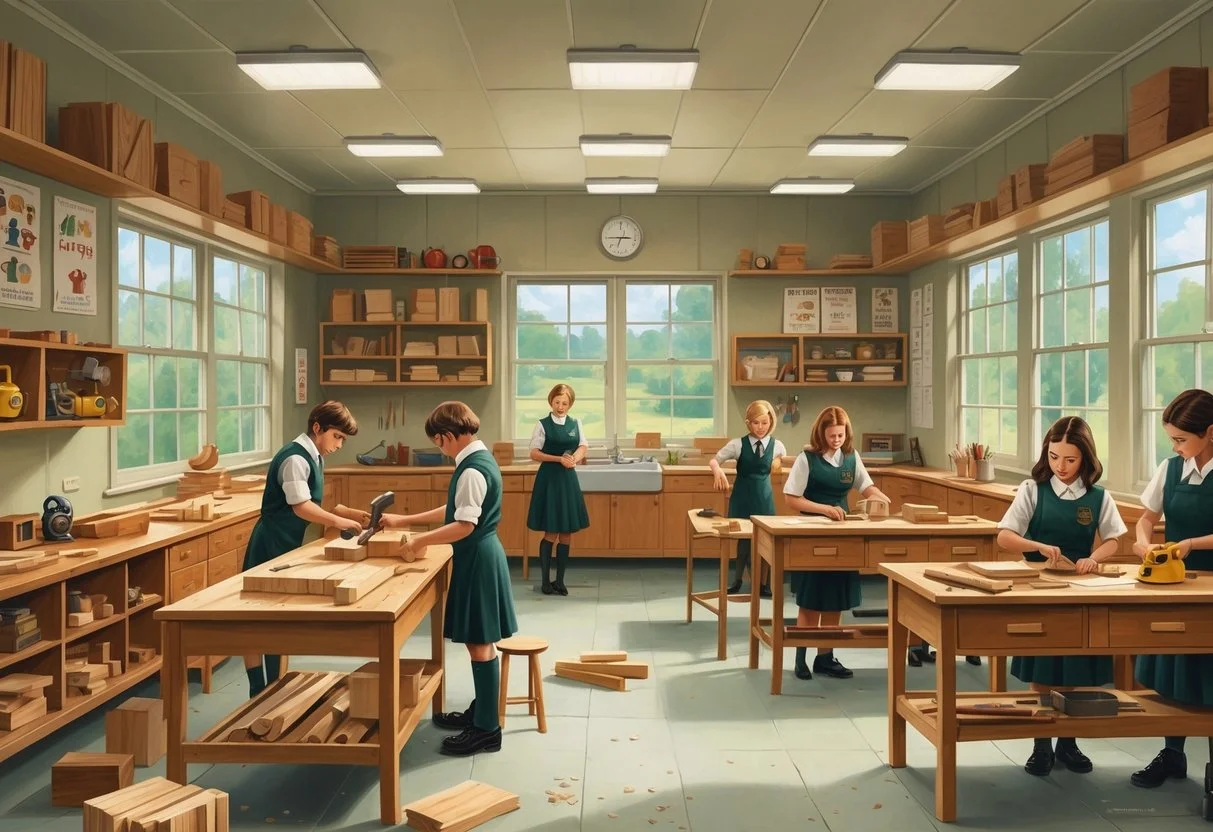
Timetables mixed algebra and Shakespeare with sawdust and the smell of baking. Boys and girls shuffled between workshops and kitchens, picking up skills that felt useful—sometimes more useful than trigonometry, if you’re honest. Those shiny new craft wings in comprehensive schools, with their rows of benches and gleaming ovens, seemed almost futuristic at the time.
Nobody looked down on these subjects. If you were more into hands-on stuff, you could shine just as much as the brainy kids. There was a sense that learning to use your hands mattered, and it really did shape how a whole generation saw themselves and their futures.
The Place of Woodwork and Home Economics in 1970s Schools

Woodwork and home economics were right there in the thick of the curriculum during the 1970s, reflecting the changing winds around education and gender roles in British schools.
The Rise of Practical Subjects in the Curriculum
Before 1989, schools treated woodwork, metalwork, home economics, and needlework as their own separate worlds. They built proper craft wings to house all this activity.
Take The Holy Trinity School in Crawley, which opened its doors in 1967. It boasted woodworking and metalworking shops that smelled of oil and sawdust, plus a home economics suite with shiny demonstration kitchens and individual cooking bays.
Comprehensive schools drew a lot from secondary moderns, which already had a strong tradition of teaching crafts and manual skills.
Key subjects included:
- Woodwork and metalwork
- Home economics (cooking and nutrition)
- Needlework and textiles
- Technical drawing
If you lived near places like Manor Royal, your school probably funneled kids straight into local factories or trades. The practical stuff wasn’t just for show—it prepped you for the world waiting outside the school gates.
Gender Roles and Changing Expectations
By the late ‘60s and early ‘70s, schools started to shake up the old rules about what boys and girls should learn. Suddenly, boys found themselves sewing, and girls picked up saws and hammers.
It felt like a small revolution. Teachers talked about “the new world coming.” Still, not everything changed overnight. Metalwork often stayed a boys-only club, and some lessons clung to old stereotypes.
Traditional expectations still influenced teaching:
- Girls picked up the skills for running a home
- Boys got prepped for factory or trade work
- The curriculum echoed the social attitudes of the day
Home economics was all about practical cooking—making those classic British dishes that still show up at family gatherings.
Types of Schools Offering Practical Subjects
If you went to a comprehensive, you probably got the full spread: woodwork and home economics under one roof. Secondary moderns had already set the bar high, and comprehensives ran with it.
Primary schools gave you a taste too. Little ones learned to thread needles and make fairy cakes, though nothing as ambitious as the older kids.
Different school types offered varying programmes:
| School Type | Woodwork | Home Economics | Age Range |
|---|---|---|---|
| Primary | Basic skills | Simple cooking | 5-11 years |
| Secondary Modern | Full workshops | Complete kitchens | 11-16 years |
| Comprehensive | Extensive facilities | Professional suites | 11-18 years |
Vocational schools kept their craft traditions alive, often running evening classes for adults from the neighborhood.
Grammar schools, usually more academic, started to dip their toes into woodwork around this time too. Out in the countryside, rural schools leaned even harder into practical skills—maybe because life demanded it.
School Life: Timetables, Facilities, and Daily Routines

The school day in the 1970s revolved around practical subjects like woodwork and metalwork. Schools poured money into proper workshops and made sure these lessons got enough time—no quick dashes between bells.
Structure of the School Day
Your school timetable back then ran from 9:00 AM to 3:30 PM, with periods you could almost set your watch by.
Woodwork and metalwork weren’t crammed into quick 40-minute sessions. You usually had them once or twice a week, and when you did, they lasted—double periods of 70 or 80 minutes weren’t unusual.
Drawing lessons often went hand-in-hand with practical work. You’d sketch designs before heading to the workshop, sometimes with more enthusiasm than skill.
A typical day looked like:
- Morning registration at 9:00 AM
- Four periods before lunch
- Lunch break from 12:00-1:00 PM
- Two afternoon periods
- Home at 3:30 PM
Specialist Classrooms and Equipment
Schools took pride in their workshops. These weren’t just old classrooms with a few tools—these were purpose-built, with the smell of new wood and oil in the air.
Woodwork rooms had rows of benches, each with its own vice and a battered set of hand tools. Everyone had a little cubby for their half-finished projects.
Safety was basic: goggles if you remembered, aprons to protect your uniform (or at least try). The rules were simple, but you learned to respect the tools.
Key workshop features included:
- Benches with built-in vices
- Tool cabinets lined up along the walls
- Racks stacked with pine, beech, and other woods
- A few power tools, like a pillar drill (if you were lucky)
- First aid box in the corner
Metalwork had its own space, with anvils and forges that seemed both exciting and a bit scary.
Drawing rooms were lighter, with big tables and the scratch of pencils echoing off the walls.
Double Periods and Hands-On Learning
Those double periods made all the difference. You had time to get stuck in—no mad rush to finish a project in half an hour.
The lesson usually started with everyone grabbing their stuff and setting up. Then you’d get a solid hour to saw, hammer, or cook, while the teacher wandered around, offering advice or a gentle nudge when you got stuck.
Cleanup was a group effort. The last ten minutes were for sweeping up sawdust or washing out mixing bowls. Not glamorous, but it taught you to respect the space.
With that extra time, you could actually finish things. A wooden stool or a metal hook took weeks, but you saw real progress each time.
Key Practical Subjects: Skills and Experiences
Workshops, kitchens, and specialist rooms—these were where you picked up skills you’d actually use. You learned old-fashioned crafts and essential life skills that still come in handy today, honestly.
Woodwork: Workshops and Projects
In the woodwork shop, you started with the basics—chisels, saws, planes. Projects were simple at first: bookends, stools, maybe a wobbly spice rack.
Safety was drummed in, but there was always someone who nicked a finger. The smell of wood shavings and varnish still brings it all back.
Typical Projects:
- Wooden toys and games
- Storage boxes
- Small shelves or stools
- Garden tools, if you were ambitious
Teachers showed you the difference between pine and oak. Pine was soft and forgiving; oak, not so much. You practiced measuring, cutting, and joining. Getting a mortise and tenon joint just right felt like a real achievement.
Sanding and finishing took patience—sometimes more than you had.
Home Economics: Kitchens and Life Skills
Home economics happened in bright, tiled kitchens with rows of cookers. Aprons on, hands washed, off you went.
First up: scrambled eggs or fairy cakes. Measuring flour, following recipes, trying not to drop anything on the floor (not always successfully).
Essential Skills Taught:
- Cooking basics: boiling, frying, baking, grilling
- Nutrition: what made a balanced meal
- Kitchen safety: sharp knives and hot pans
- Budgeting: planning meals, making shopping lists
You learned to set the table and, like it or not, had to do the washing up. Etiquette was part of the lesson, even if everyone giggled through it.
There was also a bit of household management: how to clean, sew on a button, or stretch a family budget. These lessons stuck, even if you didn’t realize it at the time.
Metal Work and Technical Drawing
Metalwork felt like stepping into another world. You picked up hammers and files, made simple hooks or brackets, and learned to respect the forge’s heat.
Projects were usually small but felt substantial—something you could actually use.
Technical drawing went hand-in-hand, with drawing boards, set squares, and rulers everywhere.
Drawing Skills:
- Working to scale
- Drawing technical plans
- Visualizing objects from different angles
- Using proper instruments (and not losing them!)
Drawing first, then making—if only life always worked like that.
Needlework Classes
Needlework started with the basics: running stitch, cross stitch, chain stitch. Everyone made a sampler, some neater than others.
You moved on to aprons or cushion covers. The sewing machine was a rite of passage—threading it was a test of patience.
Key Techniques:
- Hand sewing with different stitches
- Using the sewing machine (eventually)
- Reading and cutting patterns
- Simple garment construction
Embroidery added a personal touch. Mending and darning weren’t glamorous, but they saved money and gave you a quiet sense of pride.
Educational Outcomes and Pathways from Practical Subjects
Practical subjects in the 1970s opened doors for kids who weren’t heading for university. These lessons gave you real-world skills, and for many, they were the first step toward a job or apprenticeship.
Vocational Skills and Factory Work
Woodwork and home economics taught you what employers wanted. If you were at a secondary modern, these lessons filled your week.
Boys learned to handle lathes, saws, and tape measures—skills that translated straight into carpentry shops or factories. Factories needed people who could read a technical drawing and use their hands without fuss.
Girls picked up cooking, sewing, and running a household—skills that led to jobs in kitchens, textile mills, or as the backbone of family life. Knowing how to budget or whip up a meal from scratch was more valuable than it sometimes gets credit for.
Key factory skills from practical subjects:
- Safe tool use
- Following instructions (even if you grumbled about it)
- Quality control—making sure things looked right
- Managing your time
- Working with your hands, not just your head
By sixteen, you could walk into a job interview with something to show for your time at school. That hands-on experience counted for a lot, and maybe it still should.
Qualifications and Exams
Back in the 1970s, most hands-on classes didn’t really land you any fancy qualifications like A-levels. Instead, you’d get school certificates or maybe just some kind of internal assessment—nothing too official.
A few technical colleges did offer City and Guilds certificates in woodwork and similar trades, which actually meant something if you were eyeing an apprenticeship. But honestly, most comprehensive schools just wanted you to get your hands dirty and pick up real skills, not stress over exams.
CSEs (Certificate of Secondary Education) tossed in some practical stuff, too. Maybe you’d build a little table in woodwork or put together a home economics portfolio, and that counted toward your grade. It wasn’t as academic as O-levels, sure, but it still showed what you could do.
Really, though, your projects were your ticket. If you showed up to a job interview with a chair you’d made or could whip up a decent meal, that spoke louder than any piece of paper.
Academic Versus Vocational Tracks
Back in the 1970s, school felt like a fork in the road—either you went down the academic path or you landed in something more hands-on. If you made it into the top streams, you’d spend your days slogging through O-levels and A-levels, barely touching anything practical.
Secondary modern schools leaned hard into practical stuff. Most days, you’d find yourself in a workshop or a kitchen instead of stuck behind a desk. They really aimed to get you ready for work straight out of school, not a university lecture hall.
Comprehensive schools tried to blend the two, but let’s be honest—practical subjects usually got pegged as the “less academic” option. That old divide between “academic” and “practical” kids just wouldn’t go away.
Typical subject splits:
- Grammar/top streams: Languages, sciences, maths
- Middle streams: Mix of academic and practical
- Lower streams: Heavy focus on practical subjects
Those exam results at 11? They pretty much decided whether you’d be poring over Latin verbs or smoothing out a plank in woodwork. Funny how much rode on a single test, isn’t it?






Leave a Reply