
The toys of the 1950s through 1970s hold a special place in British childhood memories. From construction sets to action figures, these classic playthings did more than just entertain children.
These beloved British toys helped develop problem-solving skills, sparked imagination, and encouraged hands-on creativity during a golden age of play.
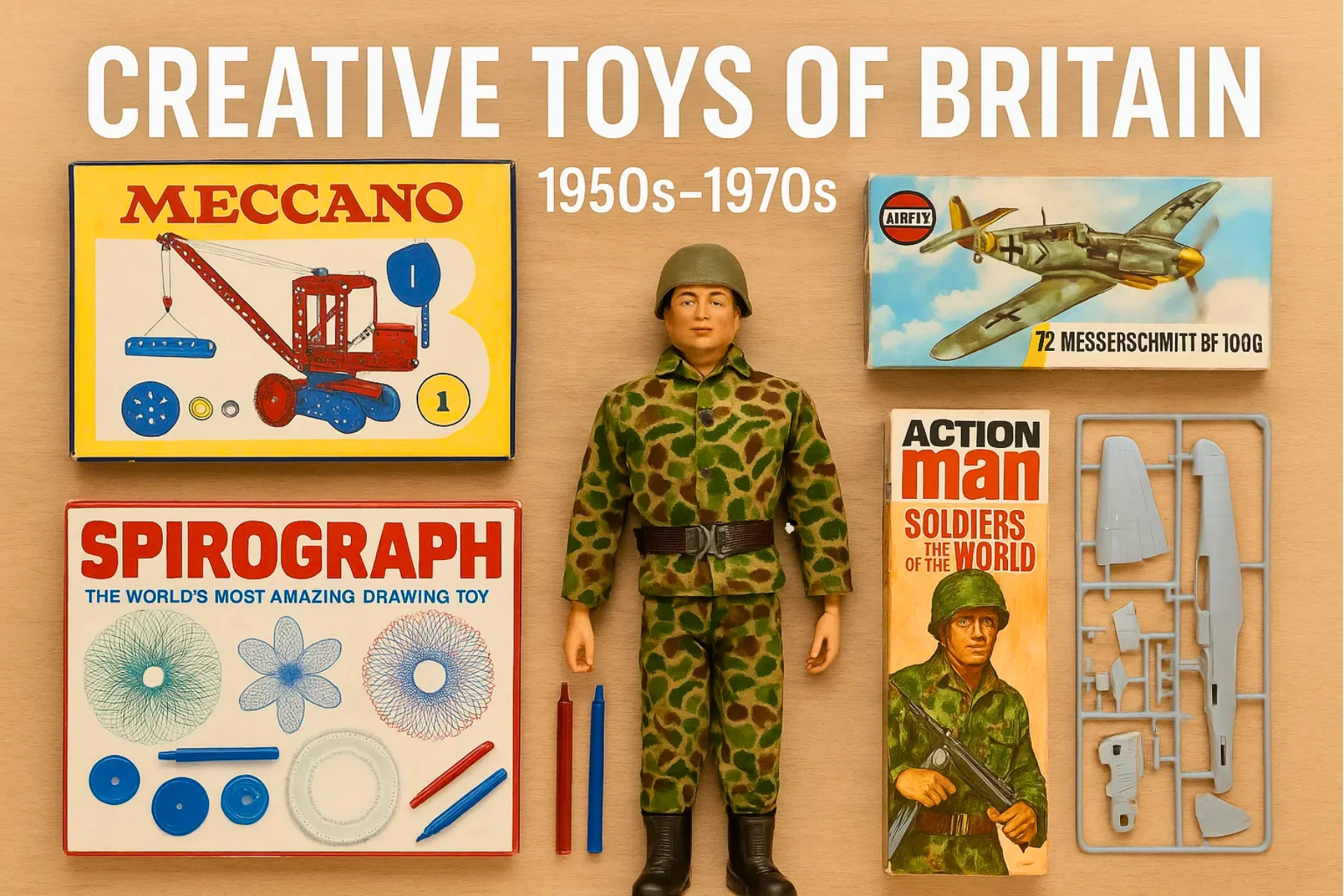
This era produced remarkable toys that challenged young minds whilst providing hours of fun. Children built railways, created intricate drawings, assembled model kits, and brought characters to life through imaginative play. Many of these toys required patience, planning, and creative thinking to master properly.
1. Mr. Potato Head
Mr. Potato Head sparked children’s imagination all over the UK. George Lerner invented this creative toy in 1949, and it quickly landed in British toy shops.
It broke new ground as the first toy ever advertised on television. Kids could make endless combinations with plastic parts—eyes, noses, mouths, you name it.
Peter Pan Toys started making British versions in the 1970s, tossing in hats, shoes, and moustaches to mix and match.
Children got to design their own silly characters, and when playtime ended, they just stuffed all the bits inside the potato body. Simple, but fun.
Mr. Potato Head stuck around because it was safe, easy, and let kids create goofy faces and unique personalities every time.
2. Spirograph
British engineer Denys Fisher dreamed up Spirograph in 1965 after noticing the intricate patterns on a £1 note. Curious about how those designs worked, he built a drafting tool using Meccano gears.
With plastic gears, rings, and pens, Spirograph mixed maths and art. Kids could make beautiful geometric patterns by moving pens in holes around fixed rings.
Spirograph snagged Toy of the Year in 1967, and Kenner scooped up the rights to take it worldwide.
By the 1970s, you had Spirotot, Super Spirograph, New Spirograph—so many versions. The original sold over 30 million units at its peak.
Parents liked that kids were learning maths without even noticing. The toy built concentration and patience through creative play, which is pretty impressive for a plastic set with pens and gears.
3. Hornby Model Railways
Hornby model railways won over British children from the 1950s onward. These detailed train sets brought the magic of real railways right into living rooms.
Hornby had been making toy trains since 1920, but by the 1950s, they’d really nailed it—realistic locomotives, carriages, and all.
Kids spent hours building tracks and miniature worlds with stations, bridges, and countryside scenes. Each piece looked just like real British trains.
OO gauge trains became the classic choice—small enough for the bedroom but detailed enough to keep young engineers hooked.
Parents often joined in, and families worked together to expand their railway empires, adding new carriages and tracks at every opportunity.
4. Dinky Toys
Dinky Toys became one of Britain’s most beloved toy ranges through the 1950s and beyond. Meccano Ltd produced these die-cast models in Liverpool from 1934 to 1979.
In the 1950s, they started numbering each toy, ditching the old letter system and making collecting way easier for kids.
These toys looked just like the real vehicles on British streets—cars, lorries, buses, even military vehicles with the latest Army equipment.
Dinky Toys fought for attention with brands like Corgi, so they added two-tone paint and windows to make their models stand out. Details like that made playtime feel more real.
The range included everything from commercial vehicles to racing cars and aircraft, not just regular cars.
5. Meccano Construction Sets
Meccano sets ruled British playrooms during the 1950s. Kids could build complex models with nuts, bolts, and metal strips.
The mid-50s were great for Meccano. Boys all over Britain formed clubs, meeting up to build elaborate models together. It was a thing.
Each set came with proper tools, and the quality was top-notch—no wonder these toys were so sought after by young builders.
Kids built everything from simple bridges to intricate locomotives. The sets taught basic engineering and encouraged creative problem-solving.
Meccano really set the standard for construction toys and inspired countless young engineers across the UK.
6. Airfix Plastic Model Kits
Airfix changed the way British kids played in the 1950s. They started out making simple toys but soon became famous for their plastic model kits.
Their first kit, a Spitfire, took off across the UK. Kids could build detailed planes, tanks, and ships at home.
The kits came with plastic pieces to glue together, so young builders had to follow instructions and focus. Painting the models made them look realistic, which was half the fun.
Airfix models taught patience and attention to detail. Kids learned about history while building WWII aircraft and military vehicles, and it definitely helped their fine motor skills.
There were kits for every skill level—simple ones for beginners, and complex designs with hundreds of pieces for the ambitious. Airfix became a British icon, sparking an interest in engineering and craftsmanship for generations.
7. Spacehopper
The Spacehopper bounced into British homes in 1968 when Mettoy brought the inflatable toy to the UK. It started life as “Pon-Pon,” but the orange Spacehopper quickly became a playground staple.
The first ones were blue, but the bright orange version soon took over as the most recognisable and loved by British kids.
Children sat on the big rubber ball, grabbed the handles, and bounced around gardens and playgrounds. It was great for developing balance and coordination.
By the 1970s, Spacehoppers were everywhere. They got kids outside, moving, and laughing. The simple design let kids invent their own games and challenges—no rules, just fun.
8. Scalextric Slot Cars
Scalextric burst onto the scene in 1957 and quickly became Britain’s favourite slot car racing system. The name caught on so much that people called all slot cars “Scalextric,” just like “Hoovers” for vacuum cleaners.
It started with basic electric tinplate cars, but by 1960, the company upgraded to detailed plastic models that looked much more realistic.
Kids built their own racing circuits with flexible track pieces and raced friends and family using hand-held controllers. Each race brought new challenges and excitement.
Scalextric let kids design wild track layouts and featured famous car brands like Porsche and Aston Martin, giving them a taste of real motorsport right at home.
It combined building skills with competitive racing—great for creativity and social play, honestly.
9. Colourforms Playsets
Colourforms brought endless creative fun to British kids from the 1950s onward. These clever sets featured coloured vinyl shapes that stuck to special boards—no glue, no mess.
The original sets had bright geometric shapes in primary colours. Kids could arrange and rearrange them to make pictures, patterns, and stories. The pieces stuck, but peeled off easily for new designs.
Colourforms soon launched themed sets with characters like Mickey Mouse, Barbie, and the Smurfs, letting kids tell stories with their favourites.
More than a billion Colourforms sets have sold since the 1950s. That’s wild.
Colourforms encouraged open-ended play. No right or wrong answers, just whatever their imaginations dreamed up next.
10. Thunderbirds Puppet Figures
Thunderbirds puppet figures exploded in popularity during the 1960s. The TV show featured “Supermarionation” puppets created by Gerry and Sylvia Anderson.
Kids could buy their own Thunderbirds marionette puppets—string puppets that looked just like Virgil Tracy and the rest of International Rescue.
Pelham Puppets and others made these, with strings kids could pull to make the figures move and dance. It took some skill, actually.
Playing with marionettes helped kids develop hand coordination and learn how to control the strings for different movements and poses.
Many British children spent hours inventing Thunderbirds adventures, bringing the TV excitement right into their own homes.
11. Palitoy Action Man
Action Man arrived in Britain in 1966, thanks to Palitoy, as a licensed copy of America’s G.I. Joe.
Palitoy made Action Man in Coalville, Leicestershire, from 1966 to 1984. Collectors call the earliest ones “Painted Head” dolls.
Kids could pick up Action Soldiers, Pilots, and Sailors. From 1970, Palitoy gave Action Man more British themes, moving away from the American vibe.
The company added military, adventurer, and sportsman characters, which helped set Action Man apart.
Palitoy introduced flocked hair—kind of a big deal—and kids could collect all sorts of uniforms, accessories, and vehicles.
Action Man encouraged imaginative play through military adventures and sports. Boys could invent endless stories with these 12-inch poseable figures.
Cultural Impact of British Toys from the 1950s to 1970s
British toys in this era shaped kids’ thinking with hands-on problem-solving and reflected the nation’s renewed hope after wartime hardships. These playthings became powerful ways for children to develop creativity and express cultural values.
Encouraging Creative Problem-Solving
British toy makers built products that made kids think outside the box. Construction sets like Meccano pushed young builders to plan, experiment, and adapt their designs.
Metal and plastic toys got cheaper in the 1950s, so more children could get their hands on complex building systems. They figured things out through trial and error.
Radio-controlled toys showed up in the late 1970s, teaching kids about cause and effect. They saw how their actions made things happen.
Companies like Britains Ltd made detailed model sets, letting kids create whole worlds with toy soldiers and farm animals. Arranging these scenes built storytelling skills, too.
Key problem-solving benefits included:
- Spatial awareness from building
- Logical thinking with electronics
- Planning with complex model sets
- Patience from detailed assembly
Reflecting Post-War Optimism
Toys from the 1950s really captured Britain’s upbeat mood after World War II. Manufacturers ditched wartime themes for brighter, cheerier designs.
Soft toys became huge at tourist spots—bulldogs, ladybirds, penguins—symbols of a lighter, happier spirit. Families loved these cuddly characters as a sign of better days.
Wartime technology found new life in toys. Plastic materials led to colourful, safer products. Kids got toys that looked modern and exciting.
Corgi and Scalextric celebrated British engineering, showing kids their country could make amazing things. That definitely sparked some pride.
With affordable, mass-produced toys, every child could join in. This more democratic approach to play matched Britain’s changing social values after the war.
How Classic Toys Shaped Childhood Learning
British toys from the 1950s to 1970s really changed how kids picked up important life skills. These toys, designed with care and a bit of whimsy, nudged children to think more creatively and helped them pick up those social abilities everyone needs later on.
Developing Imagination Through Play
Classic British toys opened doors for kids to invent their own worlds. Building blocks, train sets, and dolls—none of them came with a strict set of rules. Kids could just make up stories and scenarios as they went along.
Meccano sets nudged children toward an engineer’s mindset. They’d plan out projects, run into problems, and figure out solutions one step at a time. Every little metal piece might end up as part of a crane, a car, or maybe a wobbly building that fell over (sometimes that was the fun part).
Spirograph drawing toys let kids spin out wild, intricate patterns. Suddenly, math and art weren’t so separate—just a few gears and pens, and you’d see how geometry could turn into something beautiful.
Play kitchens and tea sets gave kids a way to mimic the grown-up world. They’d pretend to cook meals, host wild tea parties, and act out all sorts of daily routines. It wasn’t just about copying adults; it was also about weaving stories and practicing their own version of life.
Action figures and dolls usually starred in endless, sometimes dramatic adventures. Kids invented dialogue, mapped out stories, and tried on different personalities for size. That kind of play really pushed them to think creatively about people and situations.
Without any electronic bells and whistles, these toys left everything up to the child’s imagination. Kids realized pretty quickly that they could turn a simple block or doll into just about anything—if they wanted to.
Influence on Social Skills and Collaboration
Many classic toys pushed kids to team up. Board games like Monopoly and Scrabble made them follow rules and wait their turn. Winning was fun, but losing? Well, they learned to handle that too—sometimes with a smile, sometimes not.
Building sets were just more fun with friends. Two kids could throw together something wild that one alone might not have dreamed up. They’d toss ideas back and forth, sometimes clash, sometimes laugh, and almost always end up with something cooler than expected.
Dolls and action figures got everyone involved. Suddenly, there were stories, whole worlds, and a cast of characters. Sharing control of the plot wasn’t always easy, but it definitely kept things interesting.
Out on the playground, skipping ropes and balls brought people together. Someone had to start the game, someone else had to make sure everyone got a turn. It was a crash course in fairness, whether anyone realized it or not.
Role-playing toys let kids try on different hats—doctor, teacher, shopkeeper, whatever they could imagine. It wasn’t just pretend; it was practice for the real world, and honestly, it helped a lot of shy kids find their footing.
Those group games and shared projects? They sparked friendships that sometimes lasted way past childhood. All that building, arguing, and laughing together built trust and communication skills that stuck around, even when the toys were packed away.






Leave a Reply