
Ask any British bloke over sixty about his old haircut and you’ll get a story, usually involving a comb, a tin of grease, and a very unimpressed mother.
From the greased-up quiffs of the 1950s Teddy Boys, to the Beatles’ mop-tops and Mod cuts of the 1960s, to the long layers, perms and sideburns of the 1970s, British men’s hairstyles got longer, bolder and far harder to maintain with every passing decade.
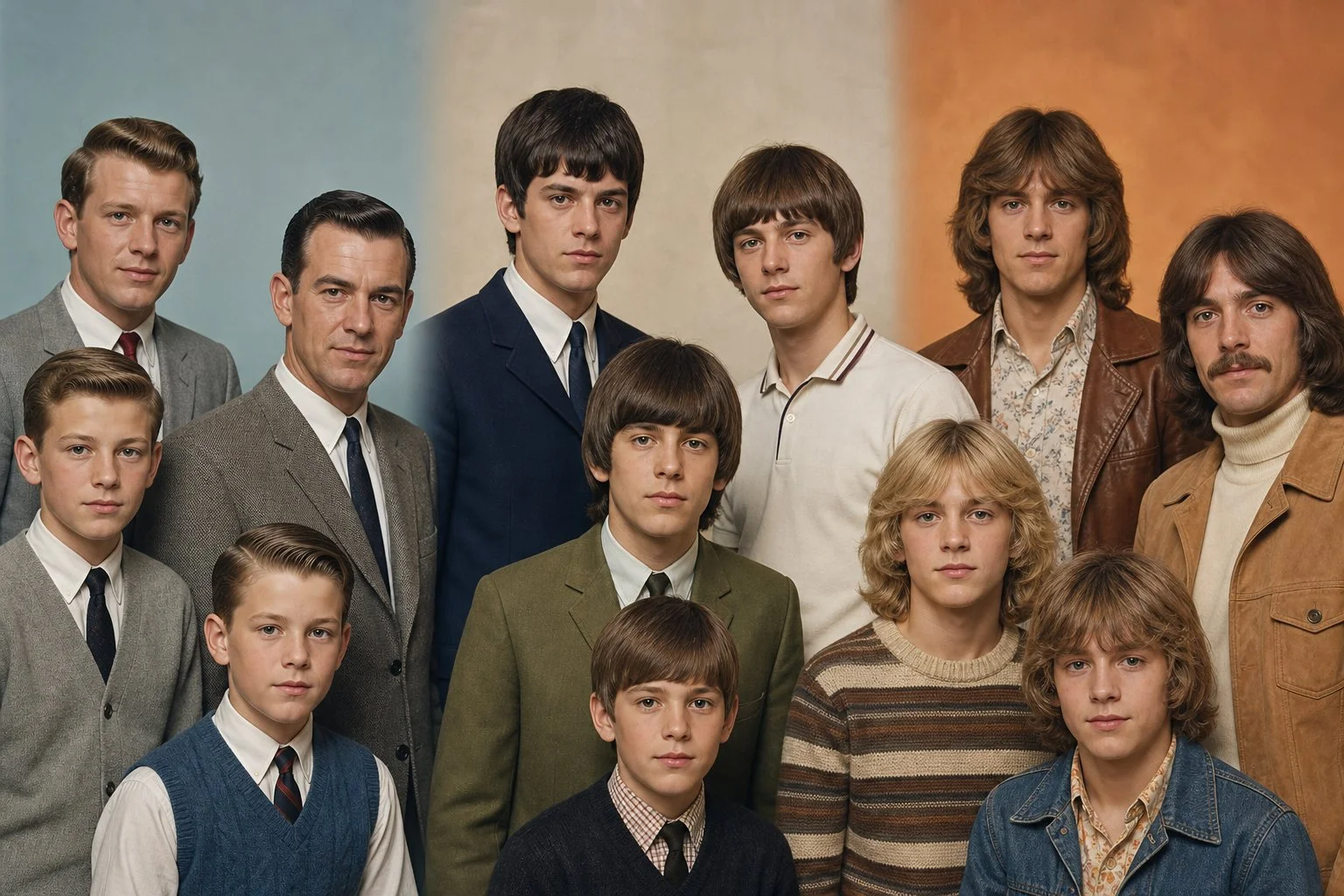
Hair was never just hair here. It was a badge, a warning, and a small act of rebellion you could grow yourself for free.
Let’s walk through three decades of British youth culture, self-expression, and some truly questionable styling choices — the cuts that defined a generation, the products that held them up, and why so many of these looks keep sneaking back into barbers’ shops today. Bring a mirror. You might spot your dad.
A Quick Decade-by-Decade Style Timeline

Three decades, three wildly different relationships with a comb. British hair went from short-back-and-sides and a tin of Brylcreem, to sharp Mod cuts and Beatle fringes, and then to shaggy layers that took up half the bathroom mirror.
The 1950s: Neat Cuts, Grease and Rebellious Youth
Most British boys in the 1950s got the same haircut: short back and sides, parted with a comb, and sent on their way.
Then Teddy Boys turned up. They grew the top longer, swept it into a quiff, and greased the back into a ducktail — two sides combed together to meet in the middle.
Brylcreem ruled the decade. It gave that wet, shiny finish you see in old photos, though using too much made you a target for teasing at school.
Barbers held the reins. School rules and dads with strong opinions kept most boys’ hair well above the collar, so 1950s hairstyles for the young often meant neat by day, quiff by Saturday night.
The 1960s: From Mod Precision to Longer Hair
The early 60s were all about precision. Mods wanted clean lines, a French crop or a tidy side parting, and they happily paid a barber to get it right.
Then the Beatles arrived with the mop-top: a straight fringe, hair over the ears, no grease at all. Suddenly the wet look felt like something your uncle did.
By 1967, the counterculture movement shifted things again. The hippie wave made long hair a statement, not just a style, and plenty of British teenagers grew theirs as a small act of rebellion.
Schools pushed back. Many boys spent the late 60s negotiating with teachers over exactly where “too long” started — a debate parents rarely won either.
The 1970s: Texture, Freedom and Plenty of Volume
The 70s went big. Layers, waves, and volume replaced the flat, combed look, and hair often sat well past the collar.
Popular choices included:
- Long, centre-parted hair — feathered back at the sides
- The shag — choppy layers, deliberately messy
- The Afro — worn proudly by Black British men and boys
- Sideburns — thick, long, occasionally alarming
Hairdryers became normal for men, which would have baffled a 1950s barber.
By the late 70s, punk crashed in with spikes and cropped, dyed hair — a direct answer to all that softness. Shorter cuts crept back in as the decade closed.
The Sharp 1950s Look: Barbershop Classics

The British barbershop of the 1950s ran on three things: a sharp pair of scissors, a tin of pomade, and a chap who was willing to sit very still. Out of that came the towering pompadour, the rebellious ducktail, the tidy crew cut, and the side part that got you the job at the bank.
Pompadours, Quiffs and the Art of Height
The classic pompadour meant long hair on top, short at the back and sides, and a great deal of upward ambition. Guys combed their hair up and slightly back, then locked it in place with pomade or Brylcreem.
The quiff was its slightly scruffier cousin. Instead of sweeping the whole top backwards, lads pushed the front section up and forward, leaving a soft curl over the forehead.
Elvis Presley and James Dean gave both styles their reputation, and British teenagers copied them with real enthusiasm. Teddy Boys took things further with the jelly roll, where the hair rolled forward and out from the forehead instead of straight up.
A word of warning from history: the higher the hair, the more product you needed, and the more you minded a stiff British breeze.
Ducktail Styles and the Greaser Comb-Back
The ducktail — known politely as the D.A. — dealt with the back of the head. Guys combed their hair towards the centre from both sides, then parted it down the middle so it met in a seam.
The name came from the obvious resemblance. Nobody in the barber’s chair seemed embarrassed by this.
It was rarely worn alone. Most lads paired a ducktail at the back with a pompadour, quiff or elephant trunk at the front, so the whole head told a story.
The slick back haircut was the simpler option. All the hair went straight backwards with a comb and a generous scoop of pomade, no parting needed.
Products of choice:
- Pomade — heavy shine, strong hold, and a pillowcase that never recovered
- Brylcreem — lighter, and heavily advertised in Britain
- Hair oil — for shine and a wavier texture
Crew Cuts, Flat Tops and Ivy League Neatness
Not every British lad fancied an hour with a comb each morning. The crew cut kept things short on top with tapered sides and back, cut to suit the shape of the face.
The flat top, or flattop, did what the name says. The hair on top was cut level so it sat as a flat plane, which took real skill from the barber and regular visits to keep it that way.
The Ivy League haircut was the smarter version of the crew cut. The front section was left long enough to comb into a side parting, which made it popular with students and office workers who wanted to look tidy without looking military.
The butch or brush cut was shortest of all — one length everywhere, minimal fuss, and no styling at all.
Side Parts and Executive Contours for the Respectable Chap
For most working British men, the everyday cut was a short side part with a slight wave through the top. It was unremarkable in the best possible way.
The executive contour was the polished version. Sides and back got tapered close, the top was left with enough length to shape, and the parting was combed in with a comb and a small amount of cream.
Shine mattered. A well-groomed head in 1955 was expected to stay put through a full day at the office, a bus ride home, and a pint afterwards.
Sideburns were tolerated if kept neat and short. Beards were another matter entirely, and largely limited to art students and jazz clubs.
Swinging Sixties Cuts: Mods, Mop Tops and More

The sixties took the neat, greased-back look of the fifties and gave it a good ruffle. Suddenly hair was longer at the front, sharper at the sides, and — depending on your dad’s mood — a source of shouting at the dinner table.
The Beatles and the Mop-Top Phenomenon
If one haircut owns the decade, it’s the mop top. Long-ish hair, no parting, a fringe brushed straight down, and ears politely covered up.
The Beatles picked up the idea in Hamburg, where photographer Astrid Kirchherr and her friend Jürgen Vollmer wore their hair swept forward rather than slicked back. George Harrison reportedly called the cut “Arthur”, which tells you plenty about the band’s sense of humour.
Once the British Invasion hit America, barbers everywhere got asked for “the Beatle cut”. It looked simple, but it needed decent hair and a lot of combing forward.
Why it worked so well:
- No comb-over, no grease, no fuss
- It suited the thick, straight hair many British lads had
- Older generations hated it, which was rather the point
Mod Cuts and Immaculate Side Partings
Mods took a different route: shorter, sharper, and pressed to within an inch of its life. Think a clean side part, a defined fringe, and layers cut so the shape held all night at the club.
Steve Marriott of the Small Faces wore one of the best-known versions — choppy layers, longer at the front and sides, shorter at the back, with a soft centre parting.
The mod look sat somewhere between the tidy Ivy League crop and the shaggier mop top. It paired with slim suits and desert boots, and it demanded regular trips to the barber.
A dab of setting lotion was common. Grease was not — that was for rockers.
Bowl Cuts, Caesar Cuts and Other Shorter Options

Not every boy could carry off a mop top, and plenty of mothers cut hair at home with kitchen scissors. Hence the bowl cut, which really did look like someone had used a pudding basin as a guide.
The pageboy was its smarter cousin: straight, past the ears, curling inwards, with a long fringe. It worked on boys and girls alike.
| Style | Length | Fringe |
|---|---|---|
| Bowl cut | Level all round | Blunt and straight |
| Caesar cut | Short, cropped | Short, forward-brushed |
| Crew cut | Very short | Barely any |
The Caesar cut and the crew cut stayed popular with schoolboys, servicemen and anyone whose employer had opinions about hair.
Natural Hair and the Afro in a Changing Britain
By the late sixties, the Afro was gaining ground in Britain, particularly among young Black men in London, Birmingham and Bristol. It grew out of the American civil rights movement, where wearing natural hair became a statement about pride rather than fitting in.
The style needed picking out with an Afro comb and regular moisturising — less effort than chemical straightening, but not zero effort.
For many, it was straightforward self-expression. Youth culture across Britain was pulling in the same direction: hair as a way of saying something without opening your mouth.
Seventies Hair: Longer, Shaggier and Less Interested in Rules

By the 1970s, British lads had mostly stopped asking the barber for “the usual” and started chasing length, layers, and a bit of drama. Shags, hippie manes, perms, and glam-rock statements all jostled for space, and honestly, nobody could agree on what “tidy” even meant anymore.
The Shag Haircut and Rock-Star Layers
The shag absolutely owned the decade. American hairdresser Paul McGregor gave Jane Fonda her iconic cut in Klute (1971), and suddenly everyone wanted in.
It’s all about layers that get longer as they go down, with the shortest on top and a fringe up front. Some guys kept it sleek, but plenty fluffed those top layers up into a spiky “rooster” thing—Rod Stewart went all-in on that look.
Rod was basically the poster boy, but pub bands and sixth-formers followed close behind. The sides usually tucked under for that soft, pageboy-ish shape.
Honestly, the best bit? It looked deliberately messy, so growing it out just felt like part of the deal.
Hippie Hair, Natural Texture and Growing It Out
The late ’60s counterculture handed the seventies a pretty clear message: stop cutting your hair.
Long hair rolled right into the new decade, and how far you took it depended on your job, your age, and how much your dad yelled. Some guys landed on a shaggy collar-length compromise. Others just went for it—hair past the shoulders, dead-center parting.
Natural hair was the point. Straight, wavy, curly—just wear what you’ve got, maybe with a trim to keep it from turning into a hedge.
There was still friction. Schools and some jobs hated it, so a short wig or a fake moustache sometimes became the trick for looking respectable at the bank. But that fuss faded quickly—by the mid-seventies, long hair just felt normal.
Perms, Glam Influence and David Bowie’s Bold Example
Then glam rock crashed in, and hair stopped pretending to be casual.
David Bowie’s Ziggy Stardust cut in 1972—Suzi Fussey did it—was short, spiked, flame-orange, long at the back. It was basically the mullet’s loud British debut and gave everyone permission to treat hair like a costume, not just a haircut.
Mick Jagger kept his shaggy and choppy, while footballer Kevin Keegan rocked a tight “poodle perm” that proved the perm was no longer just for women.
Perms took over by the late seventies. Straight-haired men sat under rollers for volume and curl, sometimes ending up with a full head of tight coils.
Men grabbed hairdryers, mousse, and hairspray to make it all work. Individuality was the whole point—even if some results are best left in the old photo album.
How to Recreate the Era Without Looking Like a Costume Party

If you want to pull off a fifties quiff or a seventies shag in 2026, pick a shape that actually suits your head, use products that don’t smell like your grandad’s dresser, and learn how to talk to your barber.
Choosing a Cut for Your Hair Type and Face Shape
Your hair has opinions, and it’ll share them loudly if you ignore them.
Fine, straight hair loves a slick back or a neat side part, but a proper Teddy Boy pompadour? That’ll collapse by lunchtime. Thick, wavy hair does the opposite: it holds a quiff like it’s nothing, but good luck forcing it into a flat top.
Coily and Afro-textured hair looks great in a sixties-style rounded shape or a sharp crew cut with tapered sides.
Face shape matters too:
| Face shape | Works well | Best avoided |
|---|---|---|
| Round | Quiff, height on top | Heavy fringe, bowl shapes |
| Long | Side part, fuller sides | Tall pompadour |
| Square | Crew cut, buzz cut, slick back | Very soft, shapeless layers |
| Oval | Nearly anything, lucky you | Nothing in particular |
Modern Products for Vintage Hold and Texture
The fifties ran on grease. We really don’t need to.
If you’re after a proper quiff or pompadour, a strong hold pomade still does the trick. Just pick a water-based one so it washes out without three shampoos and a prayer. Oil-based pomade gives you that old-school wet shine, and it sticks around for days—which, honestly, could go either way.
For a softer sixties mop or a seventies layered thing, grab a matte paste or styling cream. These shape the hair without too much shine, which helps you avoid looking like you’re headed to a fancy dress party.
Sea salt spray is a secret weapon for limp hair. Spray it on damp, rough dry, then add your paste. You get texture and grip without the helmet vibe.
What to Ask Your Barber for a Wearable Retro Update
Bring a photo. Barbers are skilled, not telepathic.
Just use plain language about the details that actually matter:
- Length on top: Go for at least 8–10cm if you want a quiff or pompadour, or 4–5cm for a proper crew cut from back in the day.
- The sides: Say “tapered sides”—trust me, that’s clearer than “short back and sides,” which could mean anything from tidy to buzzed.
- The weight line: Ask for a soft taper instead of a hard skin fade if you’re chasing that fifties or sixties vibe. A sharp fade just looks modern, honestly.
- The neckline: Ask for a natural, tapered neckline. Those blocked, square necklines? Not really retro at all.
Maybe one more thing: ask your barber to keep the shape a bit softer than the photo you brought. A little imperfection makes the cut look like real hair, not a helmet.






Leave a Reply